Nanzen-ji
Photo: Jakub Hałun / CC BY 4.0 · Original · Resized and croppedMomoyama period · Temples · National Treasures
Nanzen-ji
南禅寺 (なんぜんじ)
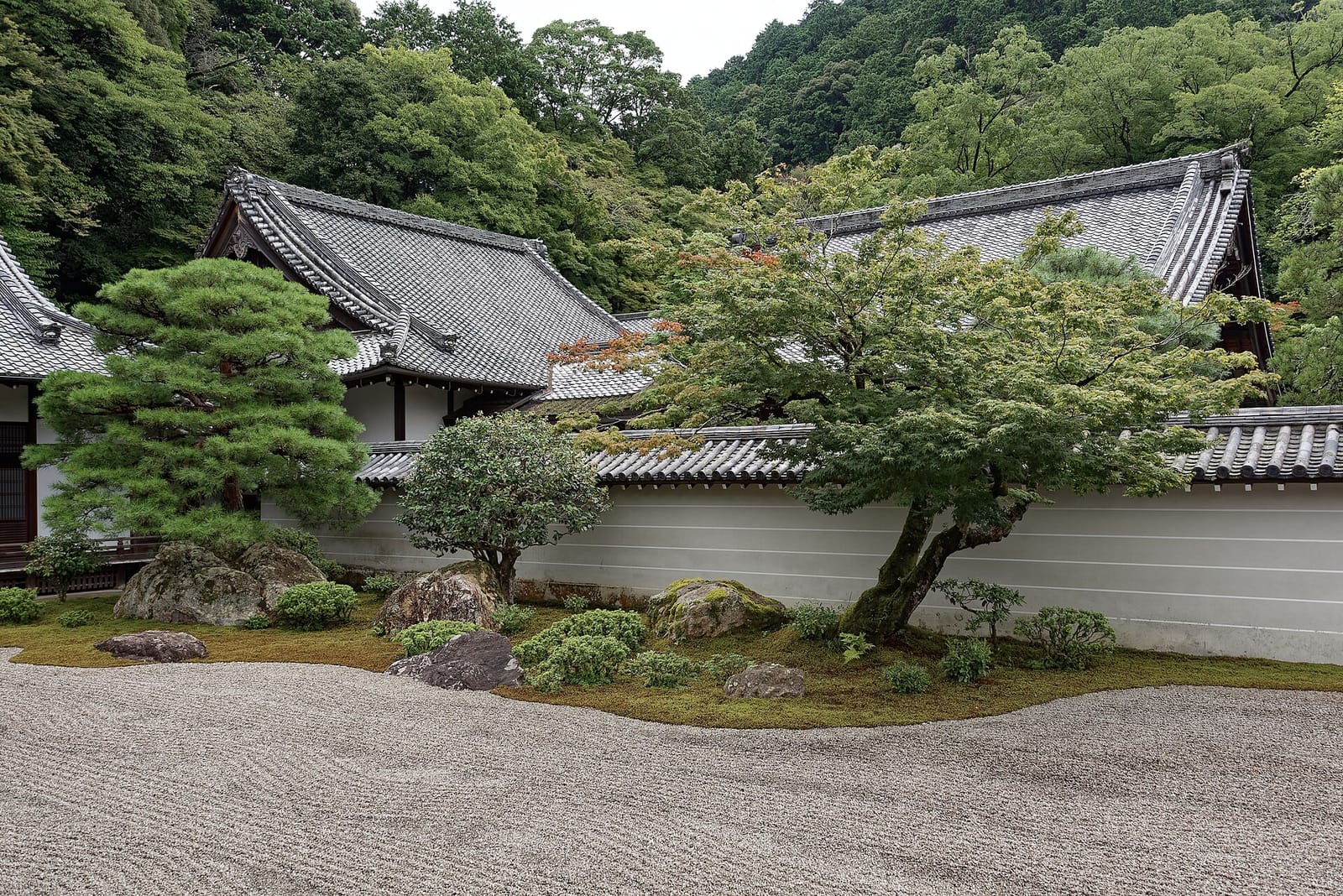
A head temple of the Rinzai school, begun when the retired Emperor Kameyama turned his villa into a Zen temple. In the National Treasure Hojo you can see wall paintings in the Large and Small Hojo, moved from the imperial palace, and the dry garden known as Tiger Cubs Crossing.
Key facts
- Designation
- National Treasures
- Era
- Momoyama period
- Type
- Temples
- Location
- Kyoto, Kyoto
- Address
- 京都府京都市左京区南禅寺福地町
Before you go
- Opening hours
- 8:40 to 17:00 from March to November and 8:40 to 16:30 from December to February. Last admission is 20 minutes before closing.
- Closed
- Closed to general visitors December 28 to 31. Open over the New Year.
- Admission (adults)
- The Hojo garden and the Sanmon gate are ¥600 each for adults; Nanzen-in is ¥500.
- Time needed
- Check the official site
- Getting there
- About 10 minutes on foot from Keage Station on the Tozai subway line; the shortcut goes through a brick tunnel known as the Nejirimanpo. By city bus, it is a 10-minute walk from the Higashi-Tennocho or Nanzenji Eikando-michi stops. The No. 1 car park on the approach costs ¥1,000 for up to 2 hours (then ¥500 per hour) but may be reserved for buses from mid-November to mid-December.
- Good to know
- The grounds have many steps and slopes, so wheelchair users are asked to come with a helper where possible.
Checked against official information on November 12, 2026. Fees and hours can change, so please also check the official site before you go.
Sources for visitor information
Key facts
- Designation
- National Treasures
- Era
- Momoyama period
- Type
- Temples
- Location
- Kyoto, Kyoto
- Address
- 京都府京都市左京区南禅寺福地町
About this place
Nanzen-ji is a head temple of the Rinzai school of Zen in Sakyo Ward, Kyoto. According to the temple, the retired Emperor Kameyama took Buddhist vows in 1289 at his villa, the Zenrinji-den, and in 1291 he turned the villa into a Zen temple, inviting the Zen master Mukan Fumon (Daimin Kokushi) as its founder. Mukan died in December of that same year, and Kian Soen, who became the second abbot the following year, spent about 15 years building the temple halls. For this reason Kian is also called the founding builder. Nanzen-in, within the grounds, stands on the site of the villa and is regarded as the birthplace of Nanzen-ji.
The National Treasure is one building, the Hojo (Abbot's Quarters), made up of the Large Hojo and the Small Hojo joined behind it. It was designated in 1953 and is dated to the Momoyama period. The temple explains that the Large Hojo was rebuilt in 1611 using a palace building granted by the imperial court. Temple tradition holds that it was the Seiryoden hall of the imperial palace from the Tensho era, but the temple itself notes another view that it was the audience hall of a retired empress's palace. The Small Hojo dates from the Kan'ei era and is said to come from Fushimi Castle. The Large Hojo has a hip-and-gable roof and the Small Hojo a gabled rear roof, both covered with wooden shingles.
Inside, the Large Hojo was originally decorated throughout with wall paintings (Important Cultural Properties) by painters of the Kano school from the early Momoyama period. As they had deteriorated, 84 of the 124 panels were moved into storage in 2011, and the rooms now show 84 new panels painted from digital photographs of the originals. The Small Hojo holds 40 panels of tigers attributed to Kano Tan'yu, and the room is known as the Tiger Room. The name of the central south room, the Ohiru-no-ma, along with the carved transoms of the veranda, the ceilings and the wooden doors, are said to preserve the look of the building when it was part of the palace.
The garden in front of the Hojo is a dry landscape garden of the early Edo period attributed to Kobori Enshu. Known as the Tiger Cubs Crossing garden, it is a designated Place of Scenic Beauty. On a site long from east to west, the large rock groupings are set along the wall toward the far left, while wide areas of white sand are left open in front and to the right. Laying large stones on their sides is described as a composition that moves away from gardens depicting Buddhist cosmology, such as Mount Sumeru or the isle of Horai. There are also the Joshin-tei garden of the Small Hojo, made in 1966 with stones laid out in the shape of the character for heart, and the Rokudo garden, with stones set in cedar moss.
If you walk the grounds along with the Hojo, the Sanmon Gate (Important Cultural Property), rebuilt in 1628 by Todo Takatora, stands about 22 meters tall, its Zen-style mass and rows of pillars giving it a powerful presence. Beside the grounds runs the Lake Biwa Canal, begun in 1885 and completed in 1890, and its red-brick arched aqueduct has become part of the temple scenery. Further in, Nanzen-in keeps a pond-and-stroll garden said to date from the late Kamakura period, where you can trace the days when this was an imperial villa.
Buildings designated as National Treasures
Nanzen-ji Hojo (Abbot's Quarters)
- Era
- Momoyama period
- Structure
- consisting of the Large and Small Hojo
- Designated
- November 14, 1953
Sources and date checked
Facts such as eras, structures and locations are edited and translated by us from the Agency for Cultural Affairs’ database of nationally designated cultural properties. The Agency and the national government did not produce this page.
Database of nationally designated cultural properties- Agency for Cultural Affairs, Database of National Cultural Properties: Nanzen-ji Hojo (Abbot's Quarters)
- Nanzen-ji: History (Nanzen-ji official site)
- Nanzen-ji: Hojo (Nanzen-ji official site)
- Nanzen-ji: Gardens (Nanzen-ji official site)
- Nanzen-ji: Sanmon Gate (Nanzen-ji official site)
- Nanzen-ji: Nanzen-in (Nanzen-ji official site)
- Nanzen-ji: Lake Biwa Canal (Nanzen-ji official site)
Checked on November 6, 2026
Report an error
If you notice a mistake, please tell us along with a source for the correct information.
Where to go next
Places you could see on the same day, and places worth comparing.
Nearby cultural heritage
Places within 10 km, nearest first. Distances are in a straight line.
More from Kyoto
Discover more of the same region on our sister sites.
Matsuri Biyori
UNESCO-listed festivals in Kyoto
- Yamahoko, the float ceremony of the Kyoto Gion festival
- Kyoto no Rokusai Nenbutsu
- Yasuraibana
- Kuta no Hanagasa Odori
Meiga no Furusato
Paintings linked to Kyoto
- View of Amanohashidate
- Viewing Maple Leaves
- Scenes in and around Kyoto (Funaki Version)
- Morning View of Uji River