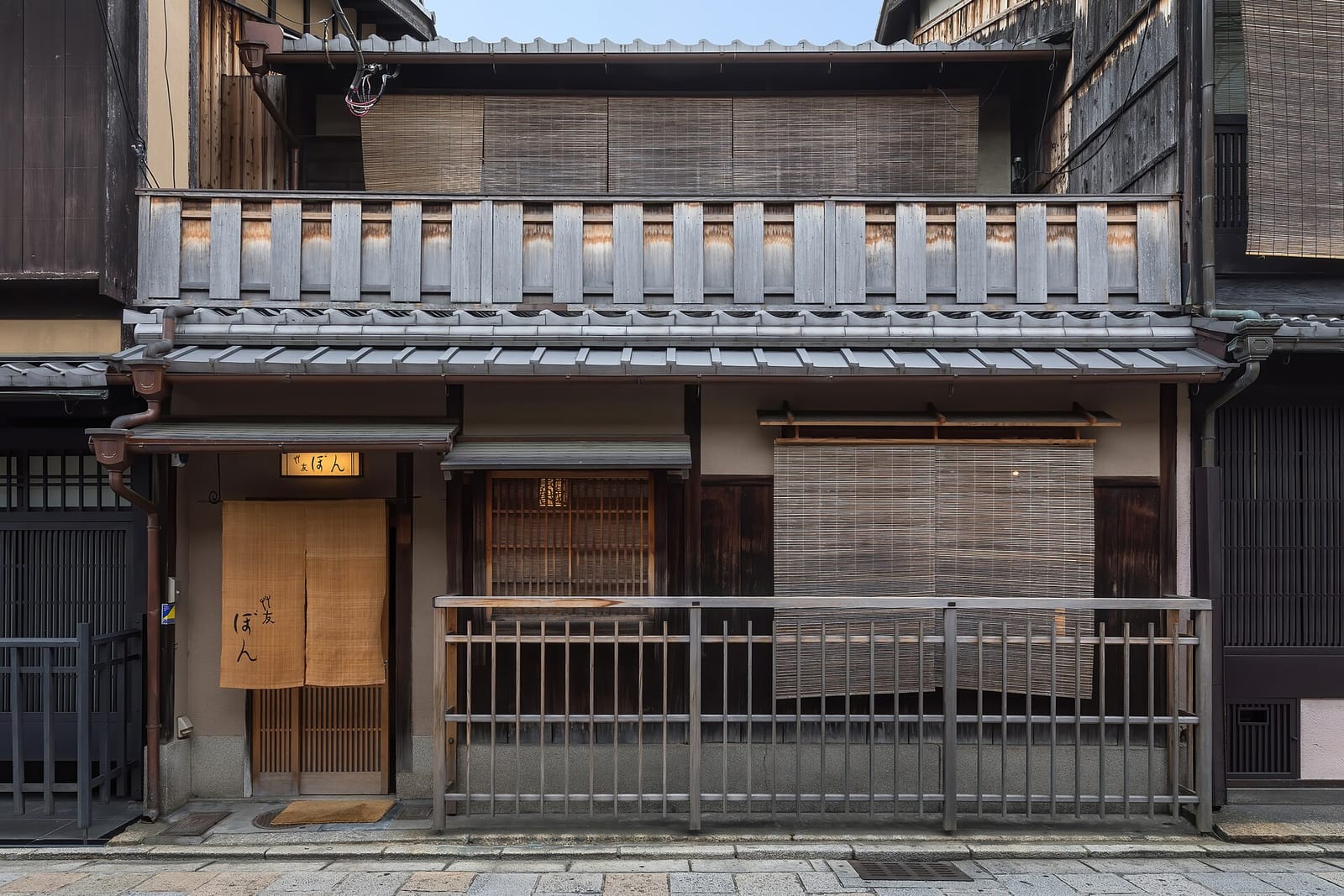
A townhouse on Shinbashi-dori
Photo: Basile Morin / CC BY-SA 4.0 · Original · Resized and croppedHistoric districts
Gion Shinbashi, Kyoto
京都市祇園新橋 (きょうとしぎおんしんばし)
Gion Shinbashi is a teahouse quarter where ochaya-style townhouses with lattices and bamboo blinds line the Shirakawa stream. Its two-story houses, built just after the great fire of 1865, stand together with the stone paving and rows of cherry trees to form a quintessential Kyoto scene.
Key facts
- Designation
- Important Preservation Districts for Groups of Traditional Buildings
- Type
- Historic districts
- Location
- Kyoto, Kyoto
- Address
- 京都府京都市
Before you go
- Opening hours
- Check the official site
- Closed
- Check the official site
- Admission (adults)
- Check the official site
- Time needed
- Check the official site
- Getting there
- 3 minutes on foot from Keihan Gion-Shijo Station or the Shijo Keihan-mae city bus stop, and 5 minutes from Sanjo Keihan Station on the Tozai subway line.
- Best time to visit
- During cherry blossom season the Gion Shirakawa illumination lights up the stream from Kawabata-dori to Tatsumi Bridge (March 27 to April 5 in 2026, 18:00 to 22:00).
- Good to know
- Stopping maiko or geiko for photos, or photographing them without permission, is prohibited. Kyoto's official tourism site also asks visitors not to enter private lanes, set up tripods on the street, touch teahouse lanterns or lean on fences. People live here, so do not photograph residents or children without asking.
Checked against official information on November 12, 2026. Fees and hours can change, so please also check the official site before you go.
Sources for visitor information
Key facts
- Designation
- Important Preservation Districts for Groups of Traditional Buildings
- Type
- Historic districts
- Location
- Kyoto, Kyoto
- Address
- 京都府京都市
About this place
Gion Shinbashi is a teahouse district in Gion, Kyoto. It was selected as an Important Preservation District for Groups of Traditional Buildings on 4 September 1976. At 1.4 hectares it is small, covering about 160 meters east to west and 100 meters north to south. It is the part of the six Gion towns centered on Shinbashi-dori. Where Sannenzaka spreads along the road linking temples and shrines, this district took shape as a place of entertainment and the performing arts.
The town grew up around the temples and shrines gathered east of the Kamo River, the Gion shrine among them, and around the river itself. By the medieval period it was already a place where popular culture and performing arts flourished. The turning point came in the early Edo period: once embankments were built along the Kamo, the city spread east of the river and Gion grew as a place of entertainment. This district opened as a teahouse quarter after that, in 1712 (Shotoku 2), when the six inner Gion towns were developed following the earlier six outer towns. Its links with theater and the performing arts made it still busier from the end of the Edo period into the Meiji era.
According to the National Council of Traditional Building Preservation Districts, the buildings facing the street were built right after the great fire of 1865 (Genji 2). They have two stories and gabled roofs of pantiles, with the entrance on the side parallel to the ridge (hirairi). What you see from outside is the lattice on the ground floor and, upstairs, the veranda projecting in front of the tatami room with a sudare screen hanging from it. Look first at the relation between the first-floor lattice and the second-floor room, and at the shadows of the projecting veranda and the screen under the eaves. The individual buildings share a form, and the fact that the whole street was built in the same period gives it a quiet unity.
In the history of preservation, after Kyoto enacted its cityscape ordinance in 1972, it designated the Gion Shinbashi area (1.4 hectares, about 100 houses) as a special conservation and restoration district in 1974. It became a national district in 1976. In recent years, as visitors increased, the community has recognized problems with litter and visitor manners. As residents decreased, livelihoods changed and local ties weakened, the Gion Shinbashi Townscape Council was formed by residents and business operators and was certified on 26 May 2017. Its townscape plan was certified by the city on 1 August 2018, and anyone planning construction in the district must now consult the council before filing the required procedures.
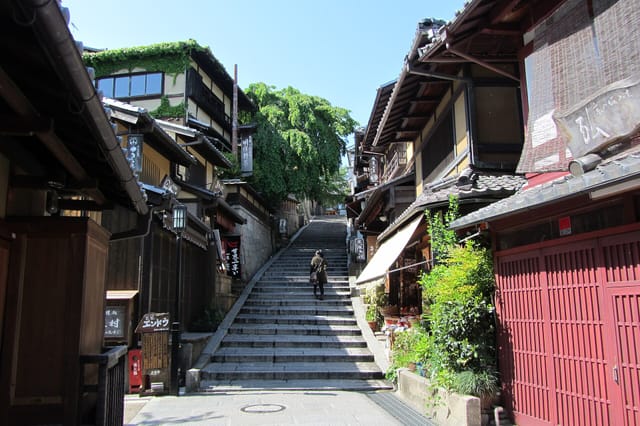
To combine it with its surroundings, Sannenzaka, selected on the same day, has the contrasting character of a temple-and-shrine town along the pilgrimage road. Changing what you look for makes the difference clear: slopes and steps at Sannenzaka, the aligned rows of townhouses at Gion Shinbashi. This quarter is also a place where people live today, so take care where you stop and how you take photographs in the lanes.
About the district
- Type of district
- teahouse district
- Area
- 1.4 hectares
- Selected
- September 4, 1976
Sources and date checked
Facts such as eras, structures and locations are edited and translated by us from the Agency for Cultural Affairs’ database of nationally designated cultural properties. The Agency and the national government did not produce this page.
Database of nationally designated cultural properties- Agency for Cultural Affairs, Database of National Cultural Properties
- Kyoto City: Sannenzaka, Gion Shinbashi, Saga-Toriimoto and Kamigamo (Agency for Cultural Affairs, Preservation and Utilization of Important Preservation Districts for Groups of Traditional Buildings, document by Kyoto City)
- National Council for Preservation of Historic Districts: Kyoto City Gion Shinbashi
Checked on November 6, 2026
Report an error
If you notice a mistake, please tell us along with a source for the correct information.
Where to go next
Places you could see on the same day, and places worth comparing.
Nearby cultural heritage
Places within 10 km, nearest first. Distances are in a straight line.
More from Kyoto
Discover more of the same region on our sister sites.
Matsuri Biyori
UNESCO-listed festivals in Kyoto
- Yamahoko, the float ceremony of the Kyoto Gion festival
- Kyoto no Rokusai Nenbutsu
- Yasuraibana
- Kuta no Hanagasa Odori
Meiga no Furusato
Paintings linked to Kyoto
- View of Amanohashidate
- Viewing Maple Leaves
- Scenes in and around Kyoto (Funaki Version)
- Morning View of Uji River