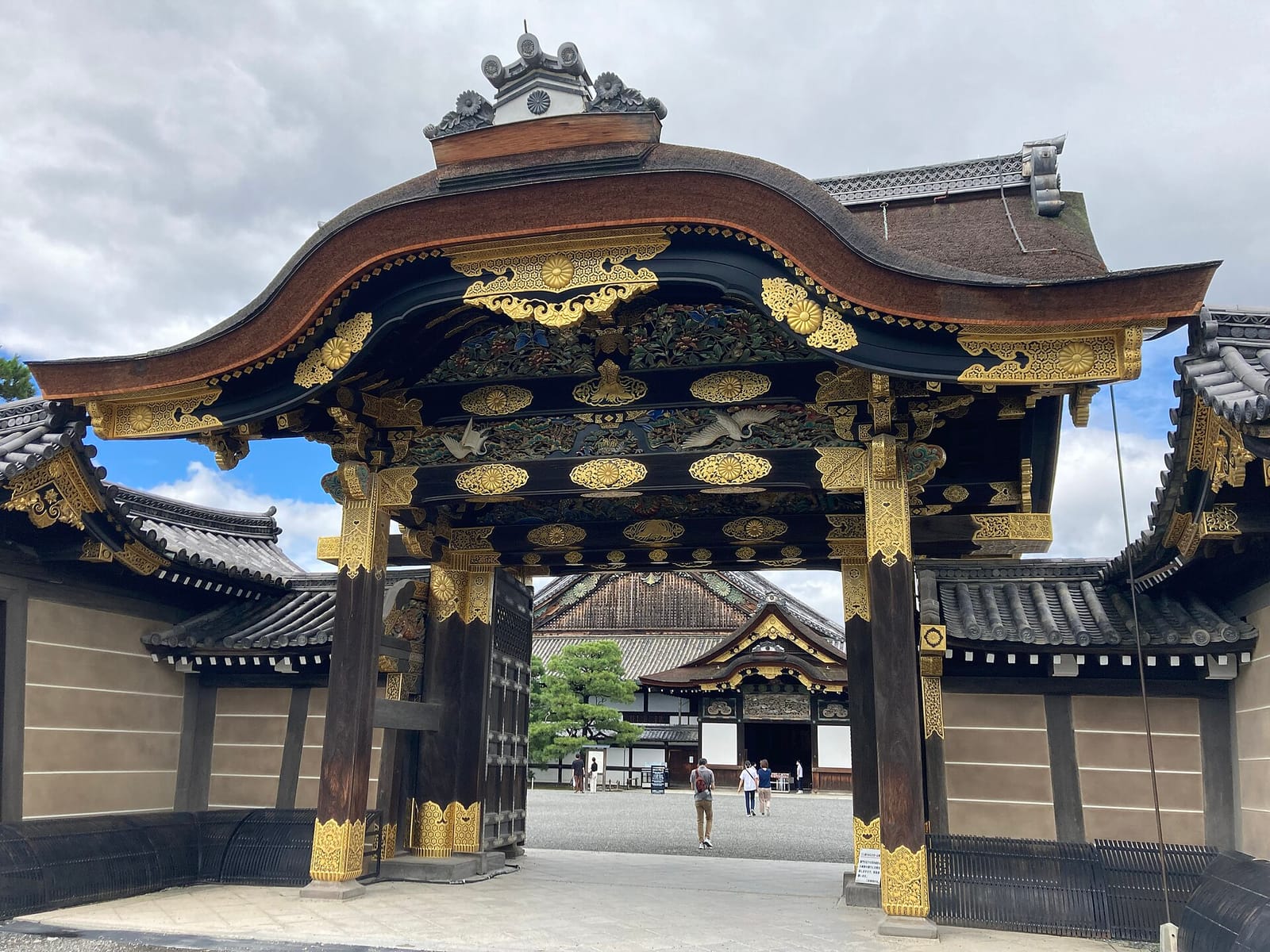
The Karamon gate of the Ninomaru Palace
Photo: 京都東 / CC BY-SA 4.0 · Original · Resized and croppedMomoyama period · Castles · National Treasures
Nijo Castle
二条城 (にじょうじょう)
Built by Tokugawa Ieyasu, Nijo Castle keeps the Ninomaru Palace, six linked halls that form the only castle palace complex surviving in Japan. Inside are Kano school wall paintings, "nightingale" floors that chirp underfoot, and the Ohiroma hall where the shogun returned power to the emperor in 1867.
Key facts
- Designation
- National Treasures
- Era
- Momoyama period
- Type
- Castles
- Location
- Kyoto, Kyoto
- Address
- 京都府京都市中京区二条通堀川西入二条城町
Before you go
- Opening hours
- 8:45 to 17:00 (last entry to the grounds 16:00). Ninomaru Palace admits visitors until 16:10; Honmaru Palace is open 9:30 to 16:00.
- Closed
- Closed December 29 to 31. Ninomaru Palace is also closed every Tuesday in January, July, August and December (the next day if Tuesday is a holiday), December 26 to 28 and January 1 to 3. Honmaru Palace closes on the third Monday of each month (open if a holiday) and the following day, among other dates.
- Admission (adults)
- ¥1,300 for castle entry plus Ninomaru Palace (castle grounds only ¥800). Honmaru Palace costs an extra ¥1,000 and must be booked in advance online.
- Time needed
- The castle's official model routes take about 1 hour for a quick tour of Ninomaru Palace and its garden, about 2 hours for the recommended route that adds Honmaru Palace, and about 2 hours 30 minutes to cover the whole grounds.
- Getting there
- Nijojo-mae Station on the Tozai subway line is right outside the castle. From Kyoto Station, take the Karasuma Line to Karasuma Oike (about 6 min) and change to the Tozai Line (about 2 min). Kyoto City Bus routes 9 and 50 run from Kyoto Station to the Nijojo-mae stop in about 16 minutes. There is a paid car park on the east side (¥600 per 40 min for cars).
- Best time to visit
- The Nijo Castle Sakura Festival runs each spring around March and April, with evening illuminations and special night viewing of Ninomaru Palace (March 19 to April 19 in 2026). In autumn the night event "NAKED meets Nijo Castle" is held (October 23 to December 5 in 2026).
- Good to know
- Photos and video are not allowed inside Ninomaru and Honmaru palaces, and tripods and monopods are banned on the grounds. Honmaru Palace needs an advance online reservation, so book your time slot before you go.
Checked against official information on November 12, 2026. Fees and hours can change, so please also check the official site before you go.
Sources for visitor information
- Nijo Castle official site: Opening hours and closed days
- Nijo Castle official site: Admission fees
- Nijo Castle official site: Access
- Nijo Castle official site: Visitor rules
- Nijo Castle official site: Sakura Festival 2026
- Kyoto City official travel guide: Autumn 2026 night viewings and illuminations
- Nijo Castle official site: Model routes
Key facts
- Designation
- National Treasures
- Era
- Momoyama period
- Type
- Castles
- Location
- Kyoto, Kyoto
- Address
- 京都府京都市中京区二条通堀川西入二条城町
About this place
Nijo Castle was built in 1603 by Tokugawa Ieyasu to guard the Kyoto Imperial Palace and to provide lodging for the shogun when he came to Kyoto. The grounds measure about 600 meters east to west and 400 meters north to south, with a perimeter of about 2 kilometers. The National Treasure is the six buildings of the Ninomaru Palace, and in 1994 the castle was inscribed as a World Heritage site. The Ninomaru Palace is regarded as the only castle palace complex still standing in Japan; those of Edo, Osaka and Nagoya castles are gone.
What changed the castle most was the 1626 visit of Emperor Go-Mizunoo. In the time of the third shogun Iemitsu, the retired shogun Hidetada carried out a large-scale renovation of the castle for the visit. About two years earlier he had extended the castle to its present size and built a keep, a palace for the imperial visit and the Honmaru Palace. In September the emperor stayed five days with Hidetada's daughter Kazuko, the empress, and others, and Noh performances and waka poetry gatherings were held. The palace for the visit was later moved and the keep and others burned, but the Ninomaru Palace conveys the appearance of that time.
The Ninomaru Palace consists of six linked buildings with clearly separate functions. The Toozamurai was where visitors waited and is the largest building; the Shikidai was where business with the shogun and tribute gifts were relayed; the Ohiroma was where the shogun formally met daimyo and court nobles. The Kuroshoin was used for meetings with close daimyo and high-ranking nobles, and the Shiroshoin is thought to have been the shogun's living room and bedroom. If you walk with the progression from front to back, from public to private, in mind, the reasons for the differences in paintings and room sizes begin to show.
About 3,600 wall and screen paintings survive, including those of the Kan'ei era, and 1,016 of them became Important Cultural Properties in 1982. Those of the Kan'ei era were painted during the major rebuilding for Emperor Go-Mizunoo's 1626 visit by Kano Tan'yu, the shogunate's official painter, leading his school; the first and second rooms of the Ohiroma are by Tan'yu, and the sliding-door paintings of the Kuroshoin are by his younger brother Naonobu. The 'Pine and Hawk' in the fourth room of the Ohiroma is the most famous, and the Shiroshoin shows West Lake in ink. The corridors are 'nightingale floors' that make a birdlike chirp when walked on, a sound produced by clamps and nails rubbing together.
West of the Ohiroma lies the Ninomaru Garden, a Special Place of Scenic Beauty. It is a pond garden with a waterfall, thought to have been modified for the 1626 visit, and Kobori Enshu and other construction magistrates are said to have been involved. The Ohiroma was also the setting of the 1867 return of governing power. On October 13 the senior retainers of 40 domains then in Kyoto were gathered to hear their views, on the 14th Tokugawa Yoshinobu offered to return power, and on the 15th the court approved it. The castle also hosted the banquet after the 1915 enthronement ceremony of Emperor Taisho, and the only building newly built then that remains is the South Gate.
Buildings designated as National Treasures
Nijo Castle Ninomaru Palace Toozamurai and Kuruma-yose
- Era
- Momoyama period
- Structure
- Toomurai (outer waiting room), eight bays wide, eight bays deep, single-story, hip-and-gable roof, hongawara tile roofing
- Designated
- March 29, 1952
Nijo Castle Ninomaru Palace Shikidai
- Era
- Momoyama period
- Structure
- front three bays wide, rear five bays, right side four bays deep, left side six bays, single-story, hip-and-gable roof
- Designated
- March 29, 1952
Nijo Castle Ninomaru Palace Ohiroma
- Era
- Momoyama period
- Structure
- right side eight bays wide, left side seven bays, front seven bays deep, rear five bays, single-story, hip-and-gable roof
- Designated
- March 29, 1952
Nijo Castle Ninomaru Palace Sotetsu-no-ma
- Era
- Momoyama period
- Structure
- right side eight bays wide, left side nine bays, front one bays deep, rear three bays, single-story, hip-and-gable roof
- Designated
- March 29, 1952
Nijo Castle Ninomaru Palace Kuro-shoin (Ko-hiroma)
- Era
- Momoyama period
- Structure
- front seven bays wide, rear eight bays, right side six bays deep, left side eight bays, single-story, hip-and-gable roof
- Designated
- March 29, 1952
Nijo Castle Ninomaru Palace Shiro-shoin (Gozanoma)
- Era
- Momoyama period
- Structure
- six bays wide, six bays deep, single-story, hip-and-gable roof, hongawara tile roofing
- Designated
- March 29, 1952
Sources and date checked
Facts such as eras, structures and locations are edited and translated by us from the Agency for Cultural Affairs’ database of nationally designated cultural properties. The Agency and the national government did not produce this page.
Database of nationally designated cultural properties- Agency for Cultural Affairs, Database of National Cultural Properties: Nijo Castle Ninomaru Palace Toozamurai and Kuruma-yose
- Agency for Cultural Affairs, Database of National Cultural Properties: Nijo Castle Ninomaru Palace Shikidai
- Agency for Cultural Affairs, Database of National Cultural Properties: Nijo Castle Ninomaru Palace Ohiroma
- Agency for Cultural Affairs, Database of National Cultural Properties: Nijo Castle Ninomaru Palace Sotetsu-no-ma
- Agency for Cultural Affairs, Database of National Cultural Properties: Nijo Castle Ninomaru Palace Kuro-shoin (Ko-hiroma)
- Agency for Cultural Affairs, Database of National Cultural Properties: Nijo Castle Ninomaru Palace Shiro-shoin (Gozanoma)
- Nijo Castle: Overview (Former Detached Palace Nijo Castle)
- Nijo Castle: History (Former Detached Palace Nijo Castle)
- Ninomaru Palace and Garden (Former Detached Palace Nijo Castle)
Checked on November 6, 2026
Report an error
If you notice a mistake, please tell us along with a source for the correct information.
Where to go next
Places you could see on the same day, and places worth comparing.
Nearby cultural heritage
Places within 10 km, nearest first. Distances are in a straight line.
More from Kyoto
Discover more of the same region on our sister sites.
Matsuri Biyori
UNESCO-listed festivals in Kyoto
- Yamahoko, the float ceremony of the Kyoto Gion festival
- Kyoto no Rokusai Nenbutsu
- Yasuraibana
- Kuta no Hanagasa Odori
Meiga no Furusato
Paintings linked to Kyoto
- View of Amanohashidate
- Viewing Maple Leaves
- Scenes in and around Kyoto (Funaki Version)
- Morning View of Uji River