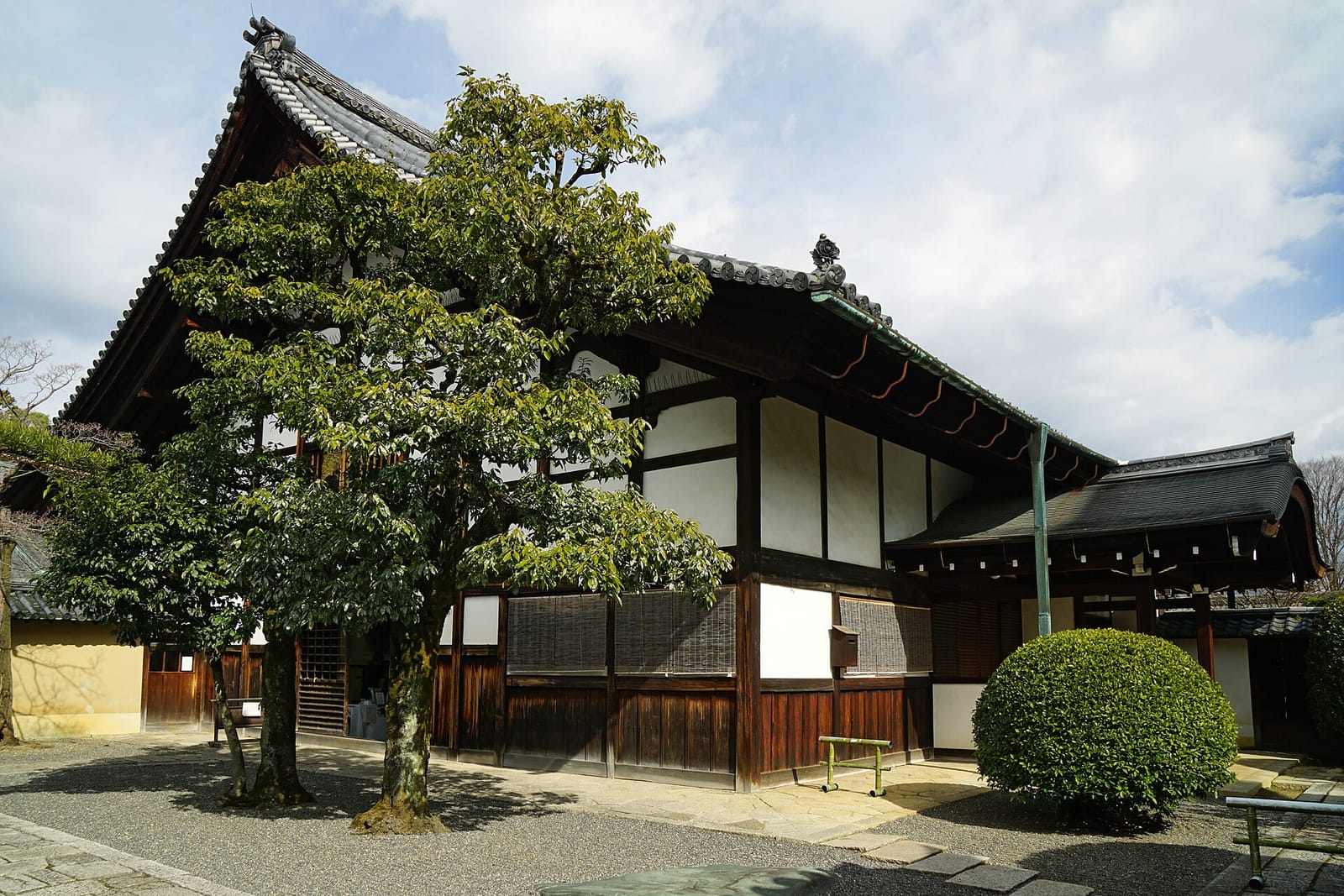
Daitoku-ji
Photo: 663highland / CC BY-SA 4.0 · Original · Resized and croppedMomoyama period · Temples · National Treasures
Daitoku-ji
大徳寺 (だいとくじ)
At Daitoku-ji you can walk through a Zen temple compound whose main buildings line up north to south, along with its many sub-temples. The head temple, with the National Treasure Hojo, its entrance and the Momoyama-period Karamon Gate, is normally closed, so visitors see the layout from outside.
Key facts
- Designation
- National Treasures
- Era
- Momoyama period
- Type
- Temples
- Location
- Kyoto, Kyoto
- Address
- 京都府京都市北区紫野大徳寺町
Before you go
- Opening hours
- Check the official site
- Closed
- Check the official site
- Admission (adults)
- Check the official site
- Time needed
- Check the official site
- Getting there
- Take Kyoto city bus 204, 205 or 206 to Daitokuji-mae; the temple is right by the stop.
- Best time to visit
- The head temple traditionally aired its treasures at the Bakuryoten on the second Sunday of October, but the event has been suspended since 2021 for restoration work, and it was not held in 2026 either.
- Good to know
- The head temple (honbo), which contains the National Treasure Hojo and Karamon Gate, is normally closed to the public. The main buildings stand in a north-south line: the Imperial Messenger Gate, the Sanmon gate, the Buddha Hall, the Lecture Hall and then the Hojo.
Checked against official information on November 13, 2026. Fees and hours can change, so please also check the official site before you go.
Sources for visitor information
Key facts
- Designation
- National Treasures
- Era
- Momoyama period
- Type
- Temples
- Location
- Kyoto, Kyoto
- Address
- 京都府京都市北区紫野大徳寺町
About this place
Daitoku-ji, in Murasakino in Kita Ward, Kyoto, is the head temple of the Daitoku-ji school of Rinzai Zen, with the mountain name Ryuho-zan. It was founded in 1315, at the end of the Kamakura period, by Daito Kokushi (Shuho Myocho), and received deep devotion from the retired Emperor Hanazono and Emperor Go-Daigo. In the Muromachi period it declined the shogunate's protection and kept an independent position as a Zen temple outside the official system. Its buildings were lost in the Onin War, but Ikkyu Sojun, the 47th abbot, restored the temple with the support of wealthy merchants from Sakai. After Toyotomi Hideyoshi held Oda Nobunaga's funeral here and built Soken-in, one warlord after another founded sub-temples on the grounds.
The grounds keep a typical Zen temple layout: the Imperial Messenger Gate, the Sanmon gate, the Buddha Hall and the Lecture Hall stand in a north-south line, with the Hojo behind them. After the Onin War, the renga poet Socho, a follower of Ikkyu, donated the ground story of the Sanmon, and Sen no Rikyu later added the upper story and named it Kinmokaku. It is a well-known story that placing a statue of Rikyu there angered Hideyoshi and became one cause of Rikyu's forced suicide. The dragon on the Lecture Hall ceiling was painted by Kano Tan'yu at the age of 35. Many tea masters, including Murata Juko and Rikyu, were devoted to the temple, and it has close ties to the tea ceremony.
The National Treasure Hojo (abbot's quarters) dates from 1635 and its entrance (Genkan) from 1636, in the early Edo period. According to the Kyoto City tourism guide, most of the present buildings were in place by the early Edo period. The Hojo measures 29.8 meters wide and 17.0 meters deep, with a hip-and-gable roof of sangawara tiles, and the Unmon-an is attached at the back. The Genkan is a long, narrow building six bays wide and one bay deep. The more than 80 sliding-door paintings in the Hojo are all by Kano Tan'yu and are Important Cultural Properties, and the Hojo garden, a leading dry landscape garden of the early Edo period, is designated a Special Place of Scenic Beauty and Historic Site. The temple's treasures also include the National Treasure painting of Kannon, monkeys and cranes by Muqi.
The Karamon Gate in front of the Hojo is a four-legged gate from the Momoyama period. It has a gable roof with karahafu (curved gables) on the eaves front and back and is roofed with cypress bark, and the Kyoto City tourism guide describes it as a leading Momoyama building adorned with lavish carvings. According to the temple, it was moved from Jurakudai, the palace Hideyoshi built in Kyoto, and is said to have escaped destruction when Hideyoshi had the palace pulled down. Until the mid-Meiji period it stood west of the Imperial Messenger Gate; today it stands in the front garden of the Hojo. It is also known by another name, Higurashi-no-mon.
The head temple (honbo), with the Hojo and the Karamon, is normally closed to the public. The Bakuryoten, at which about 100 temple treasures, including calligraphy by Emperor Go-Daigo and Tan'yu's sliding-door paintings, are aired and shown in the honbo, was traditionally held on the second Sunday of October, but it has been suspended since 2021 for restoration work and was not held in 2026 either. The grounds also hold two branch temples and many sub-temples; Rinno.net counts 20 sub-temples, while the Kyoto City tourism guide counts 21. Many sub-temples open their gardens, tea rooms and other features to the public. Daisen-in and Ryuko-in, sub-temples with National Treasure buildings, are covered on their own pages.
Buildings designated as National Treasures
Daitoku-ji Karamon Gate
- Era
- Momoyama period
- Structure
- four-legged gate, gable roof, karahafu gables on the eaves front and back, cypress-bark roofing
- Designated
- March 29, 1952
Daitoku-ji Hojo (Abbot's Quarters)
- Era
- Early Edo period
- Year
- 1635
- Structure
- 29.8 m wide, 17.0 m deep, single-story, hip-and-gable roof, sangawara tile roofing, with the Unmon-an annex at the rear
- Designated
- June 18, 1957
Daitoku-ji Hojo Entrance (Genkan)
- Era
- Early Edo period
- Year
- 1636
- Structure
- six bays wide, one bays deep, single-story, karahafu gable storehouse section, sangawara tile roofing
- Designated
- June 18, 1957
Sources and date checked
Facts such as eras, structures and locations are edited and translated by us from the Agency for Cultural Affairs’ database of nationally designated cultural properties. The Agency and the national government did not produce this page.
Database of nationally designated cultural properties- Agency for Cultural Affairs, Database of National Cultural Properties: Daitoku-ji Karamon Gate
- Agency for Cultural Affairs, Database of National Cultural Properties: Daitoku-ji Hojo (Abbot's Quarters)
- Agency for Cultural Affairs, Database of National Cultural Properties: Daitoku-ji Hojo Entrance (Genkan)
- Daitoku-ji (Rinno.net, Rinzai-Obaku Zen)
- Daitoku-ji (Kyoto Kanko Navi, City of Kyoto)
- Bakuryoten at Daitoku-ji Honbo (Kyoto Kanko Navi, City of Kyoto)
- Daitoku-ji Temple (Kyoto City Official Travel Guide, Kyoto City Tourism Association)
Checked on November 6, 2026
Report an error
If you notice a mistake, please tell us along with a source for the correct information.
Where to go next
Places you could see on the same day, and places worth comparing.
Nearby cultural heritage
Places within 10 km, nearest first. Distances are in a straight line.
More from Kyoto
Discover more of the same region on our sister sites.
Matsuri Biyori
UNESCO-listed festivals in Kyoto
- Yamahoko, the float ceremony of the Kyoto Gion festival
- Kyoto no Rokusai Nenbutsu
- Yasuraibana
- Kuta no Hanagasa Odori
Meiga no Furusato
Paintings linked to Kyoto
- View of Amanohashidate
- Viewing Maple Leaves
- Scenes in and around Kyoto (Funaki Version)
- Morning View of Uji River