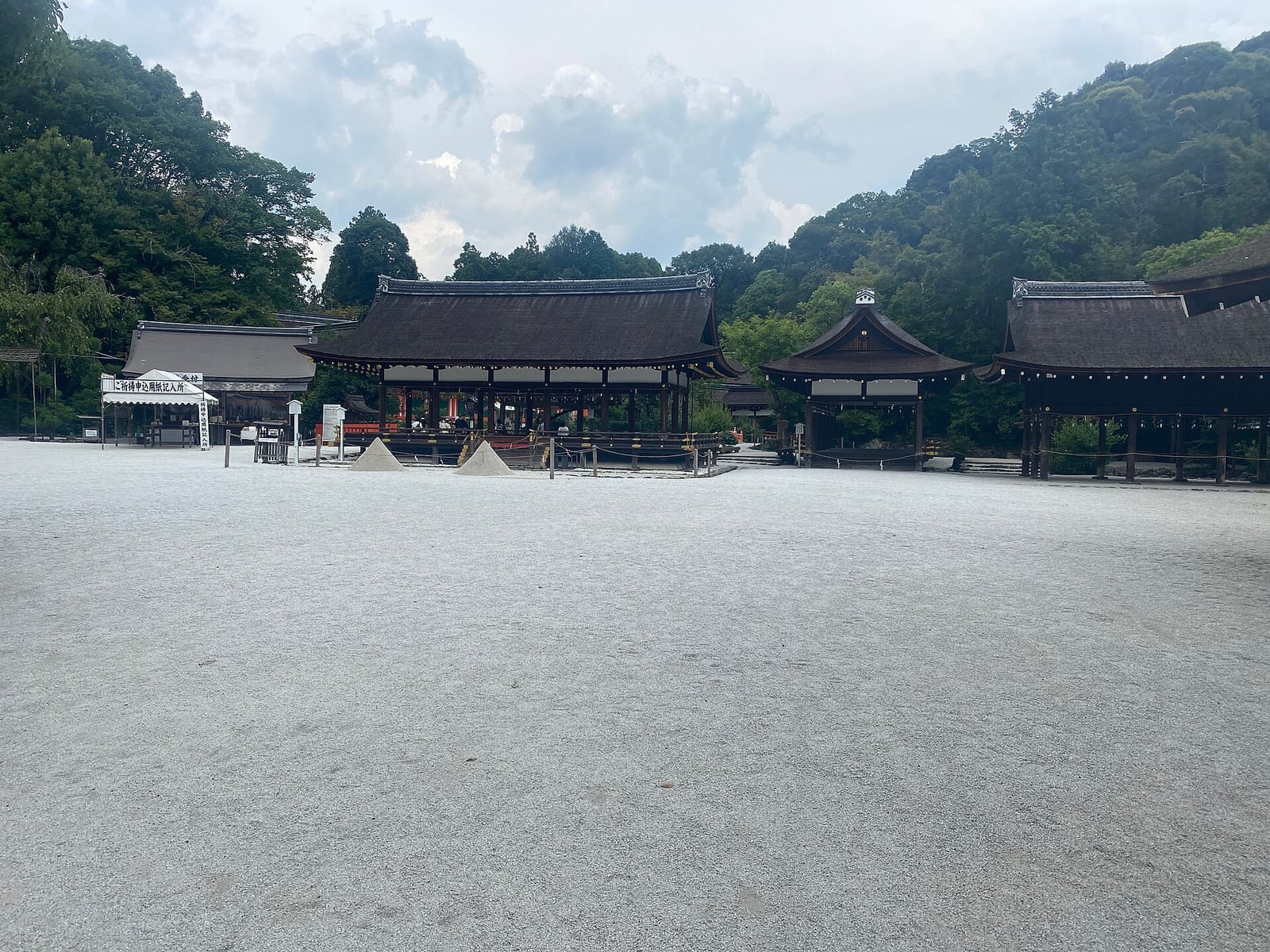
Kamowakeikazuchi Shrine (Kamigamo Shrine)
Photo: Immanuelle / CC BY 4.0 · Original · Resized and croppedEdo period · Shrines · National Treasures
Kamowakeikazuchi Shrine (Kamigamo Shrine)
賀茂別雷神社(上賀茂神社) (かもわけいかずちじんじゃ)
At Kamigamo Shrine you can view the Main Sanctuary and the Gonden, two National Treasure buildings rebuilt in 1863, up close on a special visit. Also worth seeing are the sand cones modeled on Mount Koyama and the shrine buildings spread over a slope where two streams meet.
Key facts
- Designation
- National Treasures
- Era
- Edo period
- Type
- Shrines
- Location
- Kyoto, Kyoto
- Address
- 京都府京都市北区上賀茂本山町
Before you go
- Opening hours
- The second torii gate is open 5:30 to 17:00; the Romon gate and amulet office 8:00 to 16:45. Special visits led by a priest to see the National Treasure main and spare sanctuaries up close are accepted 10:00 to 16:00.
- Closed
- Check the official site
- Admission (adults)
- The grounds are open to all. The special visit to the main sanctuary costs ¥500 for adults (it may be suspended or priced differently at times).
- Time needed
- Check the official site
- Getting there
- City bus 4 from Kyoto Station, Kitayama subway station or Demachiyanagi Station (Keihan) stops right at Kamigamo-jinja-mae. From Kitaoji subway station, take bus 37 to Kamigamo Misonobashi and walk 5 minutes. The worshippers' car park costs ¥200 per 30 minutes (¥1,000 per visit on busy days).
- Good to know
- The special visit to the main sanctuary is often suspended or rescheduled, so contact the shrine office if you are counting on it.
Checked against official information on November 12, 2026. Fees and hours can change, so please also check the official site before you go.
Sources for visitor information
Key facts
- Designation
- National Treasures
- Era
- Edo period
- Type
- Shrines
- Location
- Kyoto, Kyoto
- Address
- 京都府京都市北区上賀茂本山町
About this place
Kamowakeikazuchi Shrine is an ancient shrine in Kita Ward, Kyoto, widely known as Kamigamo Shrine. Its deity, Kamowakeikazuchi-no-Okami, is said to have descended onto Mount Koyama, 301.5 meters high and about 2 kilometers north-northwest of the shrine, and the largest rock at the summit is regarded as the stone of descent. In the shrine's myth, the child deity born after Kamo-Tamayorihime-no-Mikoto picked up a red-lacquered arrow in the river once rose to heaven, then came down onto Mount Koyama in response to a festival held to welcome him, and that festival is the origin of the shrine. In 677 the province of Yamashiro built the Kamo shrine buildings.
After the capital moved to Heian-kyo, the shrine was honored as a guardian of the capital and as the first shrine of Yamashiro Province, receiving visits and offerings from successive emperors, and from the Meiji era until the end of the Second World War it was ranked at the top of the government shrines of the highest grade. In 1036 a Shikinen Sengu renewal every 21 years was established. After the main sanctuary and other buildings burned in 1476, Tokugawa Hidetada built the shrine buildings in 1628 at the wish of Emperor Go-Mizunoo and Tofukumon-in. In 1994 the entire grounds of about 230,000 tsubo were inscribed as a World Cultural Heritage site.
The two National Treasure buildings are the Main Sanctuary and the Gonden. Identical buildings stand side by side, the Main Sanctuary on the east and the Gonden on the west; the Gonden is a permanent temporary sanctuary that serves as the main sanctuary during Shikinen Sengu. Both were rebuilt in 1863 (Bunkyu 3), the year Emperor Komei visited the shrine to pray for the expulsion of foreigners. They are in the nagare-zukuri style with cypress-bark roofs, and the shrine explains that this form is the prototype of the nagare-zukuri style used by about 60 percent of shrines in Japan. Both buildings have kagekoma, paintings of guardian lion-dogs by the Kano school from the Edo period. Most of the other shrine buildings were rebuilt in 1628, and 41 of them are Important Cultural Properties.
The Main Sanctuary and the Gonden stand in the inner court inside the Chumon gate, which is normally closed to visitors. On a special visit, a priest guides you to the Naoraiden hall for purification, and then you can go up to the front of the Gonden. The Takakura-den displays sacred treasures and items such as a votive painting of Emperor Komei's visit, which only special visitors can see. Photography and eating or drinking are not allowed, and the special visit is suspended around festivals, the Aoi Festival and the New Year, so the shrine asks you to contact its office before you go. During the spring and autumn Kyoto special openings of cultural properties not usually open to the public, and the summer Kyo no Natsu no Tabi campaign, the sanctuaries are shown as part of those programs and the regular special visit is not held.
The pair of sand cones, tatezuna, in front of you after passing through the second torii gate are modeled on Mount Koyama, with pine needles set at their tops. The shrine buildings spread over a triangular slope where the Omonoimi River on the east and the Mitarashi River on the west meet, and the main sanctuary is built facing Mount Koyama so that worship is directed toward the mountain. The metal fittings of the buildings are engraved with the shrine crest of futaba aoi (wild ginger leaves). The Kamo Kurabeuma horse race on May 5 began in 1093 when a horse-racing event at the imperial palace was moved here, and the Kamo Festival (Aoi Festival) is held on May 15. Tamayorihime-no-Mikoto, enshrined in the East Main Sanctuary of Shimogamo Shrine, is regarded as the mother of this shrine's deity.
Buildings designated as National Treasures
Kamowakeikazuchi Shrine Main Sanctuary
- Era
- End of the Edo period
- Year
- 1863
- Structure
- three-bay shrine, nagare-zukuri (flowing-gable) roof, cypress-bark roofing
- Designated
- March 31, 1953
Kamowakeikazuchi Shrine Gonden (Auxiliary Sanctuary)
- Era
- End of the Edo period
- Year
- 1863
- Structure
- three-bay shrine, nagare-zukuri (flowing-gable) roof, cypress-bark roofing
- Designated
- March 31, 1953
Sources and date checked
Facts such as eras, structures and locations are edited and translated by us from the Agency for Cultural Affairs’ database of nationally designated cultural properties. The Agency and the national government did not produce this page.
Database of nationally designated cultural properties- Agency for Cultural Affairs, Database of National Cultural Properties: Kamowakeikazuchi Shrine Main Sanctuary
- Agency for Cultural Affairs, Database of National Cultural Properties: Kamowakeikazuchi Shrine Gonden (Auxiliary Sanctuary)
- Kamigamo Shrine History and Crest (Kamigamo Shrine official site)
- Kamigamo Shrine Myth and Chronology (Kamigamo Shrine official site)
- Kamigamo Shrine National Treasure Main Sanctuary and Gonden (Kamigamo Shrine official site)
- Kamigamo Shrine Guide to the Grounds (Kamigamo Shrine official site)
- Kamigamo Shrine Special Visit to the National Treasure Sanctuaries (Kamigamo Shrine official site)
- Kamigamo Shrine Annual Events (Kamigamo Shrine official site)
- Kamigamo Shrine English site (Kamigamo Shrine official site)
- Shimogamo Shrine Grounds Map (Shimogamo Shrine official site)
Checked on November 6, 2026
Report an error
If you notice a mistake, please tell us along with a source for the correct information.
Where to go next
Places you could see on the same day, and places worth comparing.
Nearby cultural heritage
Places within 10 km, nearest first. Distances are in a straight line.
More from Kyoto
Discover more of the same region on our sister sites.
Matsuri Biyori
UNESCO-listed festivals in Kyoto
- Yamahoko, the float ceremony of the Kyoto Gion festival
- Kyoto no Rokusai Nenbutsu
- Yasuraibana
- Kuta no Hanagasa Odori
Meiga no Furusato
Paintings linked to Kyoto
- View of Amanohashidate
- Viewing Maple Leaves
- Scenes in and around Kyoto (Funaki Version)
- Morning View of Uji River