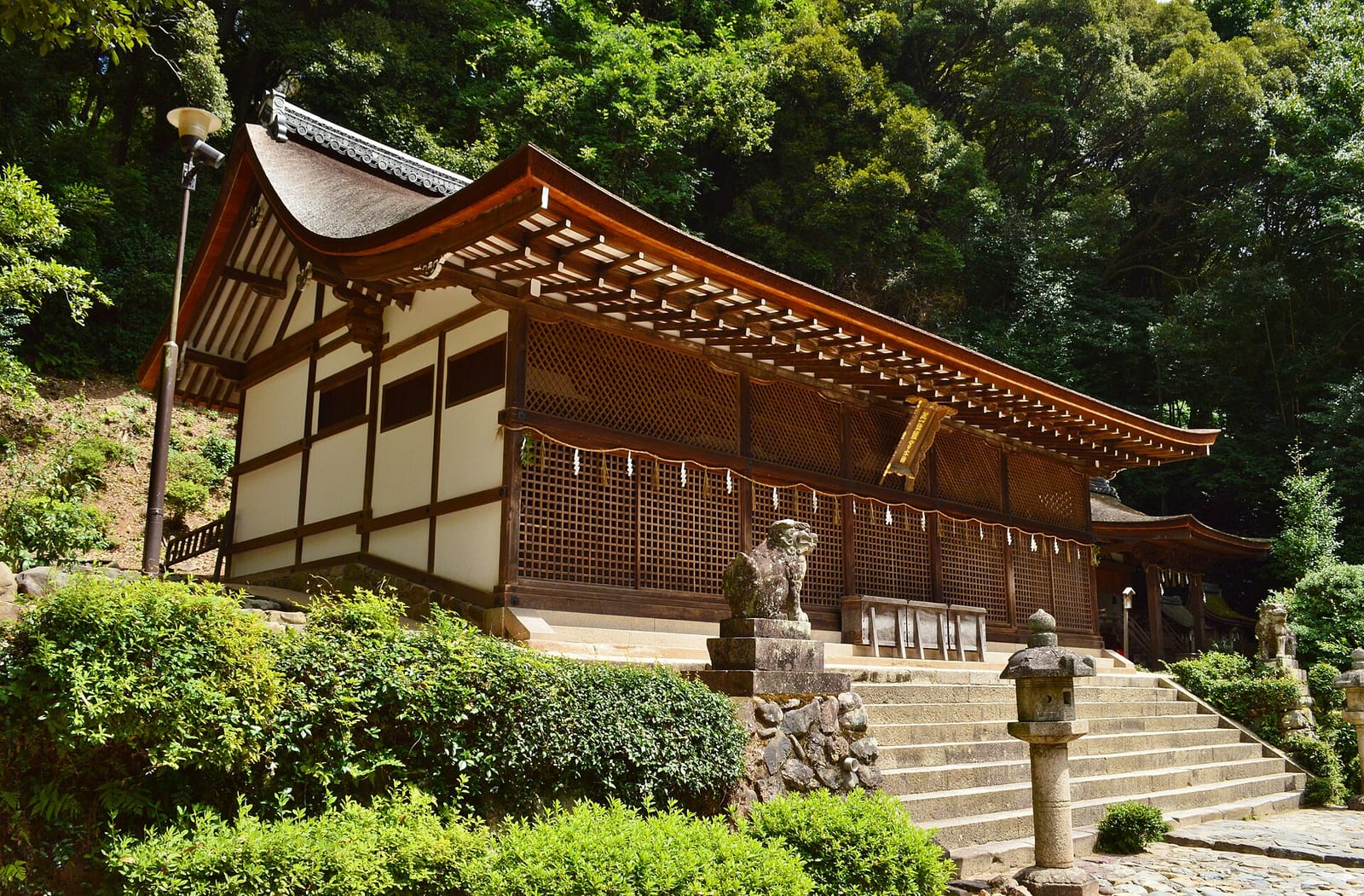
Ujigami Shrine
Photo: Saigen Jiro / CC0 · Original · Resized and croppedHeian period · Shrines · National Treasures
Ujigami Shrine
宇治上神社 (うじがみじんじゃ)
At Ujigami Shrine you can see two National Treasures: the late Heian Main Sanctuary, considered the oldest surviving shrine building, and the early Kamakura Worship Hall in the shinden-zukuri residential style. Byodo-in stands across the Uji River, so the two are easy to visit together.
Key facts
- Designation
- National Treasures
- Era
- Heian period
- Type
- Shrines
- Location
- Uji, Kyoto
- Address
- 京都府宇治市宇治山田
Before you go
- Opening hours
- Check the official site
- Closed
- Check the official site
- Admission (adults)
- Check the official site
- Time needed
- Check the official site
- Getting there
- Keihan Uji Station is a 10-minute walk away, and JR Uji Station on the Nara Line a 20-minute walk. From Kyoto Station, JR Uji is about 16 minutes by rapid train. Uji City recommends public transport during Golden Week and the autumn season, when roads are very congested.
Checked against official information on November 13, 2026. Fees and hours can change, so please also check the official site before you go.
Sources for visitor information
Key facts
- Designation
- National Treasures
- Era
- Heian period
- Type
- Shrines
- Location
- Uji, Kyoto
- Address
- 京都府宇治市宇治山田
About this place
Ujigami Shrine stands in Uji City, Kyoto Prefecture, on the east bank of the Uji River at the foot of Mt. Daikichi (also called Mt. Buttoku). It is about a 10-minute walk from the east end of Uji Bridge, on the opposite side of the river from Byodo-in, which is reached from the bridge's west end. Its deities are three: Emperor Ojin and his sons, Emperor Nintoku and Uji no Wakiiratsuko. According to the Kyoto School Trip Navi, Uji no Wakiiratsuko is said to have taken his own life so that his elder brother could become emperor. In 1994 the shrine was inscribed as a World Cultural Heritage site, one of the Historic Monuments of Ancient Kyoto.
Until the Meiji period, it formed a single pair with neighboring Uji Shrine, and the two were called Rikyu Kami-sha. According to Ochanokyoto, it was originally one with Uji Shrine, the lower shrine, and is said to have been the guardian shrine of Byodo-in. The grounds hold subsidiary shrines such as the Kasuga Shrine, built in the Kamakura period. The Kirihara spring, which wells up steadily, is one of the Seven Famous Waters of Uji, and the Japan Heritage guide says it is the only one of the seven that survives today.
The National Treasure Main Sanctuary is a late Heian building, and Kyoto Prefecture and Uji City describe it as the oldest surviving example of shrine architecture. Its form is unusual: three small inner shrines, each in the one-bay nagare-zukuri style, stand side by side in a row, all covered by a single outer shelter. The shelter itself is five bays wide and three bays deep in the nagare-zukuri style, with a cypress-bark roof. According to Ochanokyoto, the two inner shrines on the left and right are large and the one in the center is small. From outside it looks like one building, but knowing that three shrines sit inside changes how you see it.
The Worship Hall, which stands at the front of the grounds, is also a National Treasure and is dated to the early Kamakura period; Kyoto Prefecture places it at the very beginning of that period. It is a gable-roofed building six bays wide and three bays deep, with a one-bay pent roof (hisashi) at each gable end and a one-bay front porch (kohai), roofed with cypress bark. Kyoto Prefecture describes it as a building that carries on the shinden-zukuri style of aristocratic houses and singles out the beauty of its roof, which uses a technique called sugaru-hafu. Ochanokyoto describes it as a residence-like building in the shinden-zukuri manner, said to be a relic of the Uji Detached Palace.
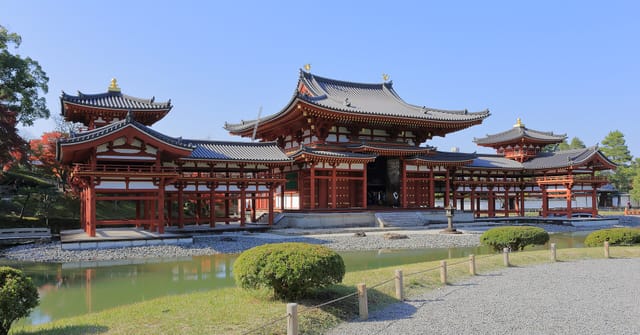
The Main Sanctuary and the Worship Hall differ in both date and construction, so you can compare two very different National Treasures in one compound. Across the Uji River is Byodo-in's Phoenix Hall, a National Treasure built in 1053, and you can cross Uji Bridge to visit both. A stop at Uji Shrine, once paired with this shrine, helps you understand their relationship from the days when they were called Rikyu Kami-sha. Uji City recommends public transport during Golden Week and the autumn tourist season, when roads are expected to be very congested.
Buildings designated as National Treasures
Ujigami Shrine Main Sanctuary
- Era
- Late Heian period
- Structure
- five bays wide, three bays deep, single-story, nagare-zukuri (flowing-gable) roof, cypress-bark roofing, three inner shrines, each a one-bay shrine in nagare-zukuri style
- Designated
- March 29, 1952
Ujigami Shrine Worship Hall
- Era
- Early Kamakura period
- Structure
- six bays wide, three bays deep, single-story, gable roof, pent roof (hisashi) one bay wide at both gable ends, one-bay front porch (kohai), cypress-bark roofing
- Designated
- November 22, 1952
Sources and date checked
Facts such as eras, structures and locations are edited and translated by us from the Agency for Cultural Affairs’ database of nationally designated cultural properties. The Agency and the national government did not produce this page.
Database of nationally designated cultural properties- Agency for Cultural Affairs, Database of National Cultural Properties: Ujigami Shrine Main Sanctuary
- Agency for Cultural Affairs, Database of National Cultural Properties: Ujigami Shrine Worship Hall
- National Treasures of the Yamashiro Area: Ujigami Shrine (Kyoto Prefecture)
- Ujigami Shrine (World Heritage) (Uji City)
- Ujigami Shrine (Ochanokyoto, Kyoto Yamashiro Regional Promotion Agency)
- Ujigami Shrine (Japan Heritage: A Walk Through the 800-Year History of Japanese Tea, Ochanokyoto)
- Ujigami Shrine (Kyoto School Trip Navi, Kyoto City Tourism Association)
- Please use public transport (Uji City)
Checked on November 6, 2026
Report an error
If you notice a mistake, please tell us along with a source for the correct information.
Where to go next
Places you could see on the same day, and places worth comparing.
Nearby cultural heritage
Places within 10 km, nearest first. Distances are in a straight line.
More from Kyoto
Discover more of the same region on our sister sites.
Matsuri Biyori
UNESCO-listed festivals in Kyoto
- Yamahoko, the float ceremony of the Kyoto Gion festival
- Kyoto no Rokusai Nenbutsu
- Yasuraibana
- Kuta no Hanagasa Odori
Meiga no Furusato
Paintings linked to Kyoto
- View of Amanohashidate
- Viewing Maple Leaves
- Scenes in and around Kyoto (Funaki Version)
- Morning View of Uji River