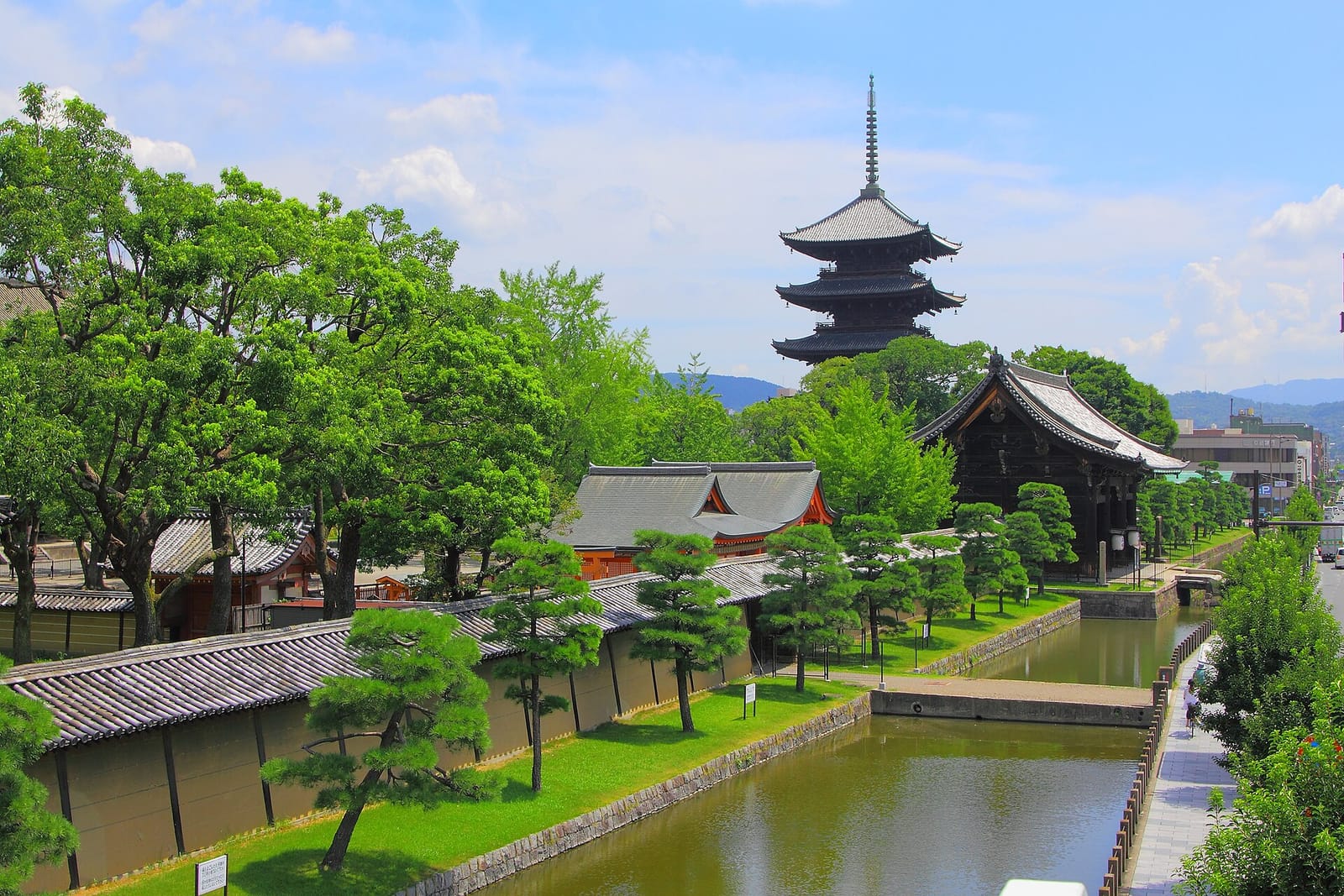
The five-story pagoda and the temple pond
Photo: Kakidai / CC BY-SA 4.0 · Original · Resized and croppedKamakura period · Temples · National Treasures
To-ji (Kyoogokoku-ji)
東寺(教王護国寺) (とうじ)
Entrusted by Emperor Saga to the monk Kukai, To-ji is the head training temple of Shingon Buddhism. Its five-story pagoda, about 55 m tall and said to be Japan's tallest wooden tower, rises just south of Kyoto Station, and the grounds hold National Treasure halls such as the Momoyama-period Kondo and the Muromachi-period Daishi-do.
Key facts
- Designation
- National Treasures
- Era
- Kamakura period
- Type
- Temples
- Location
- Kyoto, Kyoto
- Address
- 京都府京都市南区九条町
Before you go
- Opening hours
- The gates open 5:00 to 17:00. The Kondo and Kodo halls are open 8:00 to 17:00 (last entry 16:30). Kanchi-in and the Treasure Hall (open only during exhibitions) are open 9:00 to 17:00 (last entry 16:30).
- Closed
- Open every day. The Treasure Hall opens only during its spring and autumn exhibition periods.
- Admission (adults)
- ¥800 for the Kondo and Kodo halls. During special openings of the pagoda's ground floor, a ticket covering the pagoda, Kondo and Kodo costs ¥1,200. Kanchi-in is ¥600, and the Treasure Hall is ¥600 while open.
- Time needed
- Check the official site
- Getting there
- About 10 minutes on foot from Kintetsu Toji Station, or about 15 minutes from the Hachijo exit of JR Kyoto Station. From the Hachijo exit, Kyoto City Bus routes 78 and 19 go to the Toji Minamimon-mae stop and route 16 to Toji Nishimon-mae. There is a paid car park (¥600 for 2 hours for cars), but it is closed on the 21st of every month for the Kobo-ichi market.
- Best time to visit
- Evening illuminations with night viewing of the Kondo and Kodo are held in the cherry blossom, fresh green and autumn leaf seasons (in 2026: March 14 to April 12, April 28 to May 10, and October 31 to December 13; ¥1,000). The autumn session runs 18:00 to 21:30 (last entry 21:00). The Kobo-ichi market fills the grounds on the 21st of every month.
- Good to know
- The inside of the pagoda's ground floor can only be entered during special openings, and the Treasure Hall opens only in spring and autumn, so check the official site for dates. The car park is closed on the 21st of each month.
Checked against official information on November 12, 2026. Fees and hours can change, so please also check the official site before you go.
Sources for visitor information
Key facts
- Designation
- National Treasures
- Era
- Kamakura period
- Type
- Temples
- Location
- Kyoto, Kyoto
- Address
- 京都府京都市南区九条町
About this place
The capital moved to Heian-kyo in 794, and in the 29th winter after that Emperor Saga entrusted To-ji to Kukai, who had brought esoteric Buddhism back from Tang China. The temple has been the root training center of Shingon esoteric Buddhism ever since. The precinct is a rectangle 255 meters wide and 515 meters long, and the block holding the main halls is a nearly perfect 255-meter square. The Lecture Hall stands at its center, and the Dainichi Buddha enshrined there is regarded as the center of the cosmos. A look at the precinct map first makes this geometry easy to follow on foot.
The Lecture Hall was begun in 823 and finished in 839, but it burned in 1486, along with the Kondo and the South Gate, during a peasant uprising. It was rebuilt first, five years later in 1491, while the Kondo was completed in 1603, after the Battle of Sekigahara. The Kondo has a hip-and-gable, hongawara-tiled roof and blends the Tenjiku style, which drew on Song Chinese architecture, with the Japanese style, typical of the Momoyama period. The upward curve at the center of its roof also appears on the Great Buddha Hall of Todai-ji and the Phoenix Hall of Byodo-in. The main image inside is Yakushi Nyorai, flanked by the Nikko and Gakko bodhisattvas, in an old style where the Buddha holds no medicine jar. Seven small Buddhas line the halo, and the Twelve Divine Generals surround the pedestal.
The five-story pagoda is about 55 meters tall, the tallest wooden pagoda in Japan. It burned four times, partly from lightning, and the present one, rebuilt in 1644 (Kan'ei 21), is the fifth. The ground floor is closed to the public, but inside, the central pillar represents Dainichi Buddha, surrounded by Buddhas and bodhisattvas in a richly colored space, with the Diamond Realm Mandala, the Eight Dragon Kings, and the Eight Patriarchs of Shingon painted on the pillars and walls. Even seen only from outside, the tower standing above the surrounding streets gives a sense of the temple's scale.
The Miedo (Daishido) is where, in 1233, the sculptor Kosho, a son of Unkei, completed a seated statue of Kukai and a memorial service began there. The building designated a National Treasure dates from 1380, in the early Muromachi period. The Renge-mon gate is also a National Treasure and dates from the early Kamakura period. On the 21st of every month a market called Kobo-ichi is held, named after Kobo Daishi, as Kukai is also known. The Treasure Hall opens twice a year, in spring and autumn, so check the official site for this and for visiting information on each hall before you go. Walking among the Kondo, Lecture Hall, and pagoda and comparing them shows how this temple has lasted over a thousand years through repeated fires and rebuilding. The Treasure Hall, built in 1963, holds Kukai's letter known as the Fushincho and the Mandalas of the Two Realms.
Buildings designated as National Treasures
To-ji Kondo (Golden Hall)
- Era
- Momoyama period
- Year
- 1603
- Structure
- five bays wide, three bays deep, single-story with mokoshi (skirt roof), hip-and-gable roof, hongawara tile roofing
- Designated
- March 31, 1953
To-ji Five-Story Pagoda
- Era
- Early Edo period
- Year
- 1643
- Structure
- five-story pagoda, three bays square, hongawara tile roofing
- Designated
- November 22, 1952
To-ji Daishi-do (Saiin Miedo)
- Era
- Early Muromachi period
- Year
- 1380
- Structure
- rear hall, consisting of the front hall and middle gate
- Designated
- February 8, 1958
To-ji Rengemon Gate
- Era
- Early Kamakura period
- Structure
- eight-legged gate, three bays with one doorway, gable roof, hongawara tile roofing
- Designated
- November 22, 1952
Sources and date checked
Facts such as eras, structures and locations are edited and translated by us from the Agency for Cultural Affairs’ database of nationally designated cultural properties. The Agency and the national government did not produce this page.
Database of nationally designated cultural properties- Agency for Cultural Affairs, Database of National Cultural Properties: To-ji Kondo (Golden Hall)
- Agency for Cultural Affairs, Database of National Cultural Properties: To-ji Five-Story Pagoda
- Agency for Cultural Affairs, Database of National Cultural Properties: To-ji Daishi-do (Saiin Miedo)
- Agency for Cultural Affairs, Database of National Cultural Properties: To-ji Rengemon Gate
- Toji official site: History
- Toji official site: Kondo
- Toji official site: Kodo
- Toji official site: Five-Story Pagoda
- Toji official site: English
Checked on November 6, 2026
Report an error
If you notice a mistake, please tell us along with a source for the correct information.
Where to go next
Places you could see on the same day, and places worth comparing.
Nearby cultural heritage
Places within 10 km, nearest first. Distances are in a straight line.
More from Kyoto
Discover more of the same region on our sister sites.
Matsuri Biyori
UNESCO-listed festivals in Kyoto
- Yamahoko, the float ceremony of the Kyoto Gion festival
- Kyoto no Rokusai Nenbutsu
- Yasuraibana
- Kuta no Hanagasa Odori
Meiga no Furusato
Paintings linked to Kyoto
- View of Amanohashidate
- Viewing Maple Leaves
- Scenes in and around Kyoto (Funaki Version)
- Morning View of Uji River