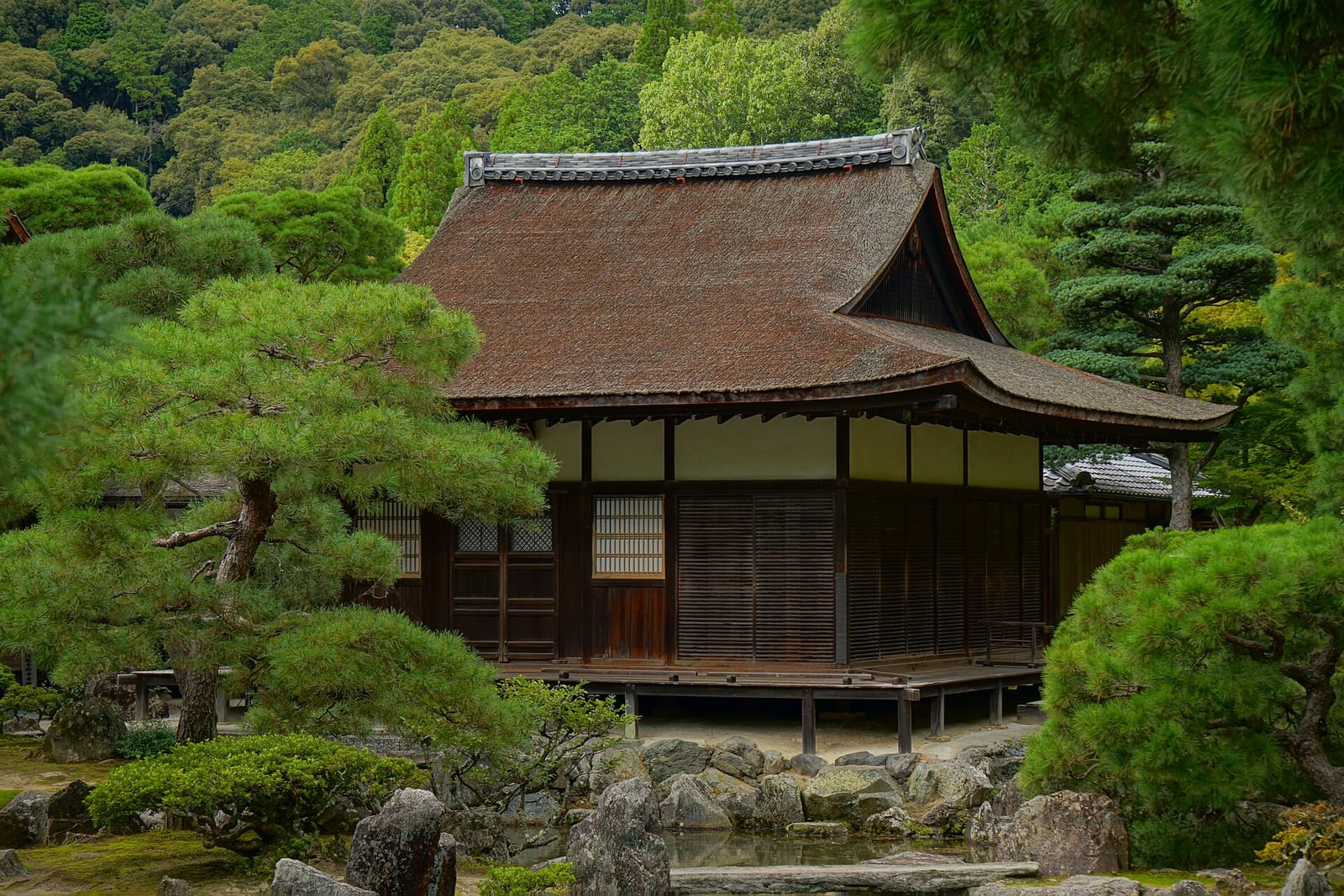
The Togu-do hall
Photo: 掬茶 / CC BY-SA 4.0 · Original · Resized and croppedMuromachi period · Temples · National Treasures
Jisho-ji (Ginkaku-ji)
慈照寺(銀閣) (じしょうじ)
Built at the Higashiyama villa of Ashikaga Yoshimasa, the eighth Muromachi shogun, the Kannon-den (Silver Pavilion) and his private chapel, the Togu-do, are both National Treasures. Modeled on the Golden Pavilion but left unadorned, the building and the garden Yoshimasa helped shape still carry the quiet taste of Higashiyama culture.
Key facts
- Designation
- National Treasures
- Era
- Muromachi period
- Type
- Temples
- Location
- Kyoto, Kyoto
- Address
- 京都府京都市左京区銀閣寺町
Before you go
- Opening hours
- 8:30 to 17:00 (9:00 to 16:30 from December to February).
- Closed
- Open every day of the year.
- Admission (adults)
- ¥1,000 for adults (high school age and up), covering the grounds and garden.
- Time needed
- About 30 minutes.
- Getting there
- Take Kyoto City Bus routes 5, 7, 32, 102, 203 or 204 to the Ginkakuji-michi stop, or routes EX100 or 105 to Ginkakuji-mae. The temple has no parking; use the city-run Ginkakuji tourist car park (private cars may be turned away in busy seasons) or nearby coin parking.
- Best time to visit
- In spring and autumn the Hondo, the Togu-do and the Rosei-tei open for special guided viewings. The autumn 2026 session runs November 1 to December 5: about 30 minutes per tour, in Japanese only, about 20 people per tour, ¥2,000 plus regular admission.
- Good to know
- The interior of the Silver Pavilion is never open. The Togu-do can be entered only during the spring and autumn special viewings, on a first-come, first-served basis on the day.
Checked against official information on November 12, 2026. Fees and hours can change, so please also check the official site before you go.
Sources for visitor information
Key facts
- Designation
- National Treasures
- Era
- Muromachi period
- Type
- Temples
- Location
- Kyoto, Kyoto
- Address
- 京都府京都市左京区銀閣寺町
About this place
The Ginkaku of Jisho-ji stands in the Higashiyama villa built by Ashikaga Yoshimasa, the eighth shogun of the Muromachi shogunate. Yoshimasa wished to withdraw from politics, and in 1464 he called his younger brother Yoshimi back to lay life and made him heir, but the next year his wife Hino Tomiko bore a son, Yoshihisa, which set off a dispute over the succession, and the Onin War (1467-77) burned much of Kyoto. Yoshimasa began building the Higashiyama villa in 1482, after the war, and in 1485 took Buddhist vows under the name Kizan Dokei. Before visiting, knowing that a shogun set out to make his own retreat amid a ruined capital changes how the building's quiet presence reads.
The Ginkaku is formally called the Kannon Hall, and construction began in March 1489. Yoshimasa is known to have visited Rokuon-ji without notice in 1487 to inspect the Relics Hall of the Kinkaku, which it is said to follow as a model. But Yoshimasa died on January 7, 1490, and never saw the Ginkaku finished. Between 1485 and 1487 the Zen practice hall, the private Buddha hall, the reception hall, and the Izumiden were completed one after another, and the Ginkaku was begun last. The Ginkaku, a National Treasure, is two stories with a pyramidal hip roof (hogyo-zukuri) and a shingle roof. The Togudo, also a National Treasure, was built as Yoshimasa's own private Buddha hall; it is single-story with a hip-and-gable roof and cypress-bark roofing. Seeing the two side by side makes clear that the Ginkaku shows itself through the grain of its wood and the lines of its roof, not through gilded decoration like the Kinkaku.
The garden is said to be the only one still in existence that Yoshimasa himself helped create. Yoshimasa was strongly influenced by Saiho-ji, known as the moss temple. Noami and his son Geiami, who catalogued the shogunate's art collection, and Noami's grandson Soami helped set the standards of the shoin style and supported the tea ceremony, which is how the restrained taste of Higashiyama culture is explained. Rather than looking only at the Ginkaku itself, stand in the garden and look across the pond at the building's outline to see how the slope of the roof and the surrounding trees fit together.
As a temple, Jisho-ji took Muso Soseki as its honorary founder after Yoshimasa's death in 1490 and was named Jisho-in, then renamed Jisho-ji in 1491. In 1550, in a battle between Miyoshi Chokei and the shogun Yoshiteru, almost every building except the Ginkaku and the Togudo burned. Its present form as a Zen temple is based on the restoration by Miyagi Tamba no Kami Toyomori in 1615. It stands in Sakyo Ward as a temple belonging to Shokoku-ji, so a visit to Shokoku-ji can be paired with it to trace the ties between the Ashikaga shoguns and Zen.
Buildings designated as National Treasures
Jisho-ji Ginkaku (Silver Pavilion)
- Era
- Late Muromachi period
- Year
- 1489
- Structure
- east and west faces 8.2 m, north face 7.0 m, south face 5.9 m, two-story, pyramidal hip roof (hogyo-zukuri), shingle roofing (kokera-buki)
- Designated
- June 9, 1951
Jisho-ji Togudo
- Era
- Late Muromachi period
- Year
- 1485
- Structure
- 6.9 m wide, 6.9 m deep, single-story, hip-and-gable roof, cypress-bark roofing
- Designated
- June 9, 1951
Sources and date checked
Facts such as eras, structures and locations are edited and translated by us from the Agency for Cultural Affairs’ database of nationally designated cultural properties. The Agency and the national government did not produce this page.
Database of nationally designated cultural properties- Agency for Cultural Affairs, Database of National Cultural Properties: Jisho-ji Ginkaku (Silver Pavilion)
- Agency for Cultural Affairs, Database of National Cultural Properties: Jisho-ji Togudo
- Jisho-ji (Ginkaku-ji) official site: Explanatory Page
- Jisho-ji (Ginkaku-ji) official site
- Jisho-ji (Ginkaku-ji) official site: Explanatory Page (Japanese)
Checked on November 6, 2026
Report an error
If you notice a mistake, please tell us along with a source for the correct information.
Where to go next
Places you could see on the same day, and places worth comparing.
Nearby cultural heritage
Places within 10 km, nearest first. Distances are in a straight line.
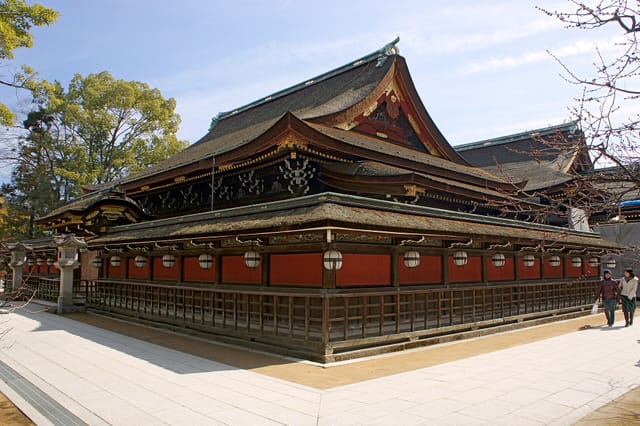
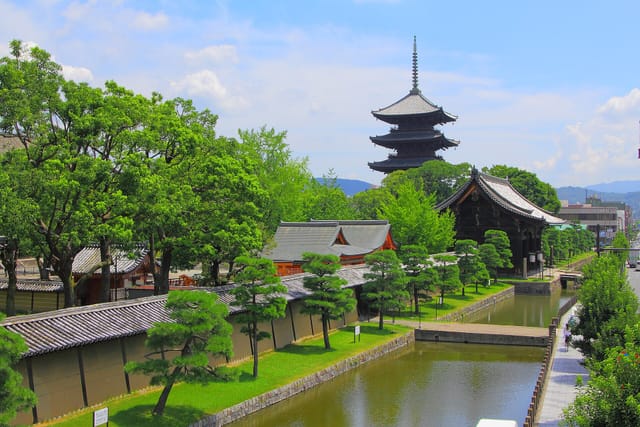
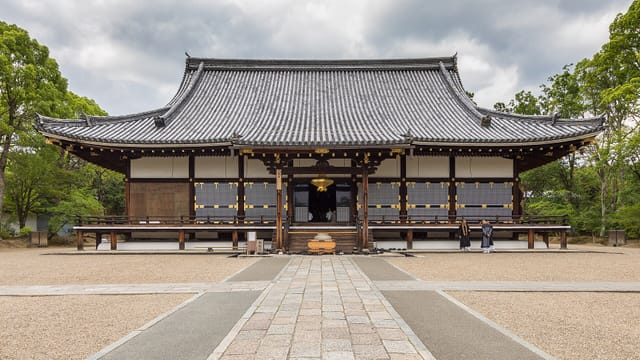
More from Kyoto
Discover more of the same region on our sister sites.
Matsuri Biyori
UNESCO-listed festivals in Kyoto
- Yamahoko, the float ceremony of the Kyoto Gion festival
- Kyoto no Rokusai Nenbutsu
- Yasuraibana
- Kuta no Hanagasa Odori
Meiga no Furusato
Paintings linked to Kyoto
- View of Amanohashidate
- Viewing Maple Leaves
- Scenes in and around Kyoto (Funaki Version)
- Morning View of Uji River