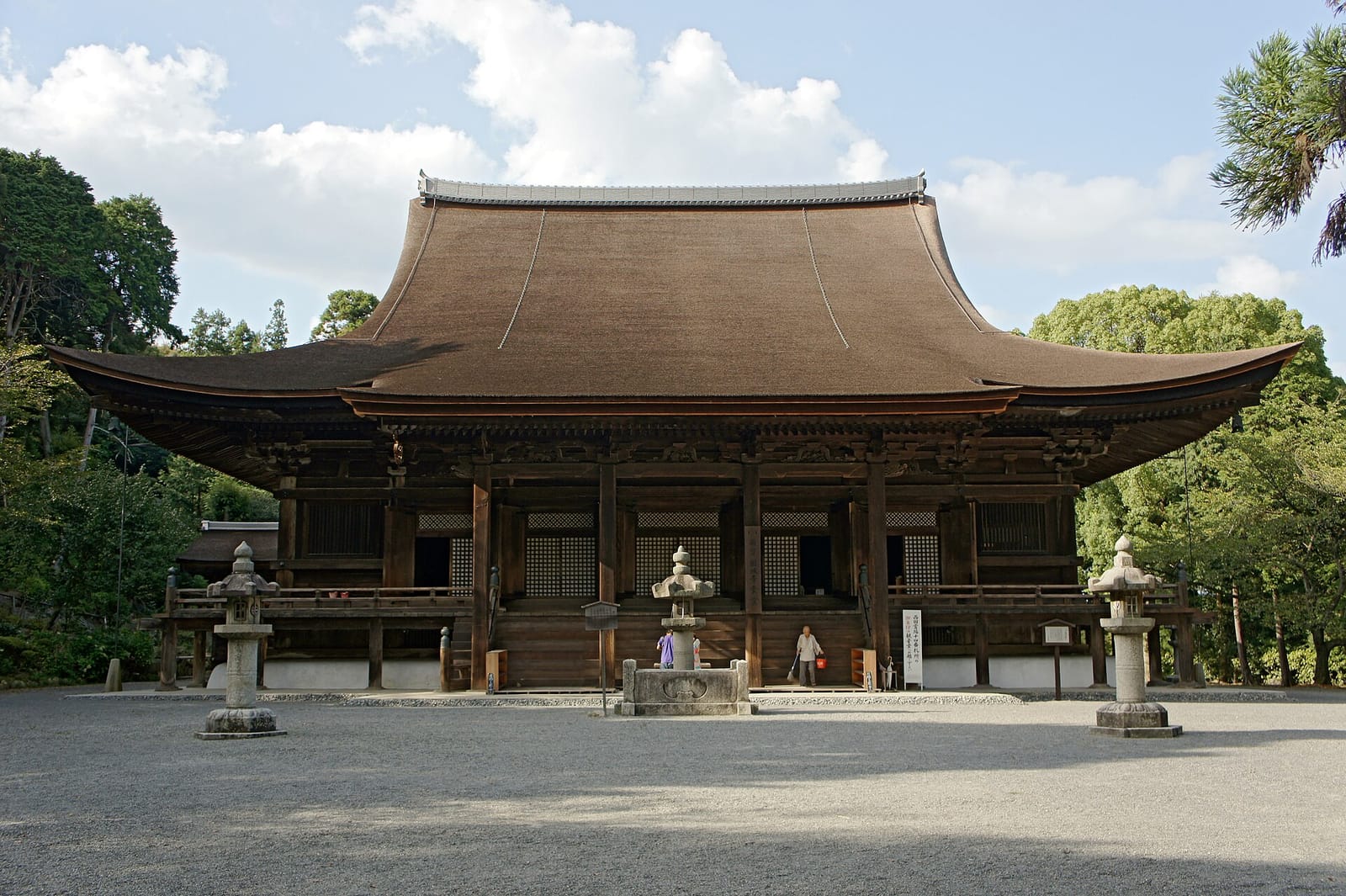
Onjo-ji (Mii-dera)
Photo: 663highland / CC BY 2.5 · Original · Resized and croppedMuromachi period · Temples · National Treasures
Onjo-ji (Mii-dera)
園城寺(三井寺) (おんじょうじ)
At Mii-dera you can see the large Momoyama-period Kondo and the Shinra Zenjin-do with its graceful cypress-bark roof. The shoin-style guest halls of Kangaku-in and Kojo-in can be seen on a special visit arranged in advance.
Key facts
- Designation
- National Treasures
- Era
- Muromachi period
- Type
- Temples
- Location
- Otsu, Shiga
- Address
- 滋賀県大津市園城寺町
Before you go
- Opening hours
- 9:00 to 16:30 (last entry 16:00).
- Closed
- Open every day of the year.
- Admission (adults)
- Admission is ¥800 for adults.
- Time needed
- Check the official site
- Getting there
- About 7 minutes on foot from Miidera Station on the Keihan Ishiyama-Sakamoto Line (about 10 minutes to the Niomon gate). From JR Otsu or Otsukyo Station, Keihan buses stop right at Miidera. Parking costs ¥600 per car.
- Good to know
- The National Treasure Kondo hall is open for worship, and you can ring the Evening Bell of Mii, one of the Eight Views of Omi, yourself.
Checked against official information on November 12, 2026. Fees and hours can change, so please also check the official site before you go.
Sources for visitor information
Key facts
- Designation
- National Treasures
- Era
- Muromachi period
- Type
- Temples
- Location
- Otsu, Shiga
- Address
- 滋賀県大津市園城寺町
About this place
Mii-dera is a temple with extensive grounds on the slopes of Mt. Nagara, southwest of Lake Biwa in Otsu, Shiga Prefecture. Its formal name is Nagarasan Onjo-ji, and it is the head temple of the Tendai Jimon school. According to the multilingual commentary of the Japan Tourism Agency, it began in 672, when Prince Otomo no Yota, son of Emperor Kobun, built it to mourn his late father. The temple says the name Mii-dera comes from a sacred spring said to have been used for the first baths of three emperors: Tenji, Tenmu and Jito.
Enchin (Chisho Daishi, 814-891), revered as the temple's founding patriarch, went to Tang China in 853. After returning in 859, he revived Mii-dera as a branch temple of the Tendai school and placed the sutras he had brought back from China in the To-in. He later became the fifth head of the Tendai school, and in 927, after his death, he was given the title Chisho Daishi. Mii-dera grew into one of the "Four Great Temples" of Japan, and because it recovered again and again after being burned in the Genpei War and the wars of the Northern and Southern Courts, it is known as the "Phoenix Temple."
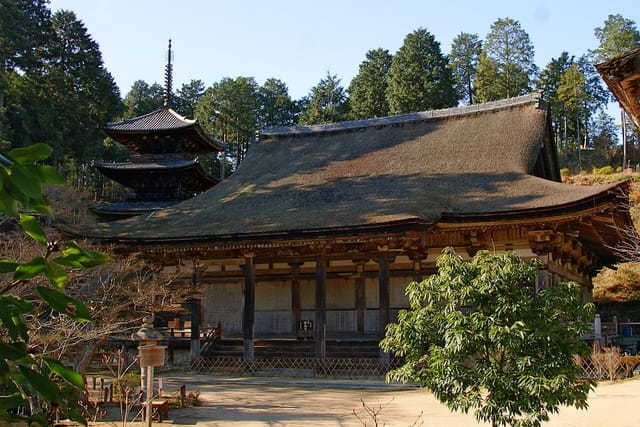
The Kondo (Main Hall), which serves as the temple's main hall, dates from 1599 and is regarded as a masterpiece of Momoyama-period architecture. After Toyotomi Hideyoshi's confiscation order brought the temple hard times, its revival went ahead with Kita no Mandokoro as patron, and carpenters who had served Toyotomi Hidenaga supported the work. It is a large hall, seven bays by seven bays, with a hip-and-gable roof covered in cypress bark. The principal image is a hidden Miroku Bodhisattva; the hall is open for worship, and statues such as Enku Buddhas, Sonjoo and Fudo Myoo are enshrined inside. The Akaiya, the next stop after the Kondo on the route, houses the sacred spring said to have given Mii-dera its name.
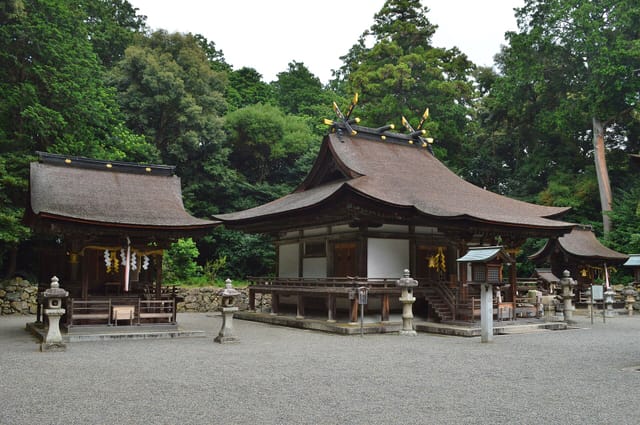
The Shinra Zenjin-do enshrines Shinra Myojin, a deity said to have promised Enchin, on board ship on his way back from China, to protect the Buddhist teachings. According to Otsu City, it was rebuilt by Ashikaga Takauji in 1347, and it is said that Minamoto no Yoshimitsu came of age before this deity and was therefore called "Shinra Saburo." The building is a three-bay nagare-zukuri shrine with a cypress-bark roof. According to the temple, Kangaku-in was founded in 1239 as a place of study, and its present Kyakuden (Guest Hall) was rebuilt in 1600 by Mori Terumoto. It has nine rooms in three rows, and the first and second rooms keep wall paintings by Kano Mitsunobu.
The Kojo-in Kyakuden (Guest Hall) was built in 1601 by Yamaoka Doami, a warrior who served Hideyoshi and was also a monk of Mii-dera, and is a leading example of the shoin style, with formal room fittings such as staggered shelves and a built-in writing alcove. Both guest halls have hip-and-gable roofs entered from the gable end, with a karahafu curved gable on the front eaves. The guest halls are not open to the general public, but groups of four or more can arrange a special visit by applying at least a week in advance. The Kangaku-in sliding-door paintings are shown in the Cultural Property Storehouse. The temple's recommended route runs from the Niomon gate past the Evening Bell of Mii, the Kondo and the To-in, then climbs to the Kannon-do, the 14th temple of the Saigoku 33 Kannon Pilgrimage, and a viewpoint overlooking Lake Biwa.
Buildings designated as National Treasures
Onjo-ji Shinra Zenjin-do
- Era
- Early Muromachi period
- Year
- 1347
- Structure
- three bays wide, three bays deep, single-story, nagare-zukuri style, one-bay porch (kohai), cypress-bark roofing
- Designated
- March 31, 1953
Kangaku-in Kyakuden (Guest Hall)
- Era
- Momoyama period
- Year
- 1600
- Structure
- seven bays wide, seven bays deep, single-story, hip-and-gable roof, entrance on the gable end, with a karahafu curved gable on the front eaves
- Designated
- November 22, 1952
Kojo-in Kyakuden (Guest Hall)
- Era
- Momoyama period
- Year
- 1601
- Structure
- seven bays wide, six bays deep, single-story, hip-and-gable roof, entrance on the gable end, with a karahafu curved gable on the front eaves
- Designated
- November 22, 1952
Onjo-ji Kondo (Main Hall)
- Era
- Momoyama period
- Year
- 1599
- Structure
- seven bays wide, seven bays deep, single-story, hip-and-gable roof, three-bay porch (kohai), cypress-bark roofing
- Designated
- March 31, 1953
Sources and date checked
Facts such as eras, structures and locations are edited and translated by us from the Agency for Cultural Affairs’ database of nationally designated cultural properties. The Agency and the national government did not produce this page.
Database of nationally designated cultural properties- Agency for Cultural Affairs, Database of National Cultural Properties: Onjo-ji Shinra Zenjin-do
- Agency for Cultural Affairs, Database of National Cultural Properties: Kangaku-in Kyakuden (Guest Hall)
- Agency for Cultural Affairs, Database of National Cultural Properties: Kojo-in Kyakuden (Guest Hall)
- Agency for Cultural Affairs, Database of National Cultural Properties: Onjo-ji Kondo (Main Hall)
- Mii-dera: Kojo-in Guest Hall, National Treasure special admission (Mii-dera official)
- Mii-dera: Recommended route (Mii-dera official)
- Mii-dera: Kangaku-in Guest Hall, National Treasure special admission (Mii-dera official)
- Mii-dera: Documents and books related to Chisho Daishi Enchin (Mii-dera official)
- Mii-dera: 1100th anniversary of the title of Chisho Daishi Enchin (Mii-dera official)
- Mii-dera: Exhibition on the Toyotomi brothers and their era (Mii-dera official)
- Historic and cultural heritage around Onjo-ji (Mii-dera) (Otsu City)
- Miidera Temple, Multilingual Commentary Database of Regional Tourism Resources (Japan Tourism Agency)
Checked on November 6, 2026
Report an error
If you notice a mistake, please tell us along with a source for the correct information.
Where to go next
Places you could see on the same day, and places worth comparing.
Nearby cultural heritage
Places within 10 km, nearest first. Distances are in a straight line.
More from Shiga
Discover more of the same region on our sister sites.
Matsuri Biyori
UNESCO-listed festivals in Shiga
- Nagahama Hikiyama Festival Float Event
- Otsu Festival Hikiyama Float Event
- Omi Konan no San'yare Odori
- Omi no Kenketo Matsuri Naginata Furi
Meiga no Furusato
Paintings linked to Shiga
- The Sixty-nine Stations of the Kisokaido: Kashiwabara
- The Sixty-nine Stations of the Kisokaido: Samegai
- The Sixty-nine Stations of the Kisokaido: Banba
- The Sixty-nine Stations of the Kisokaido: Toriimoto
Sake Tabi
Breweries and distilleries in Shiga
- Fujii Honke Sake Brewery Tour
- Nagahama Distillery (Nagahama Roman Beer)
- Nagahama Roman Beer
- Hikone Beer Kojinyama Brewery