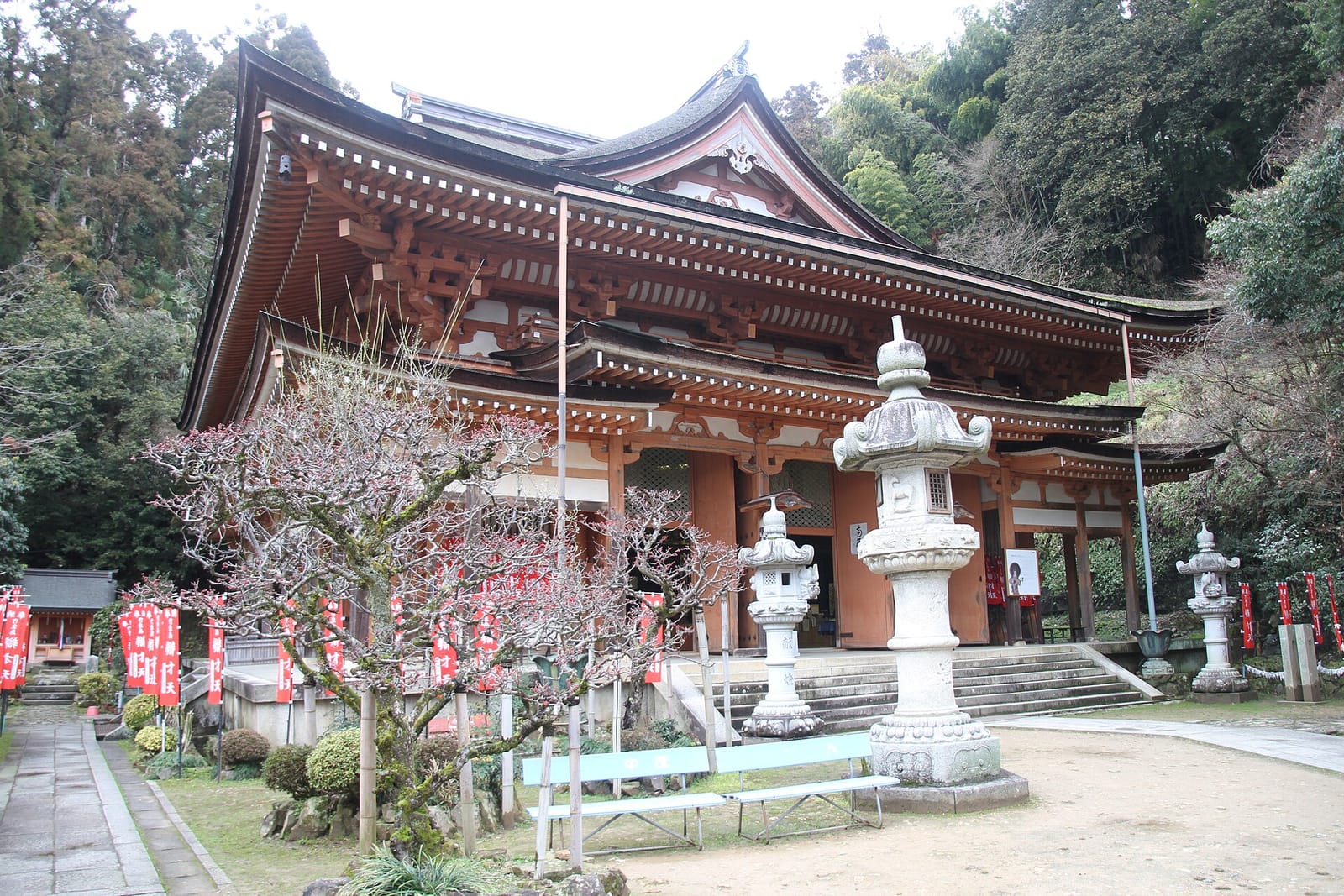
Hogon-ji
Photo: Hyppolyte de Saint-Rambert / CC BY-SA 4.0 · Original · Resized and croppedMomoyama period · Temples · National Treasures
Hogon-ji
宝厳寺 (ほうごんじ)
At Hogon-ji you can see the National Treasure Karamon Gate, noted as possibly the only surviving building of Hideyoshi's Osaka Castle, the partly cliff-hung Kannon Hall and the Funa-roka corridor leading to Tsukubusuma Shrine. Stone steps lead up to the main hall of the Great Benzaiten.
Key facts
- Designation
- National Treasures
- Era
- Momoyama period
- Type
- Temples
- Location
- Nagahama, Shiga
- Address
- 滋賀県長浜市早崎町
Before you go
- Opening hours
- Visiting hours and temple stamp service are 9:30 to 16:30, set around the sightseeing boat schedule.
- Closed
- Check the official site
- Admission (adults)
- To visit the shrine and temple after landing, an island entry fee (600 yen for adults, 300 yen for children) is charged on top of the boat fare. The treasure hall costs 300 yen for adults.
- Time needed
- Biwako Kisen suggests allowing about 60 to 80 minutes on the island.
- Getting there
- Chikubushima is reached by boat. Biwako Kisen sails from Nagahama Port (10 minutes' walk from JR Nagahama Station) and Imazu Port (5 minutes' walk from JR Omi-Imazu Station); the crossing takes about 30 minutes, and adult return fares are 3,800 yen from Nagahama and 3,400 yen from Imazu. In winter (December 7 to the end of February, except the year-end and New Year period) the Imazu route runs only on weekends and some holidays. Ohmi Marine's boats from Hikone Port have been suspended since August 14, 2026. Each port has a car park.
- Best time to visit
- The Renge-e service on August 15 is the island's largest event. The 15th of each month is Benzaiten's fair day, and services are also held at New Year (January 1 to 4) and for Setsubun in early February.
- Good to know
- The ports, boats and Chikubushima pier are not barrier-free; wheelchair users must leave their chairs to board, so contact the port in advance. Pets are not allowed on board (guide and service dogs excepted).
Checked against official information on November 13, 2026. Fees and hours can change, so please also check the official site before you go.
Sources for visitor information
Key facts
- Designation
- National Treasures
- Era
- Momoyama period
- Type
- Temples
- Location
- Nagahama, Shiga
- Address
- 滋賀県長浜市早崎町
About this place
Hogon-ji is a temple of the Shingon Buzan school on Chikubushima, an island in Lake Biwa. According to the temple, it began in 724, when Emperor Shomu received a message from the sun goddess Amaterasu in a dream and sent the monk Gyoki as his envoy to found halls on the island. The principal image, the Great Benzaiten, is counted among the Three Great Benzaiten of Japan with those of Enoshima and Miyajima, and the Kannon Hall is the 30th temple of the Saigoku 33 Kannon pilgrimage. When Shinto and Buddhism were separated in the Meiji era, the main hall building was handed over to Tsukubusuma Shrine, and the present main hall (Benzaiten Hall) was rebuilt in 1942.
The Karamon Gate, a National Treasure, is a gate with a karahafu curved gable. According to the temple, it is the Gokuraku Gate of the Hokoku mausoleum of Hideyoshi in Higashiyama, Kyoto, moved here on the orders of Toyotomi Hideyori with Katagiri Katsumoto in charge of the work. The temple's history page gives the year of the move as 1602, while the ridge tablet records 1603, the year also given by the national cultural properties database. Because of the island's terrain, it was set against the Kannon Hall. It is a one-bay, single-doorway gate facing forward under its curved gable, with a cypress-bark roof. The whole gate is lacquered black and studded with gilt metal fittings, and carvings of phoenixes, pines, rabbits and peonies around the frog-leg strut and peony scrolls on the doors and walls are painted in rich colors.
The Gokuraku Gate is thought to have begun as the Gokuraku Bridge of Osaka Castle. The temple explains that diaries of the time record that the bridge was moved to the Hokoku mausoleum and that the Gokuraku Gate there was donated to Chikubushima. In addition, a folding screen of Osaka Castle found at Eggenberg Castle in Austria in 2006 depicts the Gokuraku Bridge, and this has drawn attention to the idea that the Karamon may be the only surviving building of the Osaka Castle built by Hideyoshi.
The Kannon Hall (Important Cultural Property), joined to the back of the Karamon, is also thought to have been built in 1603, the same year as the gate. Because it stands on a slope, part of it is built on long pillars in the kakezukuri style, and the pillars are lacquered black even below the floor, which shows that the hall was moved here. The principal image, a standing Thousand-Armed Kannon, is a hidden Buddha shown only once every 60 years; the next showing is in 2037. From the Kannon Hall, the roofed Funa-roka corridor (Important Cultural Property) runs to Tsukubusuma Shrine. Its name comes from a tradition that it was built with timber from the deckhouse of Hideyoshi's flagship, the Nihon Maru.
The Karamon, Kannon Hall and corridor were repaired over six years from fiscal 2013, with new cypress-bark roofs and fresh lacquer and paint, and the work was completed in March 2020. From the pier, 165 stone steps lead up to the main hall. The grounds also hold a three-story pagoda rebuilt in 2000 for the first time in about 350 years, a 247-centimeter five-story stone pagoda (Important Cultural Property) and a treasure hall. The Renge-e on August 15 is the largest event on the island. Boats to the island leave from Nagahama Port and Imazu Port; the route from Hikone Port has been suspended since August 14, 2026.
Buildings designated as National Treasures
Hogon-ji Karamon Gate
- Era
- Momoyama period
- Year
- 1603
- Structure
- one-bay, one-doorway front karamon gate, cypress-bark roofing
- Designated
- March 31, 1953
Sources and date checked
Facts such as eras, structures and locations are edited and translated by us from the Agency for Cultural Affairs’ database of nationally designated cultural properties. The Agency and the national government did not produce this page.
Database of nationally designated cultural properties- Agency for Cultural Affairs, Database of National Cultural Properties: Hogon-ji Karamon Gate
- Hogon-ji (Chikubushima): Origins of the temple (Hogon-ji official site)
- Hogon-ji (Chikubushima): Exploring the temple - Karamon Gate (Hogon-ji official site)
- Hogon-ji (Chikubushima): Exploring the temple - Kannon Hall and Thousand-Armed Kannon (Hogon-ji official site)
- Hogon-ji (Chikubushima): Exploring the temple - Main Hall and Benzaiten (Hogon-ji official site)
- Hogon-ji (Chikubushima): Conservation of the National Treasure Karamon Gate and the Important Cultural Properties Kannon Hall and Funa-roka (Hogon-ji official site)
- Hogon-ji (Chikubushima): Exploring the temple - Three-Story Pagoda (Hogon-ji official site)
- Hogon-ji (Chikubushima): Exploring the temple - Five-Story Stone Pagoda (Hogon-ji official site)
- Hogon-ji (Chikubushima): Annual events (Hogon-ji official site)
- Hogon-ji (Chikubushima): Access (Hogon-ji official site)
- Koho Nagahama, July 1, 2018: National Treasures of Nagahama (Nagahama City)
- Chikubushima sightseeing guide (Biwako Kisen)
- Ohmi Marine service information (Ohmi Railway)
- Hogon-ji (Chikubushima): Exploring the temple - Treasure Hall (Hogon-ji official site)
Checked on November 6, 2026
Report an error
If you notice a mistake, please tell us along with a source for the correct information.
Where to go next
Places you could see on the same day, and places worth comparing.
Nearby cultural heritage
Places within 10 km, nearest first. Distances are in a straight line.
More from Shiga
Discover more of the same region on our sister sites.
Matsuri Biyori
UNESCO-listed festivals in Shiga
- Nagahama Hikiyama Festival Float Event
- Otsu Festival Hikiyama Float Event
- Omi Konan no San'yare Odori
- Omi no Kenketo Matsuri Naginata Furi
Meiga no Furusato
Paintings linked to Shiga
- The Sixty-nine Stations of the Kisokaido: Kashiwabara
- The Sixty-nine Stations of the Kisokaido: Samegai
- The Sixty-nine Stations of the Kisokaido: Banba
- The Sixty-nine Stations of the Kisokaido: Toriimoto
Sake Tabi
Breweries and distilleries in Shiga
- Fujii Honke Sake Brewery Tour
- Nagahama Distillery (Nagahama Roman Beer)
- Nagahama Roman Beer
- Hikone Beer Kojinyama Brewery