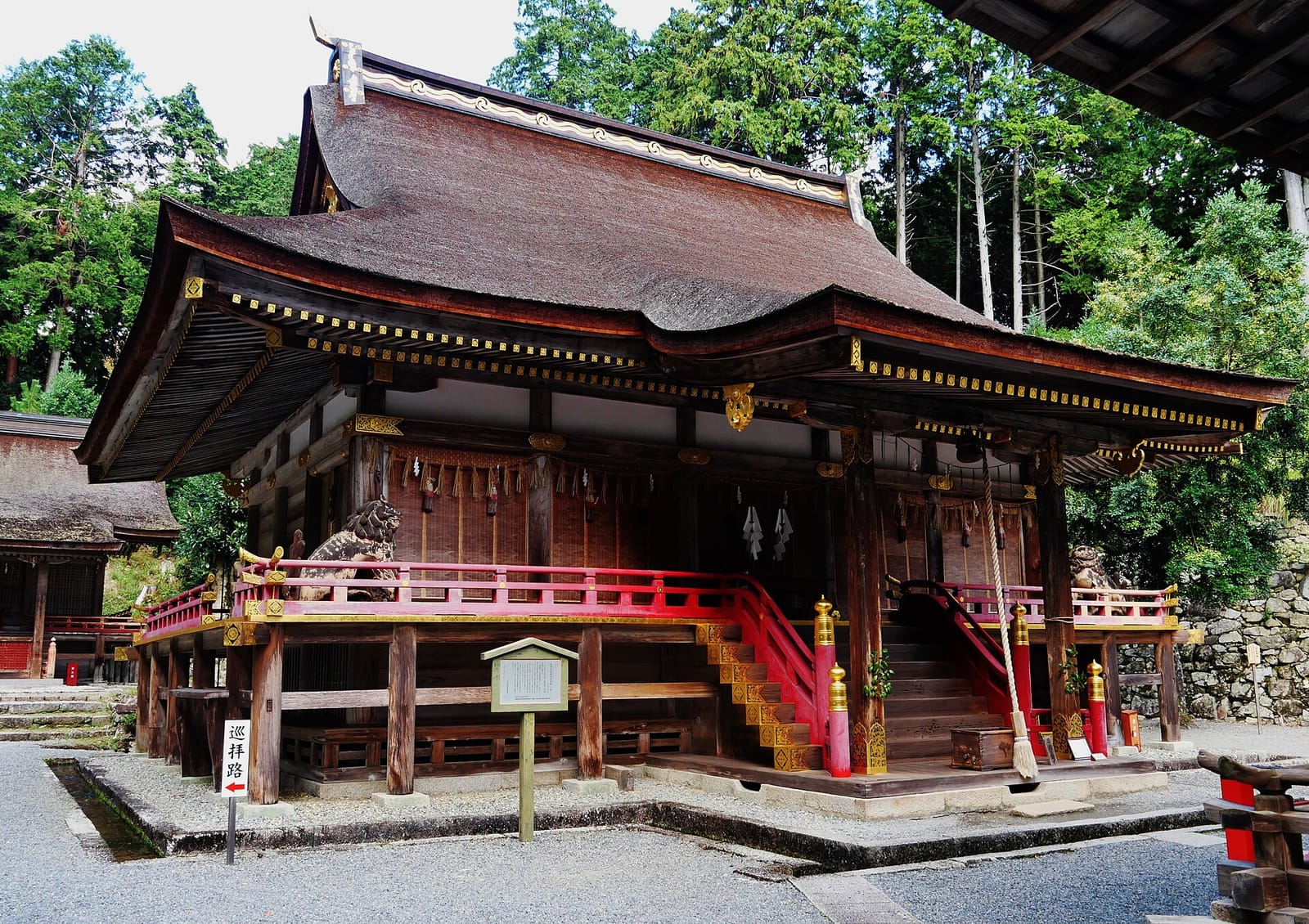
Hiyoshi Taisha
Photo: Zairon / CC BY 4.0 · Original · Resized and croppedMomoyama period · Shrines · National Treasures
Hiyoshi Taisha
日吉大社 (ひよしたいしゃ)
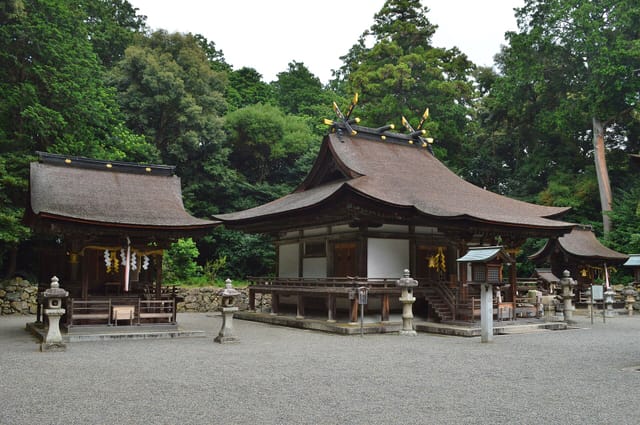
At Hiyoshi Taisha you can see the main sanctuaries of the Nishi Hongu and Higashi Hongu, built in the Hiyoshi-zukuri style found only at this shrine. The grounds at the foot of Mt. Hiei, with about 40 shrines, are a well-known spot for autumn leaves.
Key facts
- Designation
- National Treasures
- Era
- Momoyama period
- Type
- Shrines
- Location
- Otsu, Shiga
- Address
- 滋賀県大津市坂本本町
Before you go
- Opening hours
- Visiting hours are 9:00 to 16:00. The gates of the West and East Main Shrines are open 6:00 to 16:00 from April to September and 7:00 to 16:00 from October to March.
- Closed
- Check the official site
- Admission (adults)
- The entry contribution is ¥500 for adults.
- Time needed
- Check the official site
- Getting there
- About 10 minutes on foot from Sakamoto-hieizanguchi Station on the Keihan Ishiyama-Sakamoto Line, or 20 minutes from Hieizan-Sakamoto Station on the JR Kosei Line (about 20 minutes from Kyoto Station). The shrine car park holds up to 50 cars and costs ¥1,000 in November. At New Year, during the Sanno Festival and in the autumn foliage season, Otsu City's park-and-ride is recommended.
- Best time to visit
- The shrine is a well-known autumn foliage spot, with a maple festival and illuminations. The entrance area gets congested in November.
Checked against official information on November 12, 2026. Fees and hours can change, so please also check the official site before you go.
Sources for visitor information
Key facts
- Designation
- National Treasures
- Era
- Momoyama period
- Type
- Shrines
- Location
- Otsu, Shiga
- Address
- 滋賀県大津市坂本本町
About this place
Hiyoshi Taisha is a shrine at the foot of Mt. Hiei in Sakamoto, Otsu, Shiga Prefecture, and it is the head shrine of the more than 3,800 Hiyoshi, Hie and Sanno shrines across Japan. According to shrine tradition, it was founded about 2,100 years ago, in the 7th year of Emperor Sujin's reign. When the capital moved to Heian-kyo, the shrine lay to its northeast, the "demon gate" direction, so it was revered as a shrine for warding off evil and disaster for the capital; after Dengyo Daishi (Saicho) founded Enryaku-ji on Mt. Hiei, it was also worshipped as a guardian deity of the Tendai school.
There are about 40 shrines on the grounds, and all their deities are collectively called "Hiyoshi Okami." At the center are the seven Sanno shrines, led by the Nishi Hongu (West Main Shrine), dedicated to Onamuchi no Kami, and the Higashi Hongu (East Main Shrine), dedicated to Oyamakui no Kami. According to the shrine, the name was once written with characters read "Hie," and from around the Heian period a character meaning "good fortune" also came into use. The grounds hold many cultural properties, including two National Treasures and 17 Important Cultural Properties.
The two National Treasures are the main sanctuaries of the Nishi Hongu and Higashi Hongu, both built in a style called Hiyoshi-zukuri. According to the shrine, Hiyoshi-zukuri is a unique style used only for the two main shrines and the Usa-gu. From the front it looks like a hip-and-gable roof, but because aisles are attached to the front and both sides of the inner sanctuary where the deity is enshrined, the back looks as though it has been cut off. Beneath the floor is a room called the gedono, where Buddhist images of the deities were kept until the separation of Shinto and Buddhism in the Meiji era.
The Nishi Hongu Main Sanctuary dates from 1586 according to the national cultural properties database. Otsu City's description says construction began in 1586 and that it was reworked in 1597. The Nishi Hongu Worship Hall dates from the same year, 1586, as the main sanctuary and is an Important Cultural Property. The two-story gate in front of it was built around 1586, and carvings of monkeys, the shrine's divine messengers, can be seen on the eaves at its four corners. The Higashi Hongu Main Sanctuary dates from 1595; according to Otsu City, its structure is almost the same as the Nishi Hongu sanctuary, except that the ground behind it is higher.
Allow about 40 minutes to walk around the grounds, or about 90 minutes in the autumn foliage season. There are about 3,000 maple trees on the grounds, and the shrine gives mid- to late November as the best time to see them. The Okumiya (inner shrine) on Mt. Hachioji is about 1 km from the trailhead, a steep mountain path that takes about 30 minutes each way on foot. During the Sanno Festival, the Uma no Shinji on April 12 brings portable shrines down the mountain by torchlight, and on April 14 seven portable shrines cross to Lake Biwa in the Mikoshi Togyo procession.
Buildings designated as National Treasures
Hiyoshi Taisha Nishi Hongu Main Sanctuary and Worship Hall
- Era
- Momoyama period
- Year
- 1586
- Structure
- five bays wide, three bays deep, Hiyoshi-zukuri style, cypress-bark roofing
- Designated
- April 27, 1961
Hiyoshi Taisha Higashi Hongu Main Sanctuary and Worship Hall
- Era
- Momoyama period
- Year
- 1595
- Structure
- five bays wide, three bays deep, Hiyoshi-zukuri style, cypress-bark roofing
- Designated
- April 27, 1961
Sources and date checked
Facts such as eras, structures and locations are edited and translated by us from the Agency for Cultural Affairs’ database of nationally designated cultural properties. The Agency and the national government did not produce this page.
Database of nationally designated cultural properties- Agency for Cultural Affairs, Database of National Cultural Properties: Hiyoshi Taisha Nishi Hongu Main Sanctuary and Worship Hall
- Agency for Cultural Affairs, Database of National Cultural Properties: Hiyoshi Taisha Higashi Hongu Main Sanctuary and Worship Hall
- Hiyoshi Taisha: About the shrine (Hiyoshi Taisha official)
- Hiyoshi Taisha: FAQ (Hiyoshi Taisha official)
- Hiyoshi Taisha: About the Sanno Festival (Hiyoshi Taisha official)
- Hiyoshi Taisha Nishi Hongu Main Sanctuary: multilingual description (Otsu City)
- Hiyoshi Taisha Nishi Hongu Worship Hall: multilingual description (Otsu City)
- Hiyoshi Taisha Nishi Hongu Two-Story Gate: multilingual description (Otsu City)
- Hiyoshi Taisha Higashi Hongu Main Sanctuary: multilingual description (Otsu City)
Checked on November 6, 2026
Report an error
If you notice a mistake, please tell us along with a source for the correct information.
Where to go next
Places you could see on the same day, and places worth comparing.
Nearby cultural heritage
Places within 10 km, nearest first. Distances are in a straight line.
More from Shiga
Discover more of the same region on our sister sites.
Matsuri Biyori
UNESCO-listed festivals in Shiga
- Nagahama Hikiyama Festival Float Event
- Otsu Festival Hikiyama Float Event
- Omi Konan no San'yare Odori
- Omi no Kenketo Matsuri Naginata Furi
Meiga no Furusato
Paintings linked to Shiga
- The Sixty-nine Stations of the Kisokaido: Kashiwabara
- The Sixty-nine Stations of the Kisokaido: Samegai
- The Sixty-nine Stations of the Kisokaido: Banba
- The Sixty-nine Stations of the Kisokaido: Toriimoto
Sake Tabi
Breweries and distilleries in Shiga
- Fujii Honke Sake Brewery Tour
- Nagahama Distillery (Nagahama Roman Beer)
- Nagahama Roman Beer
- Hikone Beer Kojinyama Brewery