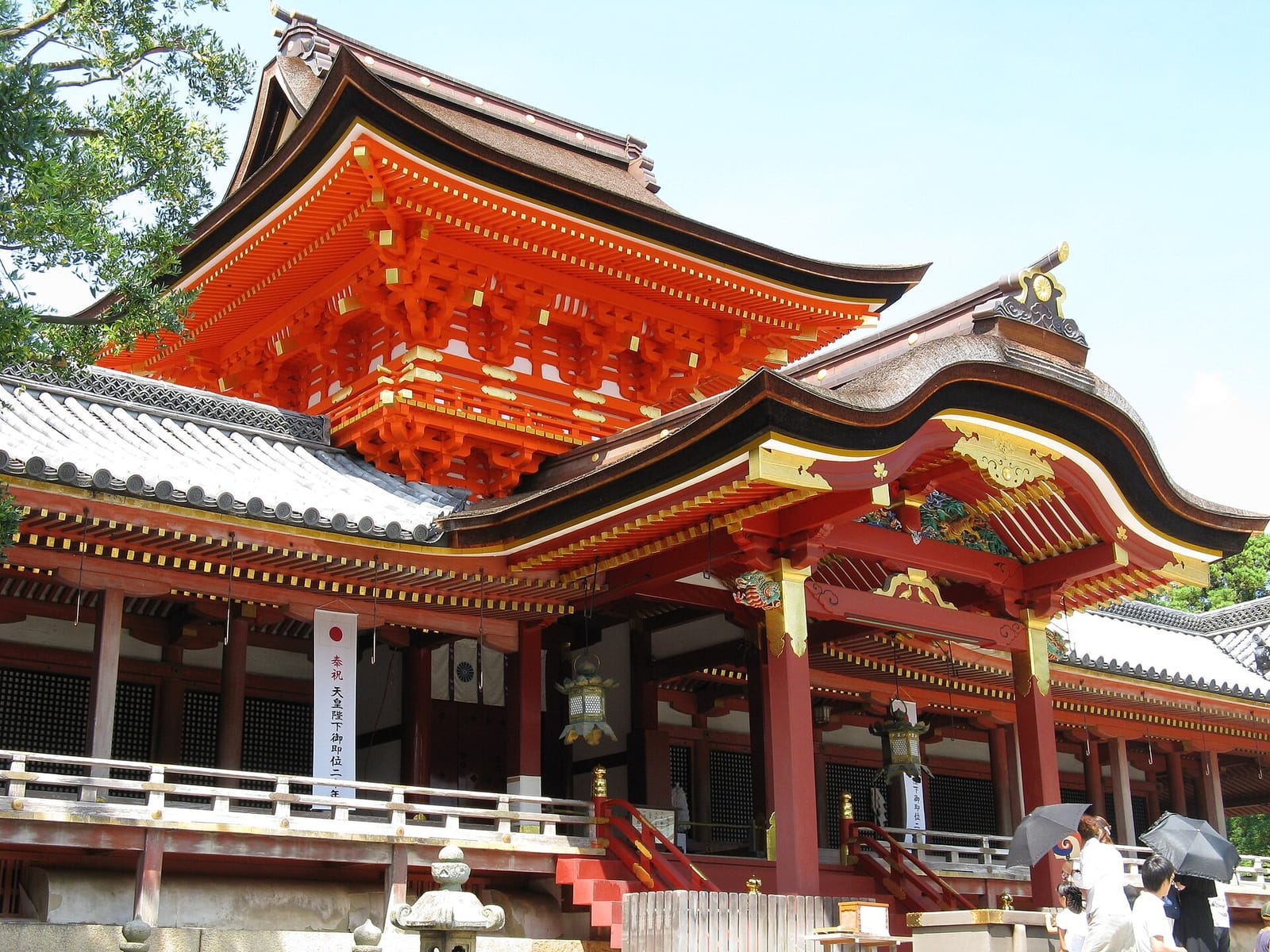
Iwashimizu Hachimangu
Photo: KENPEI / CC BY-SA 3.0 · Original · Resized and croppedEdo period · Shrines · National Treasures
Iwashimizu Hachimangu
石清水八幡宮 (いわしみずはちまんぐう)
A Hachiman shrine on top of Mount Otokoyama, where you can see ten National Treasure buildings, including the Hachiman-zukuri main sanctuary rebuilt under Tokugawa Iemitsu. Its richly colored carvings, the Nobunaga Wall and the approach path climbing from the foot of the hill are also worth seeing.
Key facts
- Designation
- National Treasures
- Era
- Edo period
- Type
- Shrines
- Location
- Yawata, Kyoto
- Address
- 京都府八幡市八幡高坊
Before you go
- Opening hours
- Check the official site
- Closed
- Check the official site
- Admission (adults)
- Check the official site
- Time needed
- Check the official site
- Getting there
- Get off at Iwashimizu-hachimangu Station on the Keihan Main Line, ride the cable car to Hachimangu-sanjo and walk 5 minutes. From Kyoto Station, change to the Keihan line at Tambabashi (Kintetsu) or Tofukuji (JR). A car park by the first torii at the foot of the hill charges up to ¥500 per car from 9:00 to 16:00 (about 60 spaces), with different rates at New Year and in cherry blossom season.
- Good to know
- The main sanctuary stands on top of Mount Otokoyama; without the cable car you climb on foot from the foot of the hill. Traffic restrictions apply over the first three days of the New Year, and the car park may be unavailable on festival days.
Checked against official information on November 12, 2026. Fees and hours can change, so please also check the official site before you go.
Sources for visitor information
Key facts
- Designation
- National Treasures
- Era
- Edo period
- Type
- Shrines
- Location
- Yawata, Kyoto
- Address
- 京都府八幡市八幡高坊
About this place
Iwashimizu Hachimangu is a Shinto shrine on top of Mount Otokoyama in Yawata, Kyoto Prefecture, affectionately known as "Yawata no Hachiman-san." Otokoyama faces the point where the Kizu, Uji and Katsura rivers join to form the Yodo River, and it was a key point on the route between Kyoto and Naniwa (Osaka). According to the shrine, it began in 859, early in the Heian period, when Gyokyo, a monk of Daian-ji in Nara, received an oracle from the deity Hachiman at Usa Hachimangu and enshrined the deity on the peak of Otokoyama.
The shrine honors Emperor Ojin in the central sanctuary, Hime-okami in the west and Empress Jingu in the east. According to the shrine, after the court prayed here for the suppression of the rebellions of Taira no Masakado and Fujiwara no Sumitomo, imperial reverence grew even deeper; emperors and retired emperors visited more than 240 times, and the shrine was ranked with the Grand Shrine of Ise as one of the two ancestral shrines of the imperial house. The Minamoto clan revered Hachiman as its guardian deity, and Minamoto no Yoshiie is well known for coming of age here and calling himself "Hachiman Taro." Renamed Otokoyama Hachimangu in the early Meiji era, the shrine took back the name Iwashimizu Hachimangu in 1918 (Taisho 7).
The present buildings were rebuilt under Tokugawa Iemitsu, the third shogun, and completed in 1634. In 2016, ten buildings, namely the Main Sanctuary, the Heiden and Maiden, the Romon Gate, the East Gate, the West Gate, three corridors, the Takenouchi Sessha Main Sanctuary and the Mizugaki Fence, were designated National Treasures together with three ridge tags. The Main Sanctuary is in the Hachiman-zukuri style: a long building that joins an inner hall and an outer hall, each eleven bays wide, one behind the other. Both the shrine and the national database describe it as the oldest and largest surviving main sanctuary of this style. It is roofed with cypress bark, and the front of the outer hall has three projecting porches.
In front of the Main Sanctuary stand the Heiden and Maiden, and the Romon Gate at the front has a hip-and-gable roof with a worship space under a cusped karahafu gable before it. The Mizugaki Fence and the corridors enclose these buildings on all sides; the rear corridor is twenty-eight bays long and includes a sacred storehouse. Highlights named by the shrine include the richly colored transom carvings of the Mizugaki Fence, the "Menuki no Saru" monkey carving, which one theory attributes to Hidari Jingoro, and the shrine's crest of three swirling commas, seen on the sanctuary's carvings and eave tiles. A golden rain gutter donated by Oda Nobunaga in 1580 also survives but is normally not shown to the public. The earthen wall around the buildings is also called the "Nobunaga Wall."
Besides the cable car, you can walk up to the sanctuary in about 20 minutes by the front or back approach path, starting beside Kora Shrine at the foot of the hill. The classic Tsurezuregusa tells of a monk from Ninna-ji who worshipped only at Gokuraku-ji and Kora Shrine at the foot and went home without climbing to the top, and the shrine itself introduces this story. The grounds also hold the site of the Shokado hermitage and the Edison Monument, built because Edison used Yawata bamboo for light bulb filaments. The Iwashimizu Festival on September 15 each year, one of the three great imperial festivals, sees the deities carried in phoenix-topped palanquins down to the Tongu hall at the foot of the hill in the middle of the night, with a procession of about 500 people.
Buildings designated as National Treasures
Iwashimizu Hachimangu Honsha (Main Sanctuary)
- Era
- Early Edo period
- Year
- 1634
- Structure
- main sanctuary, eleven bays wide, two bays deep, single-story, gable roof, cypress-bark roofing
- Designated
- February 9, 2016
Iwashimizu Hachimangu Honsha (Heiden and Maiden)
- Era
- Early Edo period
- Year
- 1634
- Structure
- offering hall (heiden), front one bays wide, rear three bays, one bays deep, single-story, gable roof, cypress-bark roofing
- Designated
- February 9, 2016
Iwashimizu Hachimangu Honsha (Romon Gate)
- Era
- Early Edo period
- Year
- 1634
- Structure
- two-story tower gate, one bay with one doorway, hip-and-gable roof, worship area at the front, two bays wide, one bays deep, single-story, mukai-karahafu (projecting curved gable) style, cypress-bark roofing
- Designated
- February 9, 2016
Iwashimizu Hachimangu Honsha (East Gate)
- Era
- Early Edo period
- Year
- 1634
- Structure
- gate, one bay with one doorway, two bays deep, gable roof, lean-to pent roof on the east side, hongawara tile roofing
- Designated
- February 9, 2016
Iwashimizu Hachimangu Honsha (West Gate)
- Era
- Early Edo period
- Year
- 1634
- Structure
- gate, one bay with one doorway, two bays deep, gable roof, lean-to pent roof on the west side, hongawara tile roofing
- Designated
- February 9, 2016
Iwashimizu Hachimangu Honsha (Corridor between the Romon and East Gate)
- Era
- Early Edo period
- Year
- 1634
- Structure
- thirteen bays wide, two bays deep, pent roof (hisashi) one bay wide along the outer side, single-story, hip-and-gable roof, hongawara tile roofing
- Designated
- February 9, 2016
Iwashimizu Hachimangu Honsha (Corridor between the Romon and West Gate)
- Era
- Early Edo period
- Year
- 1634
- Structure
- thirteen bays wide, two bays deep, pent roof (hisashi) one bay wide along the outer side, single-story, hip-and-gable roof, hongawara tile roofing
- Designated
- February 9, 2016
Iwashimizu Hachimangu Honsha (Rear Corridor)
- Era
- Early Edo period
- Year
- 1634
- Structure
- twenty-eight bays wide, two bays deep, pent roof (hisashi) one bay wide along the outer side, single-story, hip-and-gable roof, hongawara tile roofing, treasury (shinko), three bays wide, three bays deep, raised roof (taka-yane), hip-and-gable roof, hongawara tile roofing
- Designated
- February 9, 2016
Iwashimizu Hachimangu Honsha (Takenouchi Sessha Main Sanctuary)
- Era
- Early Edo period
- Year
- 1634
- Structure
- one-bay shrine, gable roof, cypress-bark roofing
- Designated
- February 9, 2016
Iwashimizu Hachimangu Honsha (Mizugaki Fence)
- Era
- Early Edo period
- Year
- 1634
- Structure
- forty-seven bays around the perimeter, copper-sheet roofing, with two gates and an aka-dana (offering shelf)
- Designated
- February 9, 2016
Sources and date checked
Facts such as eras, structures and locations are edited and translated by us from the Agency for Cultural Affairs’ database of nationally designated cultural properties. The Agency and the national government did not produce this page.
Database of nationally designated cultural properties- Agency for Cultural Affairs, Database of National Cultural Properties: Iwashimizu Hachimangu Honsha (Main Sanctuary)
- Agency for Cultural Affairs, Database of National Cultural Properties: Iwashimizu Hachimangu Honsha (Heiden and Maiden)
- Agency for Cultural Affairs, Database of National Cultural Properties: Iwashimizu Hachimangu Honsha (Romon Gate)
- Agency for Cultural Affairs, Database of National Cultural Properties: Iwashimizu Hachimangu Honsha (East Gate)
- Agency for Cultural Affairs, Database of National Cultural Properties: Iwashimizu Hachimangu Honsha (West Gate)
- Agency for Cultural Affairs, Database of National Cultural Properties: Iwashimizu Hachimangu Honsha (Corridor between the Romon and East Gate)
- Agency for Cultural Affairs, Database of National Cultural Properties: Iwashimizu Hachimangu Honsha (Corridor between the Romon and West Gate)
- Agency for Cultural Affairs, Database of National Cultural Properties: Iwashimizu Hachimangu Honsha (Rear Corridor)
- Agency for Cultural Affairs, Database of National Cultural Properties: Iwashimizu Hachimangu Honsha (Takenouchi Sessha Main Sanctuary)
- Agency for Cultural Affairs, Database of National Cultural Properties: Iwashimizu Hachimangu Honsha (Mizugaki Fence)
- About Iwashimizu Hachimangu (Iwashimizu Hachimangu official site)
- Cultural Properties of the Shrine (Iwashimizu Hachimangu official site)
- Stories of Iwashimizu Hachimangu (Iwashimizu Hachimangu official site)
- Iwashimizu Festival, an Imperial Festival (Iwashimizu Hachimangu official site)
- Access (Iwashimizu Hachimangu official site)
Checked on November 6, 2026
Report an error
If you notice a mistake, please tell us along with a source for the correct information.
Where to go next
Places you could see on the same day, and places worth comparing.
Nearby cultural heritage
Places within 10 km, nearest first. Distances are in a straight line.
More from Kyoto
Discover more of the same region on our sister sites.
Matsuri Biyori
UNESCO-listed festivals in Kyoto
- Yamahoko, the float ceremony of the Kyoto Gion festival
- Kyoto no Rokusai Nenbutsu
- Yasuraibana
- Kuta no Hanagasa Odori
Meiga no Furusato
Paintings linked to Kyoto
- View of Amanohashidate
- Viewing Maple Leaves
- Scenes in and around Kyoto (Funaki Version)
- Morning View of Uji River