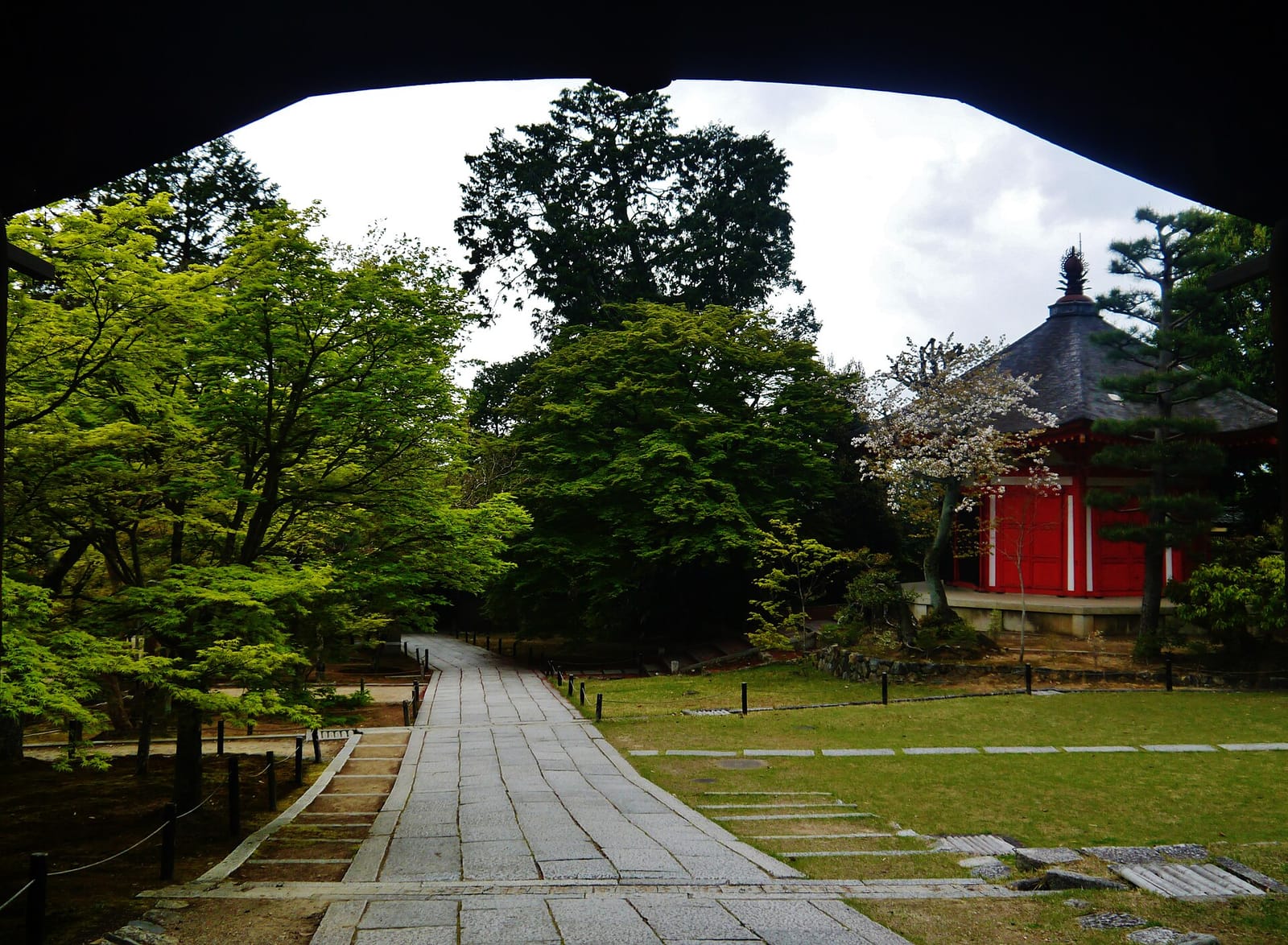
Tofuku-ji
Photo: Zairon / CC BY-SA 4.0 · Original · Resized and croppedMuromachi period · Temples · National Treasures
Tofuku-ji
東福寺 (とうふくじ)
At Tofuku-ji you can see the National Treasure Sanmon Gate, described as the oldest and largest surviving Zen temple gate, along with the statues and ceiling paintings on its upper floor. You can also visit the medieval Zendo and Tosu, Shigemori Mirei's Hojo gardens and Tsutenkyo bridge, famous for autumn colors.
Key facts
- Designation
- National Treasures
- Era
- Muromachi period
- Type
- Temples
- Location
- Kyoto, Kyoto
- Address
- 京都府京都市東山区本町十五丁目
Before you go
- Opening hours
- Admission is 9:00 to 16:00 from April 1 to December 6 and 9:00 to 15:30 from December 7 to March 31. From November 14 to December 6, Tsutenkyo bridge opens at 8:30.
- Closed
- Check the official site
- Admission (adults)
- The Hojo garden is ¥600 for adults, Tsutenkyo bridge and Kaisando hall ¥600, or ¥1,000 for both. In autumn (November 14 to December 6) Tsutenkyo and Kaisando cost ¥1,000 and there is no combined ticket.
- Time needed
- Check the official site
- Getting there
- About 10 minutes on foot from Tofukuji Station on the JR Nara Line and Keihan Main Line. From Kyoto Station, city bus 88 or 208 reaches the Tofukuji stop in about 15 minutes, then it is a 4-minute walk. Parking on the grounds and to the north is free for visitors but closed during the autumn foliage season (October 25 to December 10).
- Best time to visit
- The autumn colors of the ravine below Tsutenkyo bridge are famous, and the autumn special viewing period (November 14 to December 6 in 2026) is extremely crowded.
- Good to know
- Eating, drinking and tripods are not allowed in the grounds. Re-entry is not permitted, and in autumn you may be asked not to take photos on Tsutenkyo and Gaunkyo bridges.
Checked against official information on November 12, 2026. Fees and hours can change, so please also check the official site before you go.
Sources for visitor information
Key facts
- Designation
- National Treasures
- Era
- Muromachi period
- Type
- Temples
- Location
- Kyoto, Kyoto
- Address
- 京都府京都市東山区本町十五丁目
About this place
Tofuku-ji, in Higashiyama Ward, Kyoto, is a head temple of the Rinzai school of Zen and was ranked among the Five Mountains of Kyoto. According to the temple's history, the regent Kujo Michiie built it as a great temple to rival Todai-ji and Kofuku-ji in Nara, taking the characters "To" and "Fuku" from their names, and it took 19 years to complete, from 1236 to 1255. Shoichi Kokushi (Enni), who had gone to Song China and received the Zen lineage there, was invited as its founding priest. Fires struck repeatedly in the Middle Ages, but after rebuilding it kept its buildings as the largest Zen temple in Kyoto, untouched by war, until the Meiji era.
The National Treasure Sanmon Gate was rebuilt in the Muromachi period to replace a gate lost to fire, and the temple attributes the rebuilding to Ashikaga Yoshimochi, the fourth Muromachi shogun. The temple's Sanmon guide gives its completion as 1425, while the national cultural properties database gives 1405. It is a two-story, double-roofed gate five bays wide with three doorways, with a hip-and-gable roof of hongawara tiles and gabled stair galleries (sanro) on both sides. It stands over 22 meters high, and the temple describes it as the oldest and largest surviving Zen temple gate. In 1952 it became the first temple gate of its kind to be designated a National Treasure.
The gate is built in a manner reminiscent of the Daibutsu-yo (Tenjiku-yo) style, and the plaque on the upper story reading "Myounkaku" was written by Ashikaga Yoshimochi. On the upper floor stand a crowned seated Shaka Nyorai and statues of the Sixteen Arhats, both said to date from the early Muromachi period. The ceiling and pillars were painted in rich colors by the painter-monk Mincho and his pupils, and on the ceiling you can see two celestial maidens flying toward the center and the karyobinga and gumyocho, birds with human upper bodies. A full dismantling and repair began in 1969 and took 8 years and 9 months, finishing in 1978. In some years the upper floor is opened to the public during the autumn special viewing.
Other medieval Zen buildings survive in the precinct besides the Sanmon, and the Zendo meditation hall rebuilt in 1347, the Tosu latrine regarded as a relic of the early Muromachi period, and the bathhouse with a roof tile inscribed 1459 are Important Cultural Properties. The Buddha Hall, Dharma Hall, Hojo (abbot's quarters) and kitchen-residence were lost in a fire in 1881, and the Hojo was rebuilt in 1890 and the Hondo, which serves as both Buddha Hall and Dharma Hall, in 1934. The gardens on all four sides of the Hojo were made by Shigemori Mirei in 1939, composed with motifs such as the Big Dipper and checkerboard patterns, and have been called the "Garden of the Eight Aspects." They became a national Place of Scenic Beauty in 2014.
Tsutenkyo is a covered bridge crossing the Sengyokukan ravine from the Hondo to the Kaisando, said to have been built in 1380 by Shun'oku Myoha. Maples spread out below it, making it famous for fresh green and autumn colors, and the three-lobed maples that turn golden are said to be a Chinese maple brought from Song China by Shoichi Kokushi. The Hojo garden and Tsutenkyo-Kaisando require separate tickets, and re-entry is not allowed. The autumn special viewing period is extremely crowded, and visitors may be asked not to take photos on Tsutenkyo or Gaunkyo bridge. Visitors are also asked not to eat or drink in the precinct or use tripods.
Buildings designated as National Treasures
Tofuku-ji Sanmon Gate
- Era
- Mid-Muromachi period
- Year
- 1405
- Structure
- two-story double-roofed gate, five bays with three doorways, hip-and-gable roof, hongawara tile roofing, with stair galleries (sanro) on both sides, each with a gable roof, hongawara tile roofing
- Designated
- March 29, 1952
Sources and date checked
Facts such as eras, structures and locations are edited and translated by us from the Agency for Cultural Affairs’ database of nationally designated cultural properties. The Agency and the national government did not produce this page.
Database of nationally designated cultural properties- Agency for Cultural Affairs, Database of National Cultural Properties: Tofuku-ji Sanmon Gate
- Tofuku-ji History (Tofuku-ji official site)
- National Treasure Tofuku-ji Sanmon Gate Guide (Tofuku-ji official site)
- Special Opening of the National Treasure Sanmon Gate (Tofuku-ji official site)
- Tofuku-ji Visitor Guide (Tofuku-ji official site)
- Tofuku-ji Honbo Garden (Hojo) (Tofuku-ji official site)
- Tofuku-ji Tsutenkyo Bridge (Tofuku-ji official site)
Checked on November 6, 2026
Report an error
If you notice a mistake, please tell us along with a source for the correct information.
Where to go next
Places you could see on the same day, and places worth comparing.
Nearby cultural heritage
Places within 10 km, nearest first. Distances are in a straight line.
More from Kyoto
Discover more of the same region on our sister sites.
Matsuri Biyori
UNESCO-listed festivals in Kyoto
- Yamahoko, the float ceremony of the Kyoto Gion festival
- Kyoto no Rokusai Nenbutsu
- Yasuraibana
- Kuta no Hanagasa Odori
Meiga no Furusato
Paintings linked to Kyoto
- View of Amanohashidate
- Viewing Maple Leaves
- Scenes in and around Kyoto (Funaki Version)
- Morning View of Uji River