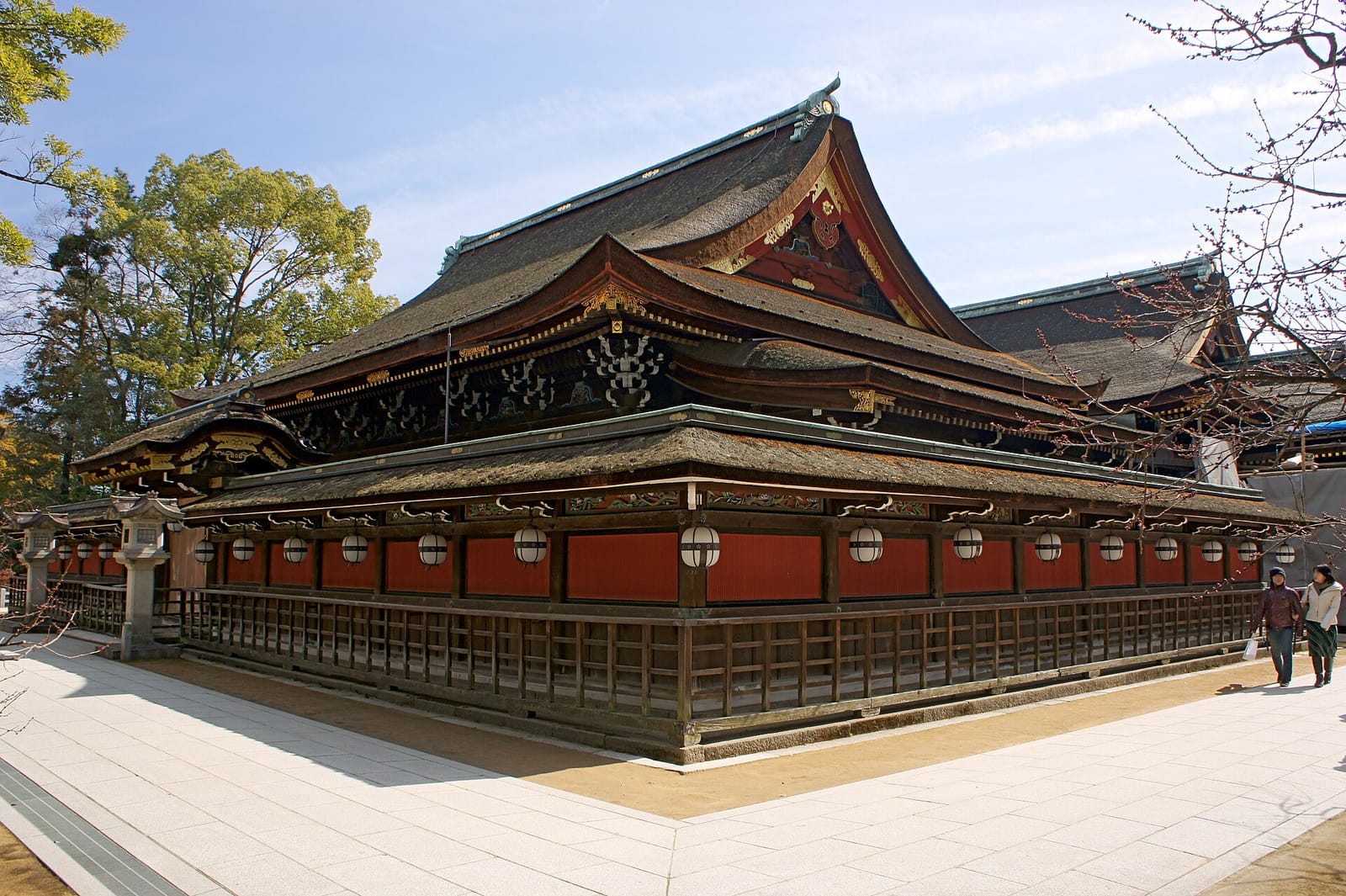
Kitano Tenmangu
Photo: 663highland / CC BY 2.5 · Original · Resized and croppedMomoyama period · Shrines · National Treasures
Kitano Tenmangu
北野天満宮 (きたのてんまんぐう)
The head shrine of all the Tenmangu and Tenjin shrines that honor Sugawara no Michizane. Its National Treasure sanctuary, built by Toyotomi Hideyori in 1607, is a Momoyama building linking the main sanctuary and worship hall through the Ishi-no-ma, and the grounds open seasonal plum and maple gardens.
Key facts
- Designation
- National Treasures
- Era
- Momoyama period
- Type
- Shrines
- Location
- Kyoto, Kyoto
- Address
- 京都府京都市上京区馬喰町
Before you go
- Opening hours
- 7:00 to 17:00. The Sanko-mon gate in front of the National Treasure main hall closes 30 minutes earlier. The shrine stays open in the evening during the autumn maple illuminations and at New Year.
- Closed
- Check the official site
- Admission (adults)
- The shrine grounds are free to visit.
- Time needed
- Check the official site
- Getting there
- From Kyoto Station, take city bus 50 to Kitano Tenmangu-mae (about 35 min). Kitano-Hakubaicho Station on the Randen tram is a 5-minute walk away. There is a car park for worshippers, but it is closed on the 25th of each month, the shrine's market day.
Checked against official information on November 12, 2026. Fees and hours can change, so please also check the official site before you go.
Sources for visitor information
Key facts
- Designation
- National Treasures
- Era
- Momoyama period
- Type
- Shrines
- Location
- Kyoto, Kyoto
- Address
- 京都府京都市上京区馬喰町
About this place
Kitano Tenmangu enshrines Sugawara no Michizane and is the head shrine of the roughly 12,000 Tenmangu and Tenjin shrines across Japan. It began in 947, when, following a divine oracle, Michizane was enshrined at Kitano, northwest of the Heian capital. In 987 Emperor Ichijo granted him the divine title Kitano Tenman Daijizai Tenjin, and the imperial family has honored the shrine ever since. Today people come to pray for success in study and exams, for the arts, and for protection from misfortune.
Michizane was a scholar who rose to high office, becoming Minister of the Right in 899. In 901 he was demoted and sent to Dazaifu in Kyushu, where he died two years later. In the Edo period, images of Michizane hung in the small village schools known as terakoya, and his worship as a god of learning spread. During the Tensho era Toyotomi Hideyoshi held the Great Kitano Tea Ceremony in the pine grove around the shrine, and Kitano has long been a stage for culture.
The National Treasure sanctuary was built in 1607 by Toyotomi Hideyori, carrying out Hideyoshi's last wishes. The main sanctuary, where Michizane is enshrined, is linked to the worship hall by a stone-paved passage called the Ishi-no-ma. A side hall stands to the west of the sanctuary, and music rooms called Gaku-no-ma flank the worship hall. The style is called yatsumune-zukuri or gongen-zukuri, and the cypress-bark roofs cover about 500 tsubo in all. According to the shrine, it is the only shrine building among the many surviving Momoyama structures kept at its original scale, and it became the prototype of the later gongen style. The sanctuary, Ishi-no-ma, worship hall and Gaku-no-ma are designated together as a single National Treasure building.
The buildings are adorned with curved karahafu gables, gleaming golden fittings and fine carvings. Visitors normally pray in front of the worship hall. Those receiving a formal prayer service go up into the worship hall. The middle gate between the tower gate and the sanctuary is the Sanko Gate, an Important Cultural Property bearing a plaque reading Tenmangu written by Emperor Gosai. Its name, meaning three lights, comes from carvings of the sun, the moon and the stars, but the stars are said to be missing, one of the shrine's seven wonders.
In honor of Michizane's love of plum blossoms, about 1,500 plum trees of 50 varieties grow on the grounds. The earliest bloom after New Year, and the season lasts until about the end of March. The Tobiume plum in front of the sanctuary is the only plum allowed to be planted before the deity. The plum garden, Hana no Niwa, usually opens from early February to late March, and the Baikasai plum festival is held on February 25. In autumn, from late October to early December, the shrine opens its maple garden on the west side of the grounds, where part of the Odoi earthen rampart built by Hideyoshi survives, with about 350 maples and a lookout over the sanctuary. The 25th of every month is a fair day associated with Michizane.
Buildings designated as National Treasures
Kitano Tenmangu (Main Sanctuary, Ishi-no-ma, Worship Hall and Gaku-no-ma)
- Era
- Momoyama period
- Year
- 1607
- Structure
- main sanctuary, five bays wide, four bays deep, single-story, hip-and-gable roof, right side three bays with a pent roof (hisashi), cypress-bark roofing
- Designated
- June 27, 1959
Sources and date checked
Facts such as eras, structures and locations are edited and translated by us from the Agency for Cultural Affairs’ database of nationally designated cultural properties. The Agency and the national government did not produce this page.
Database of nationally designated cultural properties- Agency for Cultural Affairs, Database of National Cultural Properties: Kitano Tenmangu (Main Sanctuary, Ishi-no-ma, Worship Hall and Gaku-no-ma)
- About Kitano Tenmangu (Kitano Tenmangu official site)
- National Treasure Main Sanctuary and Sanko Gate (Kitano Tenmangu official site)
- Plum garden, Hana no Niwa (Kitano Tenmangu official site)
- Maple garden on the Odoi earthworks (Kitano Tenmangu official site)
Checked on November 6, 2026
Report an error
If you notice a mistake, please tell us along with a source for the correct information.
Where to go next
Places you could see on the same day, and places worth comparing.
Nearby cultural heritage
Places within 10 km, nearest first. Distances are in a straight line.
More from Kyoto
Discover more of the same region on our sister sites.
Matsuri Biyori
UNESCO-listed festivals in Kyoto
- Yamahoko, the float ceremony of the Kyoto Gion festival
- Kyoto no Rokusai Nenbutsu
- Yasuraibana
- Kuta no Hanagasa Odori
Meiga no Furusato
Paintings linked to Kyoto
- View of Amanohashidate
- Viewing Maple Leaves
- Scenes in and around Kyoto (Funaki Version)
- Morning View of Uji River