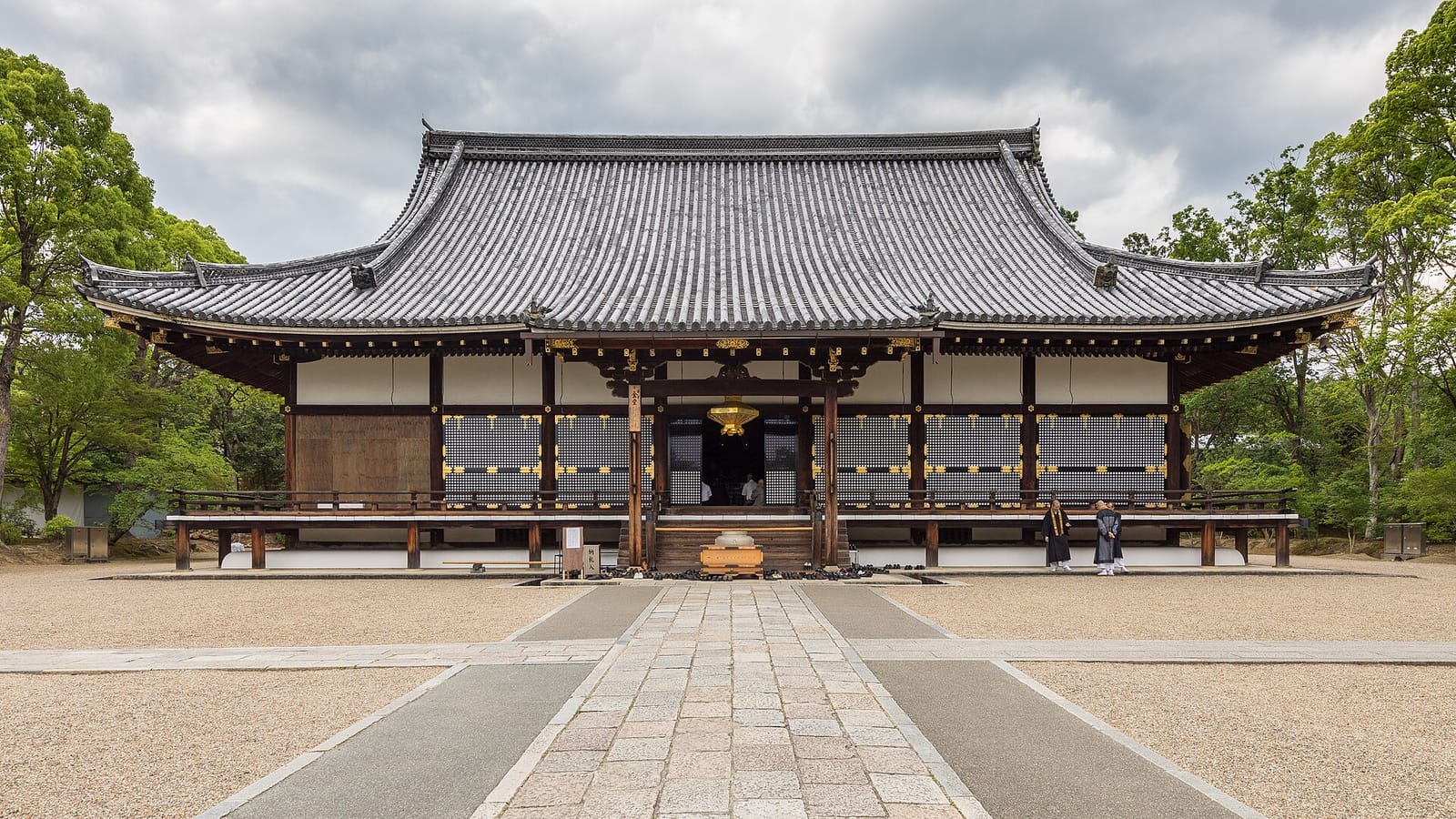
Ninna-ji
Photo: Basile Morin / CC BY-SA 4.0 · Original · Resized and croppedMomoyama period · Temples · National Treasures
Ninna-ji
仁和寺 (にんなじ)
The head temple of the Omuro school of Shingon Buddhism, completed by Emperor Uda in 888 and long headed by abbots from the imperial family. Its National Treasure Kondo is the Shishinden hall moved from the imperial palace, seen together with the Nio Gate, the five-story pagoda and the late-blooming Omuro cherry trees.
Key facts
- Designation
- National Treasures
- Era
- Momoyama period
- Type
- Temples
- Location
- Kyoto, Kyoto
- Address
- 京都府京都市右京区御室大内
Before you go
- Opening hours
- The palace garden is open 9:00 to 17:00 from March to November (last entry 16:30) and 9:00 to 16:30 from December to February.
- Closed
- Open every day, though some areas may occasionally be closed.
- Admission (adults)
- The palace garden is ¥800 for adults and the Reihokan treasure hall (open seasonally) ¥500. Free for high school students and younger.
- Time needed
- Check the official site
- Getting there
- About 3 minutes on foot from Omuro-Ninnaji Station on the Randen tram, or about 15 minutes from Hanazono Station on the JR Sagano Line. From Kyoto Station, the JR bus (Takao-Keihoku line) takes about 30 minutes and city bus 26 about 40 minutes. A 24-hour pay car park for 98 cars is on the east side.
- Best time to visit
- When the late-blooming Omuro cherries flower, the Omuro Flower Festival runs 8:30 to 17:30 (last entry 17:00) with a special admission of ¥800 for adults. Peak bloom varies widely from year to year.
- Good to know
- Photography is not allowed inside the treasure hall or the temple halls; tripods may be used outdoors only. Roads around the temple jam on cherry-blossom weekends, so public transport is strongly recommended.
Checked against official information on November 12, 2026. Fees and hours can change, so please also check the official site before you go.
Sources for visitor information
Key facts
- Designation
- National Treasures
- Era
- Momoyama period
- Type
- Temples
- Location
- Kyoto, Kyoto
- Address
- 京都府京都市右京区御室大内
About this place
Ninna-ji is the head temple of the Omuro school of Shingon Buddhism, located in the Omuro area of Ukyo Ward, Kyoto. According to the temple, in 886 Emperor Koko vowed to build a temple called Nishiyama Gogan-ji, but he died the following year. Emperor Uda carried on his wish and completed it in 888, naming it Ninna-ji after the era name. Uda gave up the throne in 897, later took Buddhist vows and became the first head of Ninna-ji, and members of the imperial family went on to serve as its abbots for generations. From the Heian to the Kamakura period it is said to have held the highest rank among temples headed by imperial abbots.
In the Onin War, which began in 1467, nearly the whole temple was destroyed by fire. The principal image, an Amida triad, and other treasures were moved to Shinko-in, one of its sub-temples, and kept safe. The chance to rebuild came in 1634, when Kakushin, the 21st head and an imperial prince, asked the third Tokugawa shogun, Iemitsu, to restore the temple and won his approval. This happened to coincide with the rebuilding of the imperial palace, so many palace buildings, including the Shishinden (now the Kondo) and the Seiryoden (now the Mieido), were granted to the temple, and the rebuilding of the temple halls was finished in 1646. In 1994 Ninna-ji was inscribed as a World Heritage Site as part of the Historic Monuments of Ancient Kyoto.
The National Treasure is one building, the Kondo (Golden Hall). It is the Shishinden hall of the imperial palace built in the Keicho era and moved here in the Kan'ei era (1624 to 1643), and the temple describes it as the oldest surviving Shishinden. National records date it to 1613 in the Momoyama period: a single-story hall seven bays wide and five bays deep, with a hip-and-gable roof of hongawara tiles, designated a National Treasure in 1953. Inside are the principal Amida triad along with statues of the Four Heavenly Kings and Bonten, and the walls are painted in rich colors with scenes of the Pure Land and images of Kannon.
The grounds begin at the Nio Gate, 18.7 meters tall, which faces the street. The temple notes that while the gates of Chion-in and Nanzen-ji from the same period were built in the Zen style, the Nio Gate keeps entirely to the Japanese style handed down from the Heian period. Past the Middle Gate, at the heart of the temple compound, stands the five-story pagoda, built in 1644 and 36.18 meters tall overall. West of the bell tower, the Mieido was built using part of the Seiryoden, and even the metal fittings of its lattice shutters came from that hall.
In spring, a grove of late-blooming, low-growing cherry trees known as the Omuro cherries flowers across the area west inside the Middle Gate. According to the temple, they are at their best in mid-April. In the palace area are the Shinden hall, completed in 1914, and the North Garden with a view of the pagoda, and the Reihokan, which displays and preserves the temple's treasures. Walking slowly from the Nio Gate to the palace buildings, with the Kondo at the center, makes clear how the temple was restored by taking over buildings from the imperial palace.
Buildings designated as National Treasures
Ninna-ji Kondo (Golden Hall)
- Era
- Momoyama period
- Year
- 1613
- Structure
- seven bays wide, five bays deep, single-story, hip-and-gable roof, one-bay front porch (kohai), hongawara tile roofing
- Designated
- November 14, 1953
Sources and date checked
Facts such as eras, structures and locations are edited and translated by us from the Agency for Cultural Affairs’ database of nationally designated cultural properties. The Agency and the national government did not produce this page.
Database of nationally designated cultural properties- Agency for Cultural Affairs, Database of National Cultural Properties: Ninna-ji Kondo (Golden Hall)
- About Ninna-ji (Ninna-ji official site)
- Ninna-ji: Guide to the Grounds (Ninna-ji official site)
- About the Omuro Cherry Trees (Ninna-ji official site)
Checked on November 6, 2026
Report an error
If you notice a mistake, please tell us along with a source for the correct information.
Where to go next
Places you could see on the same day, and places worth comparing.
Nearby cultural heritage
Places within 10 km, nearest first. Distances are in a straight line.
More from Kyoto
Discover more of the same region on our sister sites.
Matsuri Biyori
UNESCO-listed festivals in Kyoto
- Yamahoko, the float ceremony of the Kyoto Gion festival
- Kyoto no Rokusai Nenbutsu
- Yasuraibana
- Kuta no Hanagasa Odori
Meiga no Furusato
Paintings linked to Kyoto
- View of Amanohashidate
- Viewing Maple Leaves
- Scenes in and around Kyoto (Funaki Version)
- Morning View of Uji River