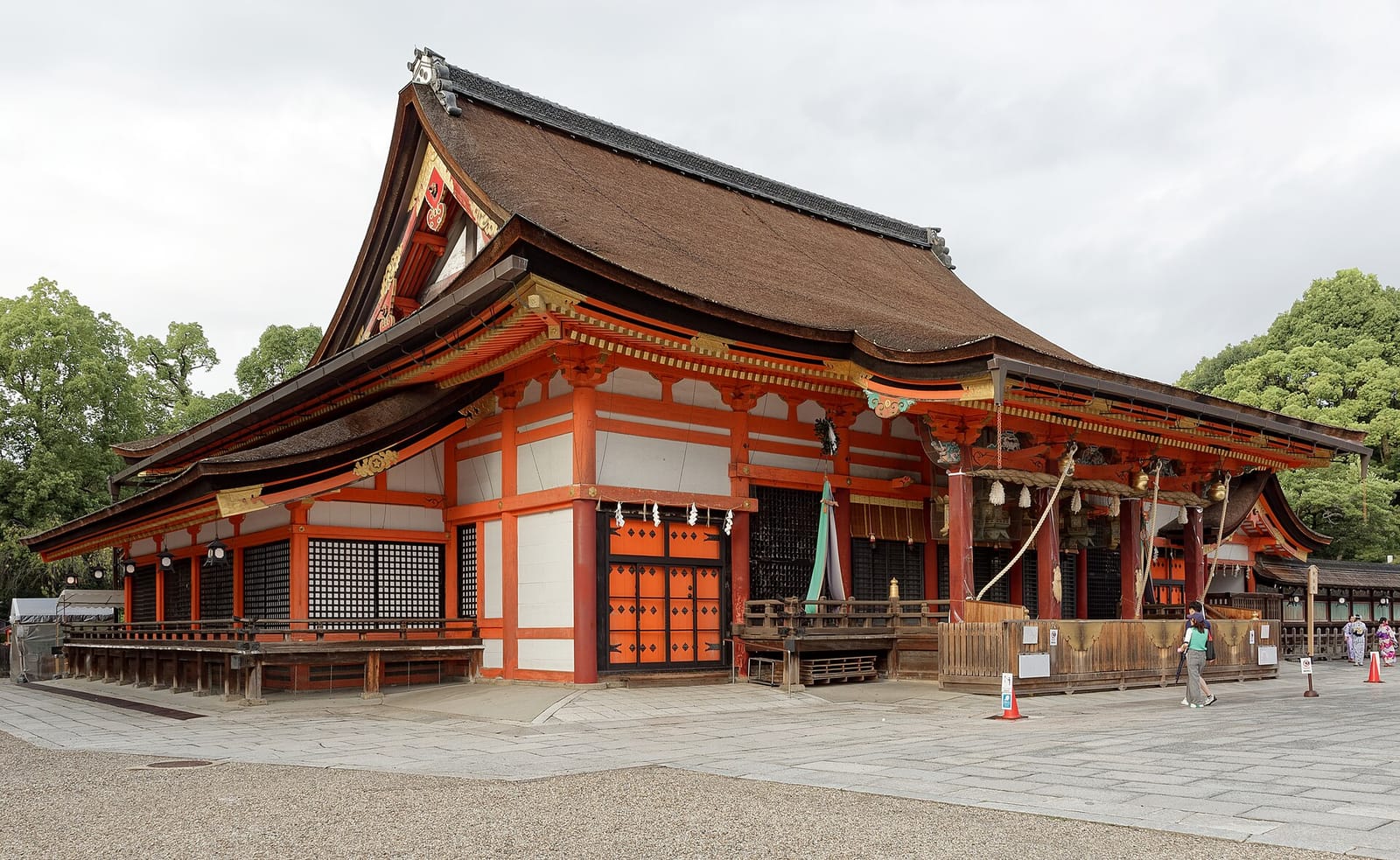
Yasaka Shrine
Photo: Jakub Hałun / CC BY 4.0 · Original · Resized and croppedEdo period · Shrines · National Treasures
Yasaka Shrine
八坂神社 (やさかじんじゃ)
A shrine at the east end of Shijo-dori, known for the Gion Festival. Its National Treasure Main Sanctuary was rebuilt by the Edo shogunate in 1654, and is distinctive for covering the sanctuary and worship hall with a single great roof.
Key facts
- Designation
- National Treasures
- Era
- Edo period
- Type
- Shrines
- Location
- Kyoto, Kyoto
- Address
- 京都府京都市東山区祇園町北側
Before you go
- Opening hours
- The shrine is open 24 hours a day. The shrine office is open 9:00 to 17:00.
- Closed
- Check the official site
- Admission (adults)
- Check the official site
- Time needed
- Check the official site
- Getting there
- About 5 minutes on foot from Gion-Shijo Station (Keihan) and about 8 minutes from Kyoto-Kawaramachi Station (Hankyu). From Kyoto Station, take city bus 100 or 206 to the Gion stop, right by the shrine. There is no car park on the grounds, so use one nearby.
- Good to know
- Drones are banned throughout the grounds. Visitors are asked to walk along the sides of the approach, as the center is reserved for the deity.
Checked against official information on November 12, 2026. Fees and hours can change, so please also check the official site before you go.
Sources for visitor information
Key facts
- Designation
- National Treasures
- Era
- Edo period
- Type
- Shrines
- Location
- Kyoto, Kyoto
- Address
- 京都府京都市東山区祇園町北側
About this place
Yasaka Shrine stands at the east end of Shijo-dori in Kyoto, and local people call it Gion-san. The name comes from the fact that until 1868 it was known as Gion-sha or Gion Kanshin-in. The enshrined deities are Susanoo-no-Mikoto, his consort Kushinadahime-no-Mikoto, and their children, the Yahashira-no-Miko-gami. The shrine passes down two accounts of its beginnings. In one, Irishi, who came from Goguryeo in 656, enshrined Susanoo here. In the other, Ennyo, a monk from Nara, built a hall on this site in 876.
The shrine is said to have grown in importance after prayers offered here during an epidemic in 877 brought the outbreak to an end. The Gion Festival, too, is a festival of Yasaka Shrine that began with prayers to drive away disease. It traces back to 869, when an epidemic spread and portable shrines were sent to the Shinsen-en garden, where 66 halberds, one for each province of the time, were raised in prayer. The festival runs from July 1 to 31, and its float procession is inscribed on UNESCO's list of Intangible Cultural Heritage.
The National Treasure is one building, the Main Sanctuary, rebuilt by the Edo shogunate in 1654 in the early Edo period. It is described as the last project the shogunate carried out directly for a shrine or temple, and it was designated a National Treasure on December 23, 2020. The sanctuary and the worship hall, which once stood apart, are covered by one great roof of cypress bark, with eaves extended around them and small rooms arranged beneath, a complex form also called Gion-zukuri. With a building area of 662.38 square meters and a height of 15.53 meters, it is the largest main sanctuary of any shrine. It is thought to have taken nearly its present form by 1148 at the latest.
When you look at the Main Sanctuary from outside, watch for the eaves that extend beneath the great roof on three sides, north, east and west. According to the shrine, this style is found only in the buildings of Yasaka Shrine, and the same feature appears in the smaller shrines on the grounds. Legend holds that beneath the sanctuary lies a dragon's den where the Blue Dragon guarding the east of the old capital lives, now sealed with plaster. Just inside the West Tower Gate, the pedestals of the guardian lion-dog statues are decorated with the Four Gods, and the Blue Dragon is shown on the lion's pedestal.
When the Main Sanctuary became a National Treasure, 26 buildings on and off the grounds were newly designated Important Cultural Properties, bringing the total, with 3 designated earlier, to one National Treasure and 29 Important Cultural Properties. You can compare buildings from different ages: the West Tower Gate of 1497, the Utsukushi-gozen-sha shrine of 1591, the Otabisho of 1837 and the portable-shrine storehouse of 1928. The West Tower Gate, facing Shijo-dori, is known as a symbol of Gion, and the shrine points visitors to the cherry blossoms of Maruyama Park in spring, the Gion Festival in summer, autumn leaves, and the Okera-mairi in winter.
Buildings designated as National Treasures
Yasaka Shrine Main Sanctuary
- Era
- Early Edo period
- Year
- 1654
- Structure
- seven bays wide, six bays deep, hip-and-gable roof, three-bay front porch (kohai), pent roofs on both sides and the rear, projecting three bays at the rear, cypress-bark roofing
- Designated
- December 23, 2020
Sources and date checked
Facts such as eras, structures and locations are edited and translated by us from the Agency for Cultural Affairs’ database of nationally designated cultural properties. The Agency and the national government did not produce this page.
Database of nationally designated cultural properties- Agency for Cultural Affairs, Database of National Cultural Properties: Yasaka Shrine Main Sanctuary
- History of Yasaka Shrine (Yasaka Shrine official site)
- Buildings of Yasaka Shrine (Yasaka Shrine official site)
- Shrines and Enshrined Deities (Yasaka Shrine official site)
Checked on November 6, 2026
Report an error
If you notice a mistake, please tell us along with a source for the correct information.
Where to go next
Places you could see on the same day, and places worth comparing.
Nearby cultural heritage
Places within 10 km, nearest first. Distances are in a straight line.
More from Kyoto
Discover more of the same region on our sister sites.
Matsuri Biyori
UNESCO-listed festivals in Kyoto
- Yamahoko, the float ceremony of the Kyoto Gion festival
- Kyoto no Rokusai Nenbutsu
- Yasuraibana
- Kuta no Hanagasa Odori
Meiga no Furusato
Paintings linked to Kyoto
- View of Amanohashidate
- Viewing Maple Leaves
- Scenes in and around Kyoto (Funaki Version)
- Morning View of Uji River