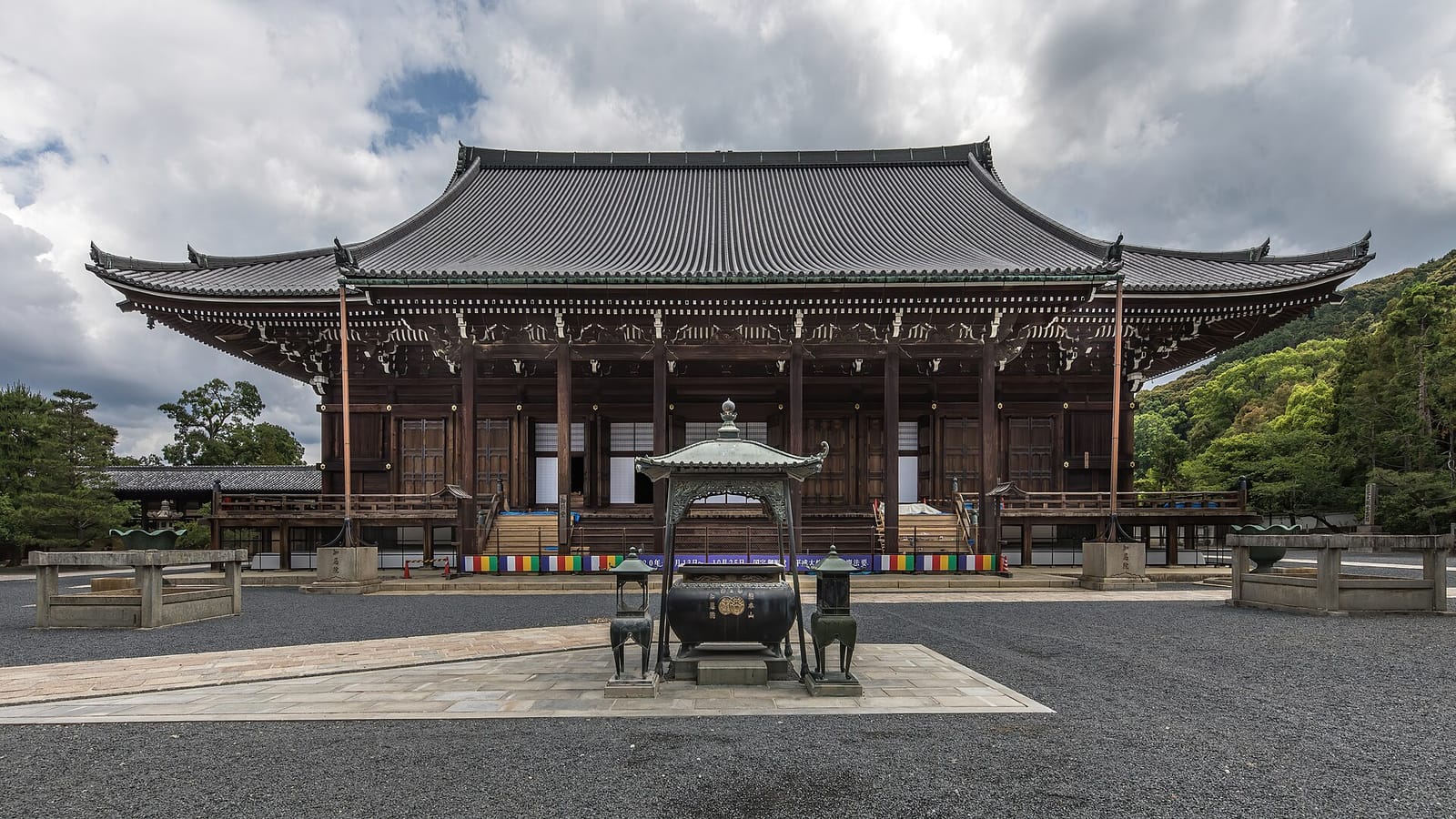
Chion-in
Photo: Basile Morin / CC BY-SA 4.0 · Original · Resized and croppedEdo period · Temples · National Treasures
Chion-in
知恩院 (ちおんいん)
The head temple of the Jodo school, standing where its founder Honen once lived and taught. Two great Early Edo buildings here are National Treasures: the Sanmon Gate, one of the largest wooden gates in Japan, and the Miedo Hall, which enshrines Honen's portrait statue.
Key facts
- Designation
- National Treasures
- Era
- Edo period
- Type
- Temples
- Location
- Kyoto, Kyoto
- Address
- 京都府京都市東山区新橋通大和大路東入三丁目林下町
Before you go
- Opening hours
- The gates are open 6:00 to 16:00, and the halls and gardens accept visitors from 9:00 (times differ on ceremony days).
- Closed
- Check the official site
- Admission (adults)
- The Yuzen-en garden is ¥300 for adults, the Hojo garden ¥400, or ¥500 for both.
- Time needed
- Check the official site
- Getting there
- From Kyoto Station, take city bus 206 to Chion-in-mae (about 23 min) and walk 5 minutes. Higashiyama Station on the Tozai subway line is an 8-minute walk. Parking on the grounds is limited, so sightseers are asked to use nearby car parks or, better, public transport.
Checked against official information on November 12, 2026. Fees and hours can change, so please also check the official site before you go.
Sources for visitor information
Key facts
- Designation
- National Treasures
- Era
- Edo period
- Type
- Temples
- Location
- Kyoto, Kyoto
- Address
- 京都府京都市東山区新橋通大和大路東入三丁目林下町
About this place
Chion-in is the head temple of the Jodo school of Buddhism, its many halls spread across the foot of Mount Kacho in Kyoto's Higashiyama hills. Honen, who founded the Jodo school, came down from Mount Hiei and settled in a hermitage at Yoshimizu, where he taught the nembutsu to anyone who visited. That spot lies near today's Miedo Hall. Honen died in 1212 at the age of 80, and in 1234 his disciple Genchi restored his grave, built a Buddha hall and a portrait hall, and named the temple Chion-kyoin Otani-dera. The name Chion-in comes from the Chion-ko, gatherings his disciples held to repay their debt of gratitude to Honen.
The temple's present scale grew out of its ties to the Tokugawa family. In 1603 Tokugawa Ieyasu made Chion-in his family's temple in perpetuity and, to pray for his late mother, enlarged the grounds to roughly their present size. In a fire in 1633, only the Sanmon Gate and the sutra repository survived. In 2002 the Sanmon Gate and the Miedo Hall were designated National Treasures, two buildings in all.
The Sanmon Gate was built in 1621 on the order of the second shogun, Tokugawa Hidetada. It is a two-story double-roofed gate, five bays wide with three doorways, 24 meters high and 50 meters across, roofed with about 70,000 tiles, and ranks among the largest wooden gates in Japan. Temple gates are usually written with characters meaning mountain gate, but Chion-in uses the characters for three gates, standing for three states of mind that lead to enlightenment. The upper story is a Buddha hall housing a crowned Shakyamuni and the Sixteen Arhats, though the interior is closed to the public. The plaque reading Kachozan on the outside of the gate is larger than two tatami mats.
The Miedo Hall enshrines the portrait statue of Honen and was built in 1639 by the third shogun, Tokugawa Iemitsu. The hall is 45 meters wide and 35 meters deep, wrapped by an outer veranda 3 meters wide. A major restoration marking the 800th memorial of Honen's death, including the complete re-roofing of its tiles, took about nine years and was finished in 2020. Look for the details: the forgotten umbrella under the eaves at the upper right of the front, the unlaid tiles left in the middle of the main ridge, and the door bolts of the great doors shaped like cicadas and turtles.
The grounds also hold the Great Bell Tower, whose bell is 3.3 meters tall and weighs about 70 tons. It is struck only during the Gyoki memorial service in April and on New Year's Eve, when a team of 17 people rings it. Two gardens, Yuzen-en and the Hojo Garden, are also open to visitors, and a free shuttle bus runs from the Sanmon Gate to the front of the Miedo Hall. Seeing the gate and the hall one after the other gives a clear sense of the scale of the complex the shoguns built in the Early Edo period.
Buildings designated as National Treasures
Chion-in Sanmon Gate
- Era
- Early Edo period
- Year
- 1621
- Structure
- two-story double-roofed gate, five bays with three doorways, hip-and-gable roof, hongawara tile roofing, with stair galleries (sanro) on both sides, each three bays wide
- Designated
- May 23, 2002
Chion-in Main Hall (Miedo)
- Era
- Early Edo period
- Year
- 1639
- Structure
- eleven bays wide, nine bays deep, single-story, hip-and-gable roof, five-bay front porch (kohai), three-bay rear porch (kohai)
- Designated
- May 23, 2002
Sources and date checked
Facts such as eras, structures and locations are edited and translated by us from the Agency for Cultural Affairs’ database of nationally designated cultural properties. The Agency and the national government did not produce this page.
Database of nationally designated cultural properties- Agency for Cultural Affairs, Database of National Cultural Properties: Chion-in Sanmon Gate
- Agency for Cultural Affairs, Database of National Cultural Properties: Chion-in Main Hall (Miedo)
- History of Chion-in (Chion-in official site)
- Honen and the Nembutsu (Chion-in official site)
- Buildings of Chion-in (Chion-in official site)
- Sanmon Gate (Chion-in official site)
- Miedo Hall (Chion-in official site)
- Completion of the National Treasure Miedo restoration (Chion-in official site)
- Great Bell Tower (Chion-in official site)
- Visitor guide (Chion-in official site)
Checked on November 6, 2026
Report an error
If you notice a mistake, please tell us along with a source for the correct information.
Where to go next
Places you could see on the same day, and places worth comparing.
Nearby cultural heritage
Places within 10 km, nearest first. Distances are in a straight line.
More from Kyoto
Discover more of the same region on our sister sites.
Matsuri Biyori
UNESCO-listed festivals in Kyoto
- Yamahoko, the float ceremony of the Kyoto Gion festival
- Kyoto no Rokusai Nenbutsu
- Yasuraibana
- Kuta no Hanagasa Odori
Meiga no Furusato
Paintings linked to Kyoto
- View of Amanohashidate
- Viewing Maple Leaves
- Scenes in and around Kyoto (Funaki Version)
- Morning View of Uji River