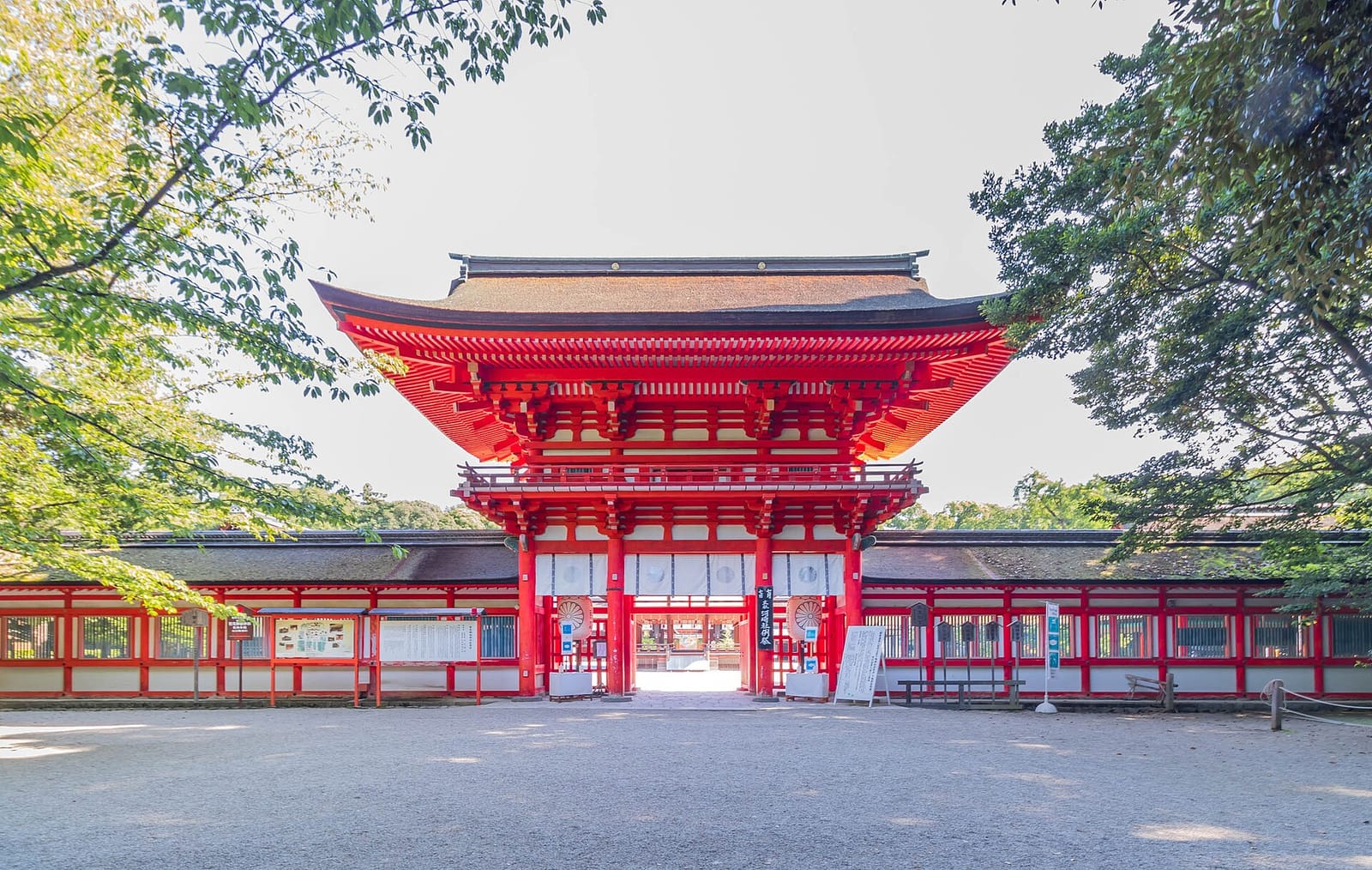
The Romon gate
Photo: Kakidai / CC BY-SA 4.0 · Original · Resized and croppedEdo period · Shrines · National Treasures
Kamomioya Shrine (Shimogamo Shrine)
賀茂御祖神社(下鴨神社) (かもみおやじんじゃ)
At Shimogamo Shrine you can see the East and West Main Sanctuaries, two National Treasure buildings from 1863 standing side by side, along with the Tadasu no Mori forest to the south and the Mitarashi Pond linked to the Aoi Festival. The special viewing also takes you into the Oidono, the kitchen of the deities.
Key facts
- Designation
- National Treasures
- Era
- Edo period
- Type
- Shrines
- Location
- Kyoto, Kyoto
- Address
- 京都府京都市左京区下鴨泉川町
Before you go
- Opening hours
- The inner precinct beyond the Romon gate is open 6:30 to 17:00 (times may change for rites). The Oidono kitchen hall is open 10:00 to 16:00.
- Closed
- Open every day.
- Admission (adults)
- The special viewing of the Oidono, the shrine's former kitchen for sacred offerings (Important Cultural Property), costs ¥1,000 for adults.
- Time needed
- Check the official site
- Getting there
- From Kyoto Station, take city bus 4 or 205 to Shimogamo-jinja-mae or Tadasunomori-mae. Demachiyanagi Station (Keihan) is a 12-minute walk. A taxi from Kyoto Station takes about 20 minutes (¥2,000 to ¥3,000). The west car park costs ¥500 for the first hour, then ¥300 per 30 minutes.
Checked against official information on November 12, 2026. Fees and hours can change, so please also check the official site before you go.
Sources for visitor information
Key facts
- Designation
- National Treasures
- Era
- Edo period
- Type
- Shrines
- Location
- Kyoto, Kyoto
- Address
- 京都府京都市左京区下鴨泉川町
About this place
Kamomioya Shrine is an ancient Kyoto shrine standing where the Kamo River and the Takano River meet. Because it lies downstream on the Kamo River and the character for duck, read kamo, has long been used for it, it is also called Shimogamo Shrine. Its official name comes from its enshrining the ancestral deities of the Kamo clan: Kamotaketsunumi-no-Mikoto in the west sanctuary and his child, Tamayorihime-no-Mikoto, in the east sanctuary. The exact founding date is unknown, but there is a record of the shrine fence being repaired in the 7th year of Emperor Sujin (90 BC), and the shrine explains that worship here began even earlier.
When the capital moved to Heian-kyo, prayers for the success of its construction were first offered at this shrine, and afterwards the imperial court honored it, together with Kamigamo Shrine, as a guardian of the capital and the nation. A system was established in which an imperial princess served the shrines as the Saio priestess, and the shrine often appears in court literature such as The Tale of Genji and The Pillow Book. Shikinen Sengu, the periodic renewal of the shrine buildings, began with its first round in 1036, and today it is carried out every 21 years, centered on repairing damaged parts. The shrine grounds were inscribed as a World Cultural Heritage site in 1994.
The two National Treasure buildings are the East Main Sanctuary and the West Main Sanctuary, both late Edo buildings constructed in 1863 (Bunkyu 3). Both are in the sangensha nagare-zukuri style with cypress-bark roofs. The two identical sanctuaries stand side by side, east and west, and Tamayorihime-no-Mikoto of the East Main Sanctuary is regarded as the mother of the deity of Kamigamo Shrine. In addition, 53 other shrine buildings are designated Important Cultural Properties. The Ura-no-Kairo corridor that runs around the back of the main sanctuaries was used for shihohai, worship of the main shrine from all four sides; it was removed during the war and restored at the 34th Shikinen Sengu.
Tadasu no Mori forest spreads across the southern part of the grounds. Covering about 124,000 square meters, it is a forest with clear streams that keeps the look of the original wild land. The Kirishiba at the center of the forest is said to have been a place of ritual since ancient times. Mitarashi Pond is where the Saio-dai of the Aoi Festival dips her hands to purify herself, and the Ashitsuke ritual of wading in the water is held here on the Day of the Ox in the midsummer doyo period. The grounds also hold the seven Kotosha shrines to the guardian deities of the zodiac signs, and the Korin plum tree, said to be the model for Ogata Korin's screen painting of red and white plum blossoms.
In the special viewing area you can see the Oidono (an Important Cultural Property), the kitchen of the deities, where replicas of offerings such as the special food offerings of the Aoi Festival and cooking utensils are displayed. The viewing area also shows a reconstruction, based on research, of the small hut where Kamo no Chomei, author of An Account of My Hut (Hojoki), lived. The main festival is the Kamo Festival (Aoi Festival) on May 15, preceded by the horseback archery ritual on May 3 and the purification rite of the Saio-dai on May 4 (held in alternate years with Kamigamo Shrine). The two Kamo shrines are also linked through the myths of their deities, so visiting Kamigamo Shrine as well makes the relationship clear.
Buildings designated as National Treasures
Kamomioya Shrine East Main Sanctuary
- Era
- End of the Edo period
- Year
- 1863
- Structure
- three-bay shrine, nagare-zukuri (flowing-gable) roof, cypress-bark roofing
- Designated
- March 31, 1953
Kamomioya Shrine West Main Sanctuary
- Era
- End of the Edo period
- Year
- 1863
- Structure
- three-bay shrine, nagare-zukuri (flowing-gable) roof, cypress-bark roofing
- Designated
- March 31, 1953
Sources and date checked
Facts such as eras, structures and locations are edited and translated by us from the Agency for Cultural Affairs’ database of nationally designated cultural properties. The Agency and the national government did not produce this page.
Database of nationally designated cultural properties- Agency for Cultural Affairs, Database of National Cultural Properties: Kamomioya Shrine East Main Sanctuary
- Agency for Cultural Affairs, Database of National Cultural Properties: Kamomioya Shrine West Main Sanctuary
- About Shimogamo Shrine (Shimogamo Shrine official site)
- Shimogamo Shrine Grounds Map (Shimogamo Shrine official site)
- Shimogamo Shrine Special Viewing (Shimogamo Shrine official site)
- Shimogamo Shrine Festivals and Rites (Shimogamo Shrine official site)
Checked on November 6, 2026
Report an error
If you notice a mistake, please tell us along with a source for the correct information.
Where to go next
Places you could see on the same day, and places worth comparing.
Nearby cultural heritage
Places within 10 km, nearest first. Distances are in a straight line.
More from Kyoto
Discover more of the same region on our sister sites.
Matsuri Biyori
UNESCO-listed festivals in Kyoto
- Yamahoko, the float ceremony of the Kyoto Gion festival
- Kyoto no Rokusai Nenbutsu
- Yasuraibana
- Kuta no Hanagasa Odori
Meiga no Furusato
Paintings linked to Kyoto
- View of Amanohashidate
- Viewing Maple Leaves
- Scenes in and around Kyoto (Funaki Version)
- Morning View of Uji River