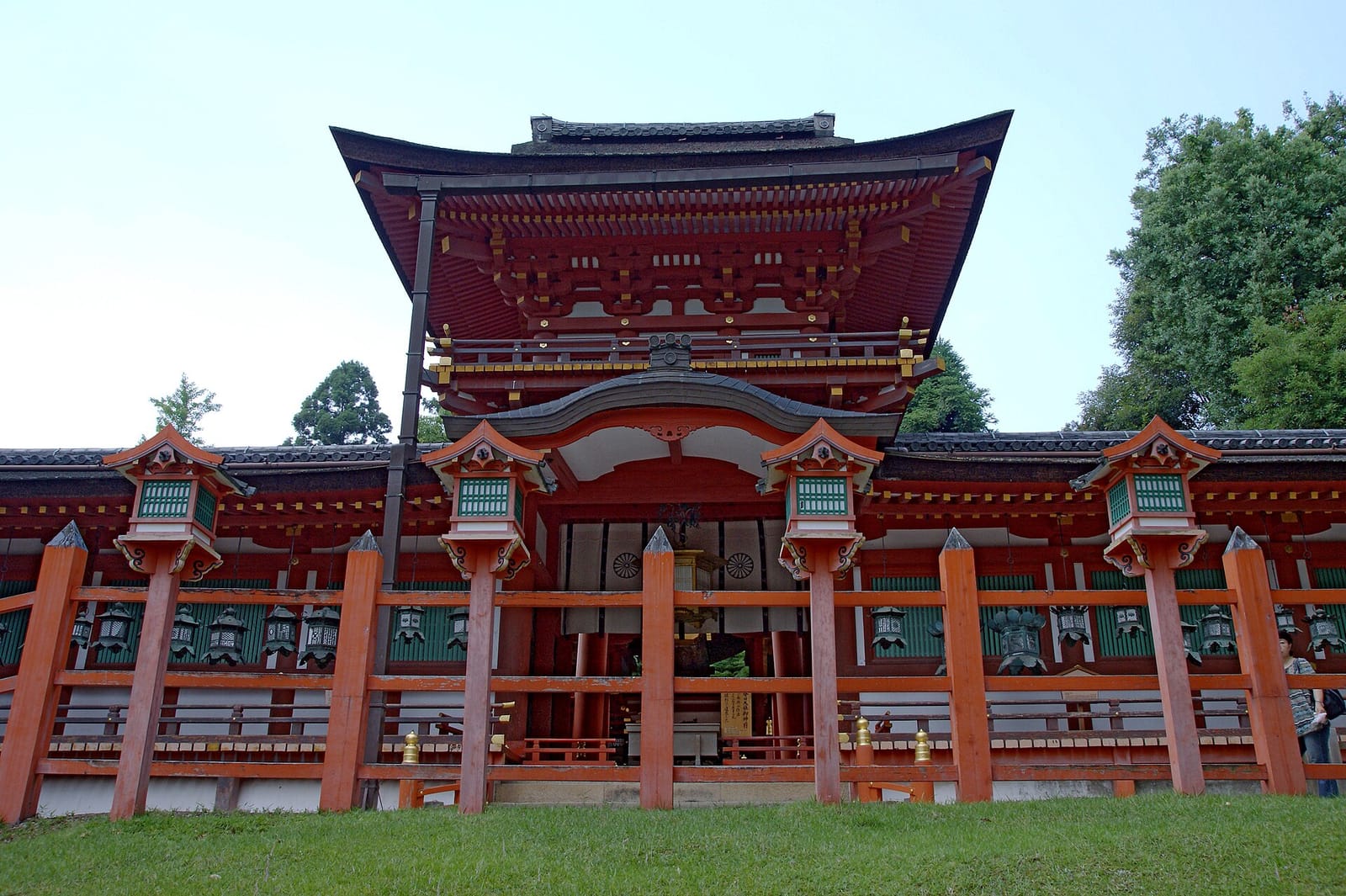
The Chumon gate
Photo: 663highland / CC BY 2.5 · Original · Resized and croppedEdo period · Shrines · National Treasures
Kasuga Taisha
春日大社 (かすがたいしゃ)
The tutelary shrine of the Fujiwara clan stands at the foot of Mount Mikasa. Its four vermilion main sanctuaries are National Treasures, the most orthodox example of the Kasuga style, kept in their old form by rebuilding roughly every 20 years. Some 3,000 lanterns line the grounds.
Key facts
- Designation
- National Treasures
- Era
- Edo period
- Type
- Shrines
- Location
- Nara, Nara
- Address
- 奈良県奈良市春日野町
Before you go
- Opening hours
- The main worship area is open 6:30-17:30 from March to October and 7:00-17:00 from November to February. The special visit inside the corridors runs 9:00-16:00. The National Treasure Museum is open 10:00-17:00 (last entry 16:30).
- Closed
- The special visit inside the corridors is not available all day from around March 8 to 13, from December 20 to January 7, and on Coming-of-Age Day. It is also unavailable on some mornings, such as the 1st, 11th and 21st of each month and festival days.
- Admission (adults)
- Praying at the main worship area is free. The special visit inside the corridors, up to the Middle Gate, is ¥700, and the National Treasure Museum is ¥700 for adults.
- Time needed
- Check the official site
- Getting there
- From JR or Kintetsu Nara Station, take a Nara Kotsu bus bound for Kasuga Taisha Honden (about 11-15 minutes); the shrine is right by the last stop. Or take the city loop bus (outer route, about 9-13 minutes) to Kasuga Taisha Omotesando and walk about 10 minutes. On foot from Kintetsu Nara Station it takes about 25 minutes. There is a car park for 100 vehicles (¥1,500 per car).
- Best time to visit
- At the Kasuga Festival on March 13, an imperial envoy still comes from the palace. The Kasuga Wakamiya On-matsuri on December 17 is an Important Intangible Folk Cultural Property.
- Good to know
- Visiting times may shift for ceremonies, and the special visit can be suspended at short notice. Bus timetables change by season, so check before you go.
Checked against official information on November 12, 2026. Fees and hours can change, so please also check the official site before you go.
Sources for visitor information
Key facts
- Designation
- National Treasures
- Era
- Edo period
- Type
- Shrines
- Location
- Nara, Nara
- Address
- 奈良県奈良市春日野町
About this place
The main shrine of Kasuga Taisha was built in 768 at the foot of the sacred Mount Mikasa by order of Empress Shotoku. According to the official site, the deities enshrined are Takemikazuchi no Mikoto, Futsunushi no Mikoto, Amenokoyane no Mikoto and Himegami. It is the tutelary shrine of the Fujiwara clan, and many nobles worshipped here and presented offerings. The Kasuga Matsuri on March 13 has continued for over 1,200 years, and an imperial envoy still comes from the court to read a prayer for the safety of the nation. The Wakamiya shrine was founded on its present site in 1135, and the Kasuga Wakamiya On-matsuri on December 17, held every year since the following year, is designated a national Important Intangible Folk Cultural Property.
The National Treasure main shrine consists of four halls, the First through the Fourth, standing eave to eave and of nearly the same size. They are in the Kasuga-zukuri style: a gabled, entrance-on-the-gable-end shrine with a lean-to roof added to the front. The Agency for Cultural Affairs describes this as the most formal example of the style, with great value in architectural history. The present buildings date from 1863. Kasuga Taisha has repeatedly renewed its buildings in the Shikinen Zotai rite, held roughly every twenty years, and the official site says it has been done sixty times. As a result, the old form has been preserved, and the style from the late Nara or early Heian period remains well kept. The vermilion color is also maintained through these renewals.
Before entering the grounds, take note of the surroundings. Mount Mikasa and Mount Kasuga are sacred mountains, and in the Heian period an edict forbade hunting and logging there, so the primeval forest remains today. The Kasugayama Primeval Forest is a Special Natural Monument. According to the tradition that the deity came to Mikasa from Hitachi Province riding a white deer in the Nara period, deer have been treated as the deity's messengers. The grounds hold about 3,000 lanterns, offered since the Heian period, and the official site says nearly 70 percent of the Muromachi-period lanterns remaining in Japan are here.
The shrine is closely tied in history to Kofuku-ji. In the Heian period Kofuku-ji took control of Kasuga Shrine, and the 1595 land survey fixed a single holding for "Kasuga Shrine and Kofuku-ji." Seeing the pagodas and halls of Kofuku-ji before or after your visit lets you feel how the two prospered as one power. The shrine's Treasure Museum holds about 3,000 items offered by emperors and nobles and is called the "Shosoin of the Heian period." A special admission to the inner side of the cloister lets you walk past its hanging lanterns to the front of the Chumon (Middle Gate). Entry may not be allowed during ceremonies or events, so check the official site for hours and closed days.
Buildings designated as National Treasures
Kasuga Taisha Main Shrine (First Hall)
- Era
- End of the Edo period
- Year
- 1863
- Structure
- one-bay Kasuga-zukuri shrine, cypress-bark roofing, with fences between the halls and on both sides
- Designated
- June 28, 1956
Kasuga Taisha Main Shrine (Second Hall)
- Era
- End of the Edo period
- Year
- 1863
- Structure
- one-bay Kasuga-zukuri shrine, cypress-bark roofing, with fences between the halls and on both sides
- Designated
- June 28, 1956
Kasuga Taisha Main Shrine (Third Hall)
- Era
- End of the Edo period
- Year
- 1863
- Structure
- one-bay Kasuga-zukuri shrine, cypress-bark roofing, with fences between the halls and on both sides
- Designated
- June 28, 1956
Kasuga Taisha Main Shrine (Fourth Hall)
- Era
- End of the Edo period
- Year
- 1863
- Structure
- one-bay Kasuga-zukuri shrine, cypress-bark roofing, with fences between the halls and on both sides
- Designated
- June 28, 1956
Sources and date checked
Facts such as eras, structures and locations are edited and translated by us from the Agency for Cultural Affairs’ database of nationally designated cultural properties. The Agency and the national government did not produce this page.
Database of nationally designated cultural properties- Agency for Cultural Affairs, Database of National Cultural Properties: Kasuga Taisha Main Shrine (First Hall)
- Agency for Cultural Affairs, Database of National Cultural Properties: Kasuga Taisha Main Shrine (Second Hall)
- Agency for Cultural Affairs, Database of National Cultural Properties: Kasuga Taisha Main Shrine (Third Hall)
- Agency for Cultural Affairs, Database of National Cultural Properties: Kasuga Taisha Main Shrine (Fourth Hall)
- Kasuga Taisha official site: History
- Kofuku-ji official site: Overview
- Kasuga Taisha official site: Special Visit Inside the Cloister
Checked on November 6, 2026
Report an error
If you notice a mistake, please tell us along with a source for the correct information.
Where to go next
Places you could see on the same day, and places worth comparing.
Nearby cultural heritage
Places within 10 km, nearest first. Distances are in a straight line.
More from Nara
Discover more of the same region on our sister sites.
Sake Tabi
Breweries and distilleries in Nara
- FARMENTRY
- Golden Rabbit Beer Taproom
- The GoodWolf Brewery
- Harushika Sake Brewery Shop (Imanishi Seibei Shoten)