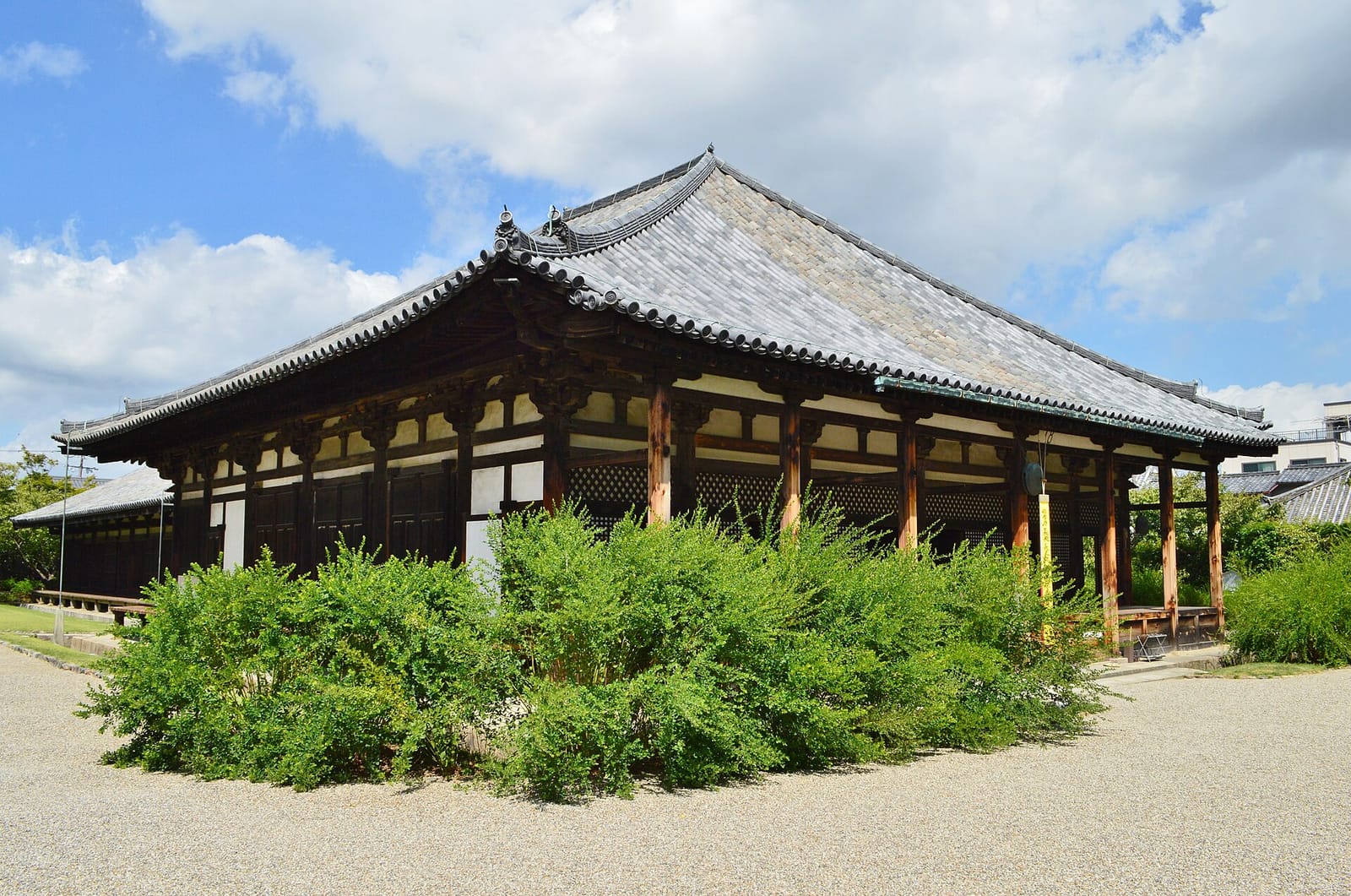
Gango-ji
Photo: Saigen Jiro / CC0 · Original · Resized and croppedNara period · Temples · National Treasures
Gango-ji
元興寺 (がんごうじ)
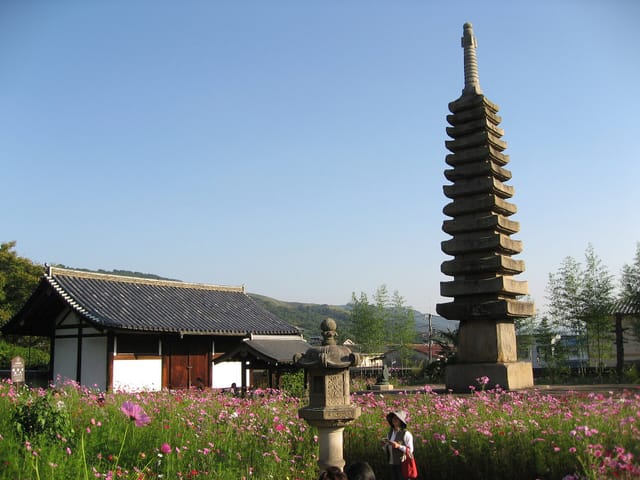
At Gango-ji you can see the National Treasure Gokuraku-do and Zen-shitsu, Nara-period monks' quarters remodeled in the Kamakura period, and the Nara-period Miniature Five-Storied Pagoda kept in the Horinkan. Old tiles brought from Hoko-ji in Asuka are still used on the roofs of the Gokuraku-do and Zen-shitsu.
Key facts
- Designation
- National Treasures
- Era
- Nara period
- Type
- Temples
- Location
- Nara, Nara
- Address
- 奈良県奈良市中院町
Before you go
- Opening hours
- Check the official site
- Closed
- Check the official site
- Admission (adults)
- Check the official site
- Time needed
- Check the official site
- Getting there
- About 15 minutes on foot from Kintetsu Nara Station, or take a bus to Fukuchiincho and walk 5 minutes. From JR Nara Station it is a 20-minute walk, or take a bus to Tanakacho and walk 5 minutes.
Checked against official information on November 12, 2026. Fees and hours can change, so please also check the official site before you go.
Sources for visitor information
Key facts
- Designation
- National Treasures
- Era
- Nara period
- Type
- Temples
- Location
- Nara, Nara
- Address
- 奈良県奈良市中院町
About this place
Gango-ji is a temple of the Shingon Ritsu school in Chuin-cho, Nara, set within the old Naramachi district. According to the temple, its predecessor was Hoko-ji (Asuka-dera), which Soga no Umako began building in Asuka in 588, and which is regarded as the first full-scale temple complex in Japan. When the capital moved to Heijo-kyo, the temple was moved to the new capital in 718 (Yoro 2) and renamed Gango-ji. In 1998 it was inscribed as one of the World Heritage "Historic Monuments of Ancient Nara."
In the late Heian period the official state temples declined, and in the Kamakura period Gango-ji's large complex broke apart. The present grounds correspond to part of the former monks' quarters and lecture hall. One room of the monks' quarters, where the Nara-period scholar monk Chiko had lived, came to enshrine the Chiko Mandala, a painting of the Pure Land associated with him; it was called Gokuraku-bo and became a center of Pure Land faith in Nara. According to the temple's chronology, these quarters were extensively remodeled in 1244 (Kangen 2) and divided into the Gokuraku-do and the Zen-shitsu.
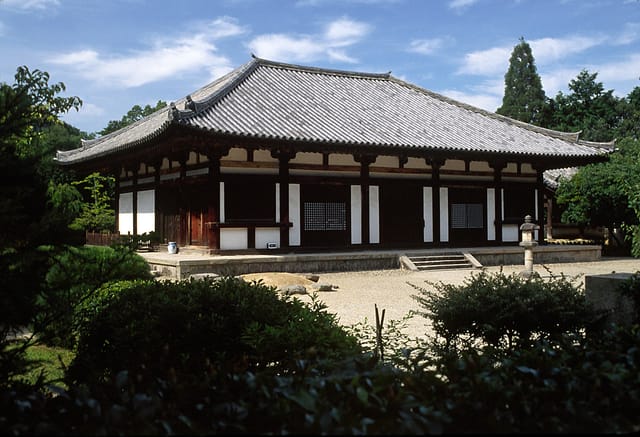
The Gokuraku-do (Gokuraku-bo Main Hall) was converted from three rooms of the monks' quarters into a hall with a hipped, tiled roof; its gable end on the east serves as the front, with a lean-to added in front. The national cultural properties database dates it to 1244, in the early Kamakura period. The Zen-shitsu Hall preserves four rooms of the monks' quarters under a gabled, tiled roof. Its style is the Daibutsu style of the Kamakura period, but many of its structural timbers are reused material from the Nara period or earlier. It keeps the layout and atmosphere of the quarters where monks of a great state temple lived and studied.
Parts of the roofs of both halls are laid with tiles in an old style, with the round tiles overlapping one another. According to the temple, tiles made by tile masters from Baekje for the building of Hoko-ji in Asuka were carried to Nara, and several thousand are still in use. Ancient eave tiles also remain at the southwest corner of the Gokuraku-do and the southeast corner of the Zen-shitsu. The Miniature Five-Storied Pagoda, kept in the Horinkan storehouse, is known as the only surviving five-story pagoda from the height of the Nara period, and because it is built authentically down to the details, one theory holds that it was a model for the pagodas of the provincial temples.
On the south side of the grounds is the Futoden, where about 1,500 stone pagodas and Buddhist figures from the medieval to the Edo period stand in rows, and at the Jizo-e on August 23 and 24 each year, a Mando Kuyo is held with lights in small oil dishes. Other events include the Setsubun-e and the Kaeru-ishi (frog stone) memorial on July 7. During the autumn special exhibition from late October to early November, the Chiko Mandala painted on a board, an Important Cultural Property, is shown and the admission fee also changes, so it is best to check the temple's information before you go.
Buildings designated as National Treasures
Gango-ji Gokuraku-bo Main Hall
- Era
- Early Kamakura period
- Year
- 1244
- Structure
- six bays wide, six bays deep, single-storied, hipped roof, entered from the gable end, with a one-bay-wide lean-to along the front, tiled roofing (honkawara-buki), including the akadana (offering shelf)
- Designated
- February 2, 1955
Gango-ji Gokuraku-bo Miniature Five-Storied Pagoda
- Era
- Nara period
- Structure
- three-bay five-storied pagoda, wooden-plank roofing shaped like tiles
- Designated
- March 29, 1952
Gango-ji Gokuraku-bo Zen-shitsu Hall
- Era
- Early Kamakura period
- Structure
- four bays wide, four bays deep, single-storied, gabled roof, tiled roofing (honkawara-buki)
- Designated
- March 31, 1953
Sources and date checked
Facts such as eras, structures and locations are edited and translated by us from the Agency for Cultural Affairs’ database of nationally designated cultural properties. The Agency and the national government did not produce this page.
Database of nationally designated cultural properties- Agency for Cultural Affairs, Database of National Cultural Properties: Gango-ji Gokuraku-bo Main Hall
- Agency for Cultural Affairs, Database of National Cultural Properties: Gango-ji Gokuraku-bo Miniature Five-Storied Pagoda
- Agency for Cultural Affairs, Database of National Cultural Properties: Gango-ji Gokuraku-bo Zen-shitsu Hall
- About Gango-ji (Gango-ji official)
- Gango-ji: History and Chronology (Gango-ji official)
- Gango-ji: Origins (Gango-ji official)
- Gango-ji: Architecture and Grounds (Gango-ji official)
- Gango-ji: Buddhist Images (Gango-ji official)
- Gango-ji: Events (Gango-ji official)
- Gango-ji: FAQ (Gango-ji official)
Checked on November 6, 2026
Report an error
If you notice a mistake, please tell us along with a source for the correct information.
Where to go next
Places you could see on the same day, and places worth comparing.
Nearby cultural heritage
Places within 10 km, nearest first. Distances are in a straight line.
More from Nara
Discover more of the same region on our sister sites.
Sake Tabi
Breweries and distilleries in Nara
- FARMENTRY
- Golden Rabbit Beer Taproom
- The GoodWolf Brewery
- Harushika Sake Brewery Shop (Imanishi Seibei Shoten)