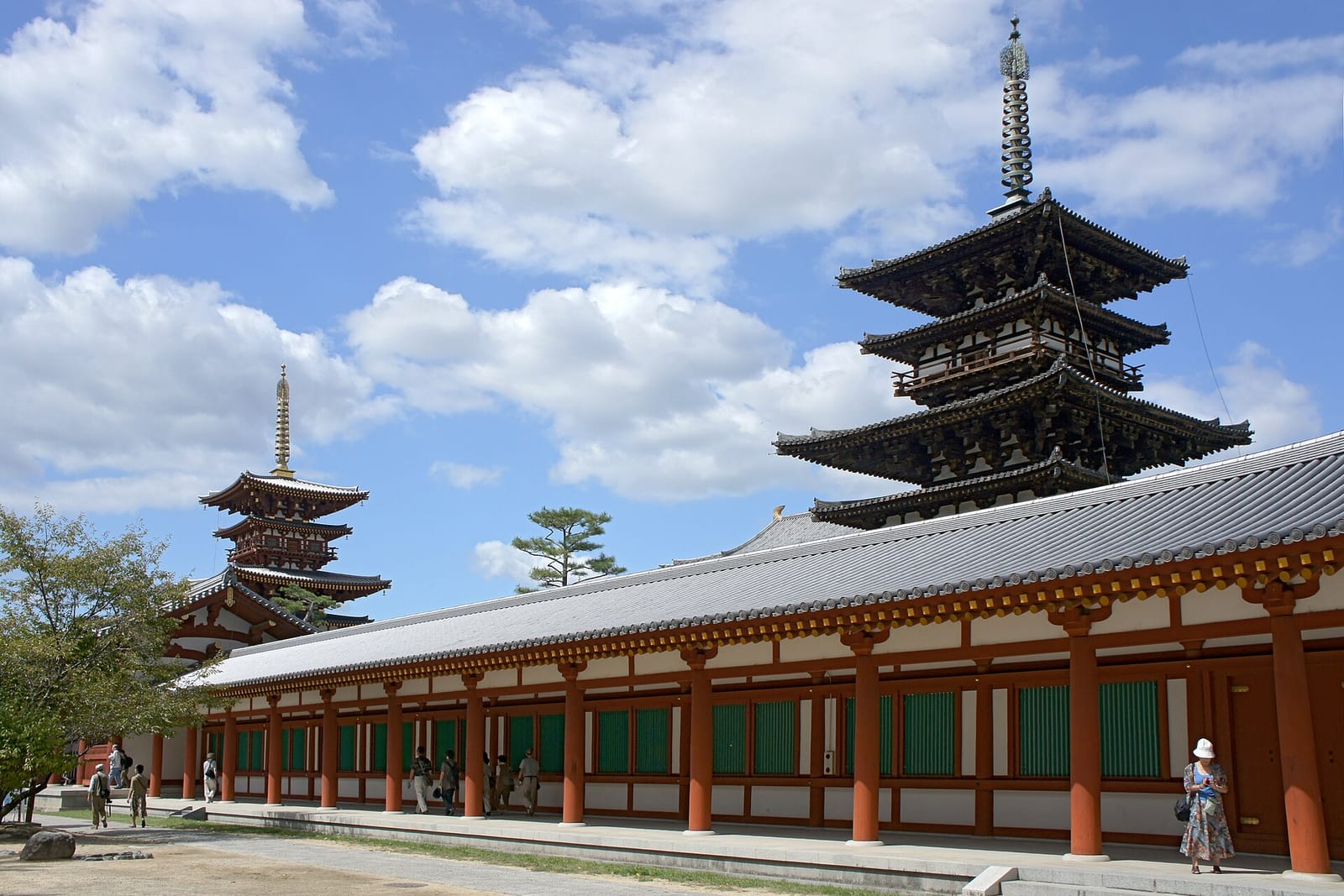
The East Pagoda and the corridor
Photo: 663highland / CC BY 2.5 · Original · Resized and croppedNara period · Temples · National Treasures
Yakushi-ji
薬師寺 (やくしじ)
The East Pagoda, the only building surviving from the founding, is a three-story pagoda that looks six-storied because of its intermediate roofs, earning it the nickname "frozen music." It stands beside the brightly colored West Pagoda rebuilt in the Showa era, and the Kamakura-period Toindo hall is also worth seeing.
Key facts
- Designation
- National Treasures
- Era
- Nara period
- Type
- Temples
- Location
- Nara, Nara
- Address
- 奈良県奈良市西ノ京町
Before you go
- Opening hours
- 9:00-17:00 (last admission 16:30)
- Closed
- Check the official site
- Admission (adults)
- ¥1,000 for adults, covering the Golden Hall, the Great Lecture Hall and the Toindo.
- Time needed
- Allow about 30 minutes to see the Golden Hall, Great Lecture Hall and Toindo.
- Getting there
- About a 2-minute walk from Kintetsu Nishinokyo Station. Parking is ¥800 per visit for a car (entry 8:45-16:20).
- Best time to visit
- The temple's biggest event, the Shuni-e Hana-eshiki, takes place in the Golden Hall on March 25-31, ending with a demon-chasing rite on the night of the 31st. Special openings in spring and autumn show places such as the Genjo Sanzo-in with Hirayama Ikuo's Silk Road murals (in 2026: April 25-May 10 and October 24-November 8).
Checked against official information on November 12, 2026. Fees and hours can change, so please also check the official site before you go.
Sources for visitor information
Key facts
- Designation
- National Treasures
- Era
- Nara period
- Type
- Temples
- Location
- Nara, Nara
- Address
- 奈良県奈良市西ノ京町
About this place
Yakushi-ji was vowed in 680 by Emperor Tenmu, who prayed for the recovery of his empress, the future Empress Jito. Tenmu died before it was finished, and after Jito took the throne construction went ahead in the new capital, Fujiwara-kyo. The Shoku Nihongi records that the main image, Yakushi Nyorai, had its eye-opening in 697 and that monks took up residence the following year. When the capital moved to Heijo-kyo in 710, the temple moved to its present site. In the Nara period it ranked among the four great temples of the realm, and its main halls and pagodas, fitted with skirt roofs, were called "Dragon Palace style."
The only building to survive from the original temple is the East Pagoda. Founded in 730, it is designated a National Treasure as the oldest surviving building in Heijo-kyo. It looks six stories tall but is actually three, each story fitted with a small skirt roof (mokoshi). The rhythm of large and small roofs has earned it the nickname "frozen music." In 1528 a fire set in warfare destroyed the Golden Hall, the West Pagoda and the Lecture Hall, leaving only the East Pagoda. The layout with a central Golden Hall and two pagodas to east and west began at Yakushi-ji and is called the "Yakushi-ji style."
The Toin-do is a Kamakura-period hall built in 1285. It is a single-story hip-and-gable building, seven bays wide and four deep, with a tiled roof. It originally faced south and was turned to face west between 1729 and 1733. The bracket sets keep the traditional Japanese style, while the hall omits horizontal tie beams (nageshi) and uses other beams in their place, with paneled doors and carved beam ends, adopting new designs of its day. Inside, an aisle runs around the central core, a plan thought to continue the tradition of early halls. It is regarded as a leading example of a Kamakura hall that kept tradition. Comparing it with the Tenpyo-era East Pagoda shows clearly how roofs and halls differ.
Rebuilding the complex began in 1968, when the abbot Takada Koin started a drive of sutra-copying donations. The goal of one million copies was reached in 1976 and the Golden Hall was dedicated; the West Pagoda was rebuilt in 1981, the Lecture Hall in 2003 and the Refectory in 2017. The temple holds nine National Treasures and twenty-six Important Cultural Properties. The old East Pagoda standing beside the brightly colored West Pagoda is the view that represents Yakushi-ji today. Looking at the two pagodas of the same form while keeping in mind the gap of nearly 1,300 years makes it easier to grasp the original design and the aim of the reconstruction.
Buildings designated as National Treasures
Yakushi-ji East Pagoda
- Era
- Nara period
- Year
- 730
- Structure
- three-bay three-storied pagoda, mokoshi (skirt roof) on every tier, tiled roofing (honkawara-buki)
- Designated
- June 9, 1951
Yakushi-ji Toin-do Hall
- Era
- Late Kamakura period
- Year
- 1285
- Structure
- seven bays wide, four bays deep, single-storied, hip-and-gable roof, tiled roofing (honkawara-buki)
- Designated
- April 27, 1961
Sources and date checked
Facts such as eras, structures and locations are edited and translated by us from the Agency for Cultural Affairs’ database of nationally designated cultural properties. The Agency and the national government did not produce this page.
Database of nationally designated cultural properties- Agency for Cultural Affairs, Database of National Cultural Properties: Yakushi-ji East Pagoda
- Agency for Cultural Affairs, Database of National Cultural Properties: Yakushi-ji Toin-do Hall
- Yakushi-ji official site: About Yakushi-ji
- Yakushi-ji official site: Temple Complex and Buddhist Statues
Checked on November 6, 2026
Report an error
If you notice a mistake, please tell us along with a source for the correct information.
Where to go next
Places you could see on the same day, and places worth comparing.
Nearby cultural heritage
Places within 10 km, nearest first. Distances are in a straight line.
More from Nara
Discover more of the same region on our sister sites.
Sake Tabi
Breweries and distilleries in Nara
- FARMENTRY
- Golden Rabbit Beer Taproom
- The GoodWolf Brewery
- Harushika Sake Brewery Shop (Imanishi Seibei Shoten)