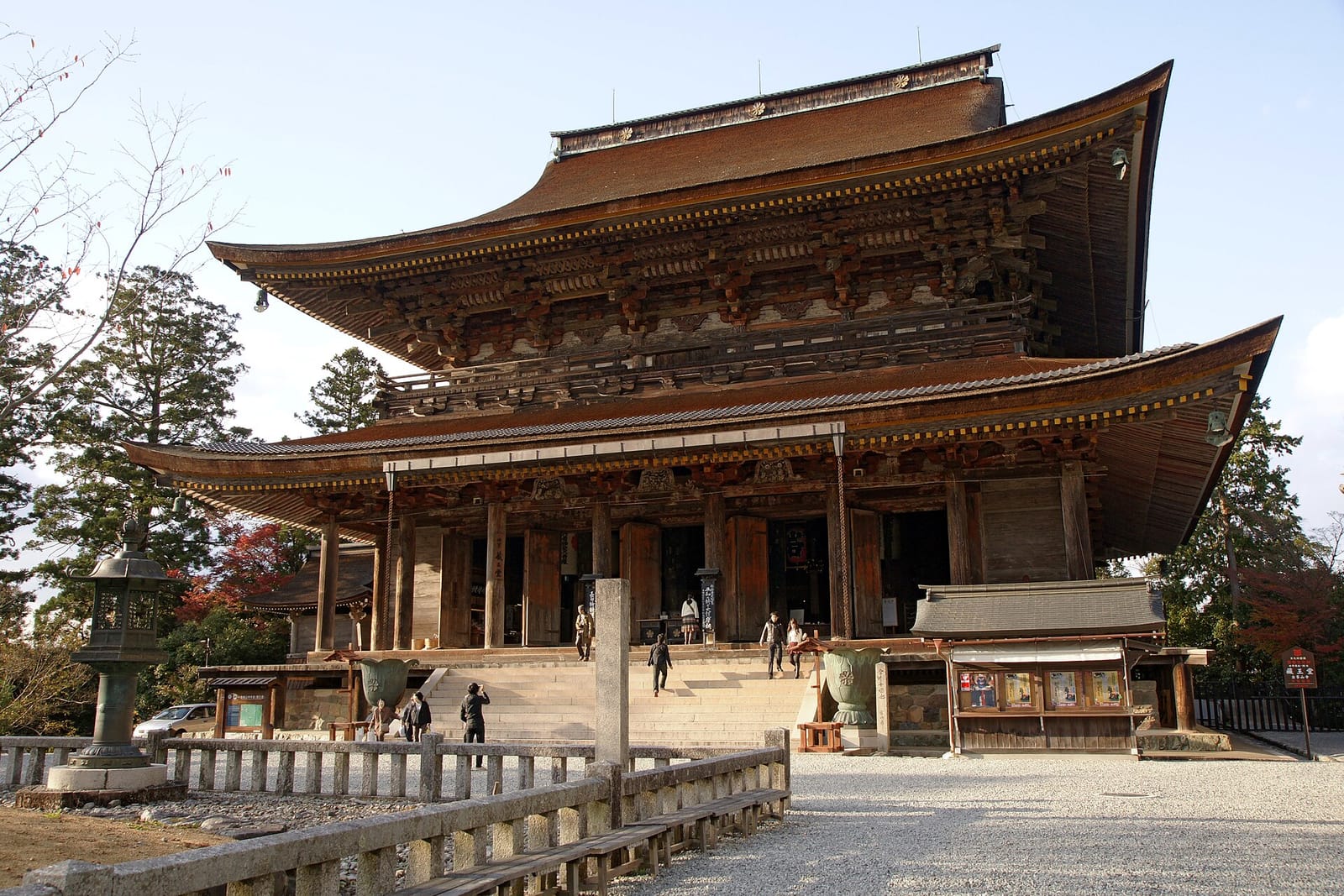
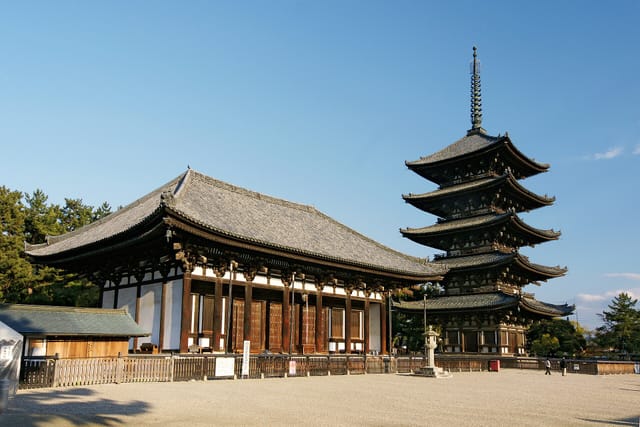
The Zao-do hall
Photo: 663highland / CC BY 2.5 · Original · Resized and croppedMuromachi period · Temples · National Treasures
Kinpusen-ji
金峯山寺 (きんぷせんじ)
Said to have been founded by En no Gyoja, this is the head temple of Shugendo mountain worship. Its cypress-bark-roofed main hall, the Zao-do, is second in size only to Todai-ji's Great Buddha Hall among old wooden buildings. It stands on cherry-famed Mount Yoshino, part of the Kii Mountains World Heritage Site.
Key facts
- Designation
- National Treasures
- Era
- Muromachi period
- Type
- Temples
- Location
- Yoshino, Nara
- Address
- 奈良県吉野郡吉野町大字吉野山
Before you go
- Opening hours
- The Zao-do is open 8:30-16:00. Entry may be restricted during services and events.
- Closed
- Check the official site
- Admission (adults)
- Admission to the Zao-do is ¥800 for adults. During special unveilings of the hidden principal images it is ¥1,600.
- Time needed
- Check the official site
- Getting there
- Get off at Kintetsu Yoshino Station and take the ropeway up to Yoshinoyama Station. From there it is about a 10-minute walk past the Kuromon Gate, the bronze torii and the Niomon Gate. Kintetsu limited express trains reach Yoshino from Osaka Abenobashi in about 1 hour 15 minutes.
- Best time to visit
- The Hanaku-eshiki festival is held on April 10-12, when Yoshino's cherry trees are in full bloom. Other major events are the Rengee lotus festival with the Kaeru-tobi frog-jumping rite on July 7, and the Setsubun-e demon festival (usually February 3).
- Good to know
- The National Treasure Niomon Gate has been under major repair since 2018. The hidden principal images are shown only during limited special unveilings, so check the official site for dates.
Checked against official information on November 12, 2026. Fees and hours can change, so please also check the official site before you go.
Sources for visitor information
Key facts
- Designation
- National Treasures
- Era
- Muromachi period
- Type
- Temples
- Location
- Yoshino, Nara
- Address
- 奈良県吉野郡吉野町大字吉野山
About this place
The area stretching from Yoshinoyama to Mount Sanjogatake has long been a sacred site known as Kinpusen. According to the official site, in the Hakuho period the ascetic En no Gyoja trained for a thousand days of seclusion on Sanjogatake, perceived the deity Kongo Zao Gongen, and carved its image in wild cherry wood to enshrine at the summit and in Yoshinoyama. This is said to be the founding of Kinpusen-ji and the beginning of Shugendo. It was abolished for a time by the separation of Shinto and Buddhism in the early Meiji era, but was revived as a Buddhist temple and is now the head temple of the Kinpusen Shugen Honshu sect. In 2004 it was inscribed as part of the World Heritage site "Sacred Sites and Pilgrimage Routes in the Kii Mountain Range."
The main hall, Zao-do, is a single-story hip-and-gable building with a skirt roof and cypress-bark roofing; it is 34 meters high and 36 meters on each side at the skirt roof. The official site says it is the largest old wooden building after the Great Buddha Hall of Todai-ji. Its founding is attributed to En no Gyoja, but it has burned and been rebuilt repeatedly. The Taiheiki says it burned in 1348 when Ko no Moronao attacked, and it burned again in 1586. The present building was completed around 1592. Inside is a shrine said to be Japan's largest, holding three hidden statues of Zao Gongen as the principal images. The central one is a colossus of more than seven meters.
The Nio-mon, the main gate on the north side, faces north, whereas the Zao-do faces south. It is the gate that welcomes people entering the Yoshino-Omine area from the north, such as from the Kyoto-Osaka-Kobe region. It is a two-story hip-and-gable gate with tiled roofing, standing on a castle-like stone wall, 20.3 meters high. Its founding is unknown, but the lower story is estimated to date from the Nanbokucho period and the upper story from the Kosho era, and it is the oldest of the surviving buildings at Kinpusen-ji. The guardian statues on either side are about five meters tall and are attributed to the Nara sculptor Kojo. A major repair of the gate began in 2018, so check the official site for the situation of the statues.
Around the temple are many places tied to the history of the Northern and Southern Courts. The Four Cherry Trees, inside a stone fence in the Zao-do grounds, mark where Prince Moriyoshi (Daito-no-miya) held a last banquet in 1333, expecting Yoshino to fall to the Kamakura shogunate forces; the cherries are replanted at the site of the camp-curtain posts. About 200 meters north of the Nio-mon stands the Important Cultural Property Kane-no-torii, the first of four gates on the way up to Omine-san, called Hosshin-mon. Walking the mountain path from the Zao-do and returning to the hall from the gate that marks the entrance to ascetic practice makes the route of mountain faith easy to follow.
Buildings designated as National Treasures
Kinpusen-ji Main Hall (Hondo)
- Era
- Momoyama period
- Year
- 1591
- Structure
- five bays wide, six bays deep, single-storied with mokoshi (skirt roof), hip-and-gable roof, cypress-bark roofing
- Designated
- November 14, 1953
Kinpusen-ji Nio-mon Gate
- Era
- Mid-Muromachi period
- Year
- 1456
- Structure
- three-bay, one-door two-tiered gate (nijumon), hip-and-gable roof, tiled roofing (honkawara-buki)
- Designated
- November 14, 1953
Sources and date checked
Facts such as eras, structures and locations are edited and translated by us from the Agency for Cultural Affairs’ database of nationally designated cultural properties. The Agency and the national government did not produce this page.
Database of nationally designated cultural properties- Agency for Cultural Affairs, Database of National Cultural Properties: Kinpusen-ji Main Hall (Hondo)
- Agency for Cultural Affairs, Database of National Cultural Properties: Kinpusen-ji Nio-mon Gate
- Kinpusen-ji official site: About Kinpusen-ji
- Kinpusen-ji official site: Grounds Guide and Temple Buildings
Checked on November 6, 2026
Report an error
If you notice a mistake, please tell us along with a source for the correct information.
Where to go next
Places you could see on the same day, and places worth comparing.
More from Nara
Discover more of the same region on our sister sites.
Sake Tabi
Breweries and distilleries in Nara
- FARMENTRY
- Golden Rabbit Beer Taproom
- The GoodWolf Brewery
- Harushika Sake Brewery Shop (Imanishi Seibei Shoten)