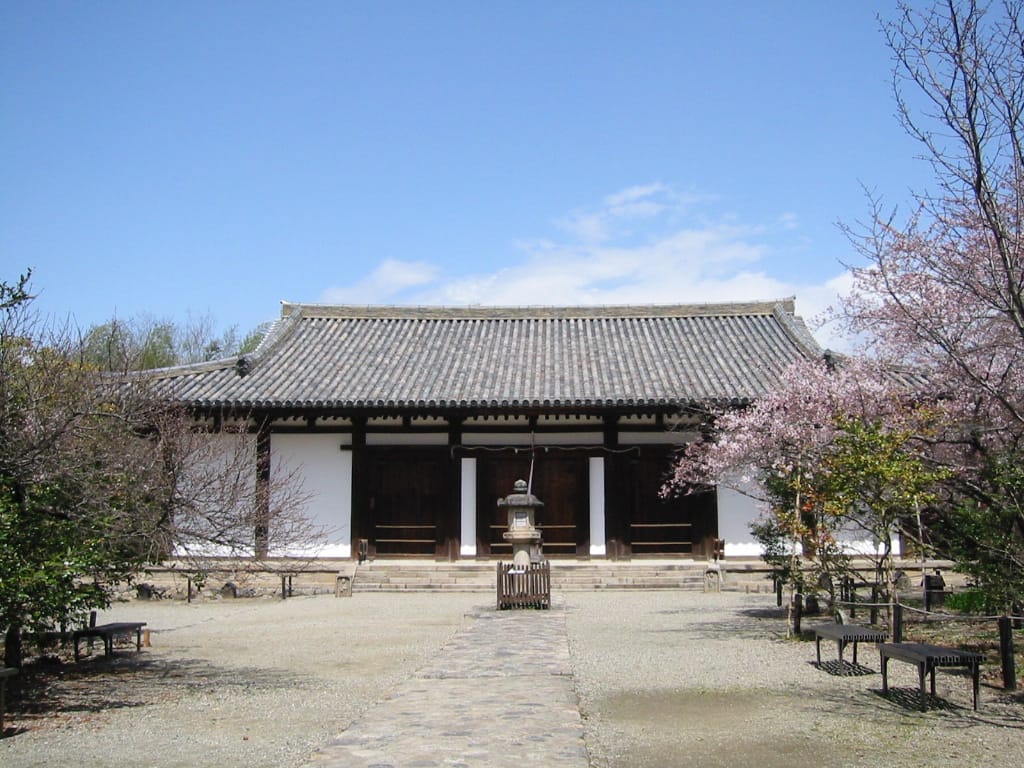
Shin-Yakushi-ji
Photo: Dddeco at Japanese Wikipedia / CC BY-SA 3.0 · Original · Resized and croppedNara period · Temples · National Treasures
Shin-Yakushi-ji
新薬師寺 (しんやくしじ)
At Shin-Yakushi-ji, inside the National Treasure main hall that survives from the temple's founding in the Nara period, you can see up close the seated Yakushi Buddha on its round earthen platform and the Twelve Heavenly Generals that surround it.
Key facts
- Designation
- National Treasures
- Era
- Nara period
- Type
- Temples
- Location
- Nara, Nara
- Address
- 奈良県奈良市高畑町
Before you go
- Opening hours
- 9:00 to 17:00.
- Closed
- Open every day.
- Admission (adults)
- Admission is ¥600 for adults. The National Treasure main hall houses the seated Yakushi Buddha and the standing Twelve Heavenly Generals.
- Time needed
- Check the official site
- Getting there
- Take the Nara city loop bus to Wariishicho and walk 10 minutes uphill. A taxi from JR Nara or Kintetsu Nara Station takes 10 minutes.
Checked against official information on November 12, 2026. Fees and hours can change, so please also check the official site before you go.
Sources for visitor information
Key facts
- Designation
- National Treasures
- Era
- Nara period
- Type
- Temples
- Location
- Nara, Nara
- Address
- 奈良県奈良市高畑町
About this place
Shin-Yakushi-ji is a Kegon-sect temple in Takabatake-cho, Nara, at the foot of Mt. Kasuga and Mt. Takamado. According to the temple, it was founded in the third month of 747 by Empress Komyo, who prayed for Emperor Shomu to recover from illness. At the time it was also known by two other names, one of which means "the Yakushi-ji of the fragrant mountain," and its large Kondo, nine bays wide, is said to have housed statues of the Seven Medicine Buddhas and the Twelve Heavenly Generals. That Kondo collapsed in a storm in 962, but excavations have confirmed its site about 150 meters west of the present main hall, on the campus of Nara University of Education.
The present main hall was originally a hall on higher ground on the east side of the precinct, and at some point it became the main hall. The temple believes it was first a hall for performing rituals. The national cultural properties database dates it to the Nara period: seven bays wide and five bays deep, single-storied, with a hip-and-gable roof covered in tiles. It was designated a National Treasure in 1952. Look for the broad, gently curving roof and the wide white walls; it is a Nara-period building surviving from the temple's founding. In the Kamakura period the South Gate, the Jizo Hall and the bell tower were built, completing the present precinct centered on the main hall.
Inside, the hall has a bare earthen floor with 40 thick round pillars. There is no ceiling, so you can look straight up at the framework that holds up the roof. In the center is a round earthen platform about 90 centimeters high and about 9 meters across, on which the principal image, the seated Yakushi Buddha, sits. According to the temple, it dates from the late Nara to early Heian period, and its head and body were carved from a single torreya (kaya) tree. A survey in 1975 found eight scrolls of the Lotus Sutra from the early Heian period (a National Treasure) inside the statue.
Standing in a circle around the principal image to guard it are the Twelve Heavenly Generals, which the temple describes as the oldest and largest set of these figures in Japan. They are made of clay; eleven date from the Nara period (8th century) and are National Treasures, and one was replaced in wood in 1931. At about 154 to 166 centimeters tall they are nearly life-size, their eyes are made of colored glass, and traces of paint still remain on their surfaces. According to the temple, they may not have been here from the start but are said to have been moved from Iwabuchi-dera at the foot of Mt. Takamado.
The entrance to the precinct is the South Gate, thought to date from the late Kamakura period. Facing the main hall, the Jizo Hall stands on the left and the bell tower, with its flared skirt-like base, on the right. Its bell dates from the Tenpyo era and is known from the Nihon Ryoiki story of the monk Dojo Hoshi defeating a demon. Every year on January 8 and April 8 the Yakushi repentance ritual is held, and on the night of April 8 ten great torches over 7 meters long are carried around the main hall. The statues are close at hand in this hall, so walk slowly around the platform and look at them one by one.
Buildings designated as National Treasures
Shin-Yakushi-ji Main Hall (Hondo)
- Era
- Nara period
- Structure
- seven bays wide, five bays deep, single-storied, hip-and-gable roof, tiled roofing (honkawara-buki)
- Designated
- November 22, 1952
Sources and date checked
Facts such as eras, structures and locations are edited and translated by us from the Agency for Cultural Affairs’ database of nationally designated cultural properties. The Agency and the national government did not produce this page.
Database of nationally designated cultural properties- Agency for Cultural Affairs, Database of National Cultural Properties: Shin-Yakushi-ji Main Hall (Hondo)
- About Shin-Yakushi-ji (Shin-Yakushi-ji official site)
- Shin-Yakushi-ji: Visiting (Shin-Yakushi-ji official site)
- Shin-Yakushi-ji: Yakushi Buddha (Shin-Yakushi-ji official site)
- Shin-Yakushi-ji: Twelve Heavenly Generals (Shin-Yakushi-ji official site)
- Shin-Yakushi-ji: Annual events (Shin-Yakushi-ji official site)
Checked on November 6, 2026
Report an error
If you notice a mistake, please tell us along with a source for the correct information.
Where to go next
Places you could see on the same day, and places worth comparing.
Nearby cultural heritage
Places within 10 km, nearest first. Distances are in a straight line.
More from Nara
Discover more of the same region on our sister sites.
Sake Tabi
Breweries and distilleries in Nara
- FARMENTRY
- Golden Rabbit Beer Taproom
- The GoodWolf Brewery
- Harushika Sake Brewery Shop (Imanishi Seibei Shoten)