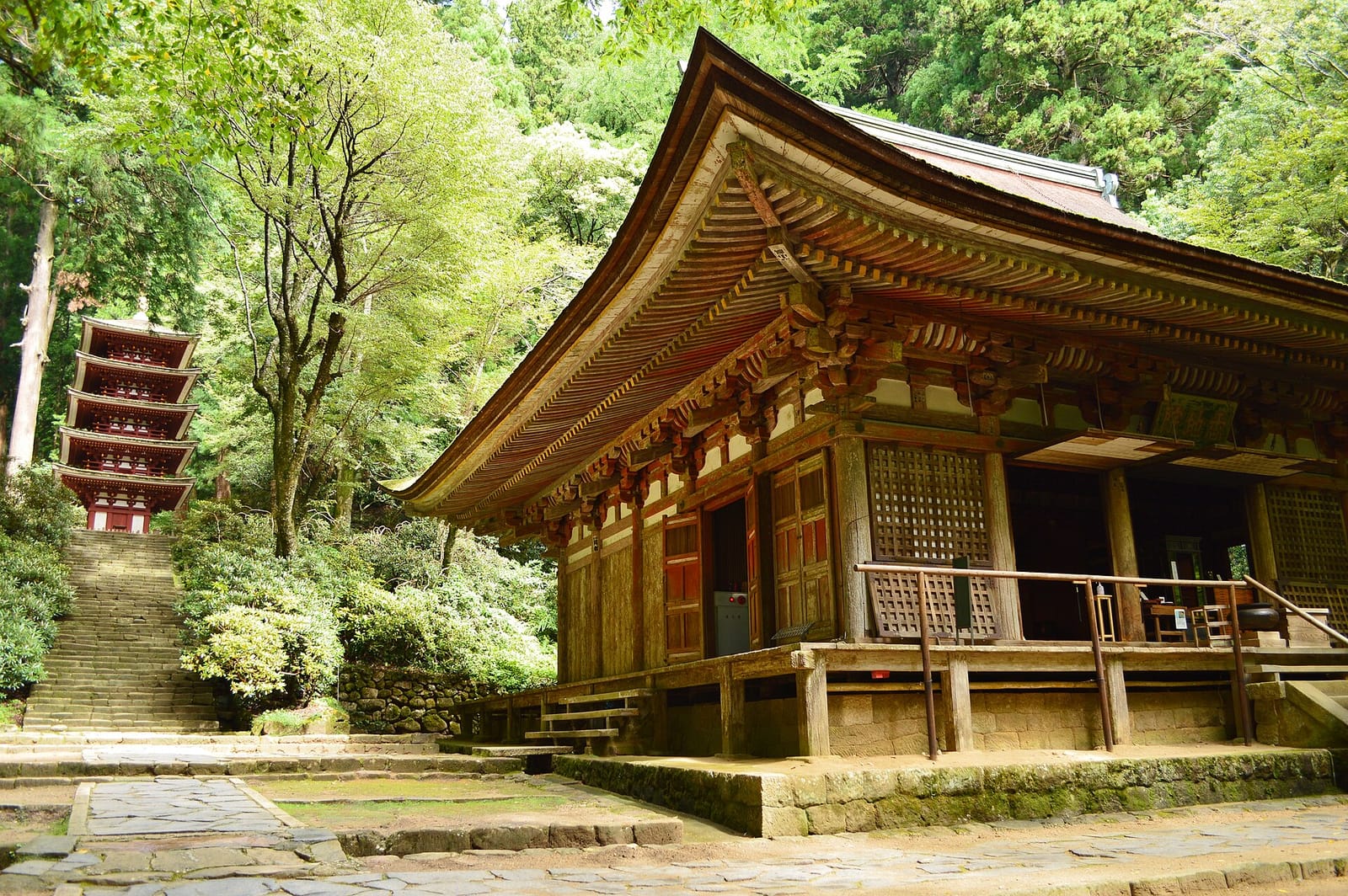
Muro-ji
Photo: Saigen Jiro / CC0 · Original · Resized and croppedHeian period · Temples · National Treasures
Muro-ji
室生寺 (むろうじ)
Muro-ji has three National Treasure buildings: a Five-Storied Pagoda said to be the smallest outdoor pagoda in Japan, an early Heian Kondo and a Kamakura-period Main Hall (Kanjo-do). The pagoda and Kondo are under covers for roof work due to finish in 2027, but you can still worship at the Main Hall and see the Buddhist images in the Treasure Hall.
Key facts
- Designation
- National Treasures
- Era
- Heian period
- Type
- Temples
- Location
- Uda, Nara
- Address
- 奈良県宇陀市室生区室生
Before you go
- Opening hours
- 8:30 to 17:00 (9:00 to 16:00 from December 1 to March 31).
- Closed
- Check the official site
- Admission (adults)
- Admission is ¥600 for adults. The treasure hall normally costs an extra ¥400 but is free while the pagoda and Kondo hall are under repair.
- Time needed
- Check the official site
- Getting there
- From Muroguchi-Ono Station on the Kintetsu Osaka Line, take a Nara Kotsu bus to Murouji-mae (about 14 min, ¥500) and walk about 5 minutes. Drivers use the paid car parks in front of the temple.
- Good to know
- The National Treasure five-storied pagoda and Kondo hall are being reroofed and are hidden under protective covers, so neither their exteriors nor the Kondo interior can be seen (work on the pagoda is due to finish by autumn 2027 and on the Kondo during 2027). The main hall, Mirokudo and Okunoin remain open, and the treasure hall displays the normally hidden Five Wisdom Buddhas from inside the pagoda.
Checked against official information on November 12, 2026. Fees and hours can change, so please also check the official site before you go.
Sources for visitor information
Key facts
- Designation
- National Treasures
- Era
- Heian period
- Type
- Temples
- Location
- Uda, Nara
- Address
- 奈良県宇陀市室生区室生
About this place
Muro-ji is a temple in the mountains of Uda, Nara Prefecture, whose grounds open up beyond a red-lacquered arched bridge, the Taikobashi, over the Muro River. According to the temple, it began at the end of the Nara period, when prayers were offered on this mountain for the recovery of Prince Yamabe, later Emperor Kanmu. Kenkei, a senior monk of Kofuku-ji, then received an imperial order, and soon after the capital moved to Heian-kyo his disciple Shuen built the halls and pagoda. Muro-ji later became a center of esoteric Shingon Buddhism, and because it was open to women while Mount Koya strictly barred them, it has long been known affectionately as "Nyonin Koya" (the Koya for women).
Three of its buildings are National Treasures: the Five-Storied Pagoda, the Golden Hall (Kondo) and the Main Hall (Kanjo-do). The pagoda stands at the top of a steep flight of stone steps west of the Main Hall, on the way to the Okunoin. The temple describes it as the smallest outdoor pagoda in Japan and the oldest after the one at Horyu-ji. The temple dates it to the late Nara period, while the national cultural properties database places it in the early Heian period. It is a three-bay, five-storied pagoda whose cypress-bark roofs and red-painted brackets stand out against the deep woods. In September 1998, Typhoon No. 7 brought down a huge tree that badly damaged the pagoda, but it was restored after repairs.
The Kondo is an early Heian Buddhist hall that stands at the top of the Yoroizaka stone steps leading up from the Nio Gate. It has a hipped roof covered with wooden shingles, and the one-bay-deep section across its front is a worship hall on stilts that was added in the Edo period. According to the temple, before this section was added, the Buddhist images inside could apparently be seen from outside. Inside stands the central image, a standing Shaka Buddha that is a National Treasure and was originally made as a Yakushi Buddha, and behind it is a large painted wooden panel, also a National Treasure, showing a mandala of the deity Taishakuten. The way its robe folds are carved like ripples is known as the "Muro-ji style."
The Main Hall (Kanjo-do) stands up more stone steps beyond the Kondo and was built for kanjo, the most important rite of esoteric Shingon Buddhism. It dates from 1308 in the late Kamakura period and is a five-by-five-bay hall with a hip-and-gable roof covered in cypress bark. The temple describes it as a blend of the traditional Japanese style and the Daibutsu style. The shrine cabinet at the front holds a Nyoirin Kannon (an Important Cultural Property) counted among the three great Nyoirin Kannon images of Japan. The Treasure Hall, opened in 2020, houses the standing Eleven-Faced Kannon that used to be in the Kondo and the seated Shaka Buddha that used to be in the Miroku-do, both National Treasures.
Reroofing work began on the pagoda in August 2026 and on the Kondo in October, and while protective covers are in place, the exteriors of both buildings and the inside of the Kondo cannot be seen. The work is due to finish by autumn 2027 for the pagoda and during 2027 for the Kondo. In the meantime the Main Hall, the Miroku-do and the Okunoin remain open for worship, the Treasure Hall can be visited freely, and for the duration of the work it displays the hidden Five Wisdom Buddhas enshrined inside the pagoda. The grounds lie at about 400 meters above sea level, and the highlights are cherry blossoms in spring, rhododendrons from mid-April, fresh green maples in early summer and autumn leaves. Steep stone steps continue all the way to the Okunoin, so wear comfortable shoes.
Buildings designated as National Treasures
Muro-ji Five-Storied Pagoda
- Era
- Early Heian period
- Structure
- three-bay five-storied pagoda, cypress-bark roofing
- Designated
- June 9, 1951
Muro-ji Golden Hall (Kondo)
- Era
- Early Heian period
- Structure
- five bays wide, five bays deep, single-storied, hipped roof, lean-to roof with a sugaru-hafu gable, one bay wide, along the front, shingle roofing (kokera-buki)
- Designated
- March 29, 1952
Muro-ji Main Hall (Kanjo-do)
- Era
- Late Kamakura period
- Year
- 1308
- Structure
- five bays wide, five bays deep, single-storied, hip-and-gable roof, cypress-bark roofing
- Designated
- March 29, 1952
Sources and date checked
Facts such as eras, structures and locations are edited and translated by us from the Agency for Cultural Affairs’ database of nationally designated cultural properties. The Agency and the national government did not produce this page.
Database of nationally designated cultural properties- Agency for Cultural Affairs, Database of National Cultural Properties: Muro-ji Five-Storied Pagoda
- Agency for Cultural Affairs, Database of National Cultural Properties: Muro-ji Golden Hall (Kondo)
- Agency for Cultural Affairs, Database of National Cultural Properties: Muro-ji Main Hall (Kanjo-do)
- Muro-ji: Halls and Grounds (Muro-ji official)
- Muro-ji: List of Halls (Muro-ji official)
- Muro-ji: Five-Storied Pagoda (Muro-ji official)
- Muro-ji: Founding and Faith (Muro-ji official)
- Muro-ji: Buddhas and Treasures: Kondo (Muro-ji official)
- Muro-ji: Buddhas and Treasures: Main Hall (Kanjo-do) (Muro-ji official)
- Muro-ji: Buddhas and Treasures: Treasure Hall (Muro-ji official)
- Visiting during the reroofing of the pagoda and Kondo (Muro-ji official)
Checked on November 6, 2026
Report an error
If you notice a mistake, please tell us along with a source for the correct information.
Where to go next
Places you could see on the same day, and places worth comparing.
Nearby cultural heritage
Places within 10 km, nearest first. Distances are in a straight line.
More from Nara
Discover more of the same region on our sister sites.
Sake Tabi
Breweries and distilleries in Nara
- FARMENTRY
- Golden Rabbit Beer Taproom
- The GoodWolf Brewery
- Harushika Sake Brewery Shop (Imanishi Seibei Shoten)