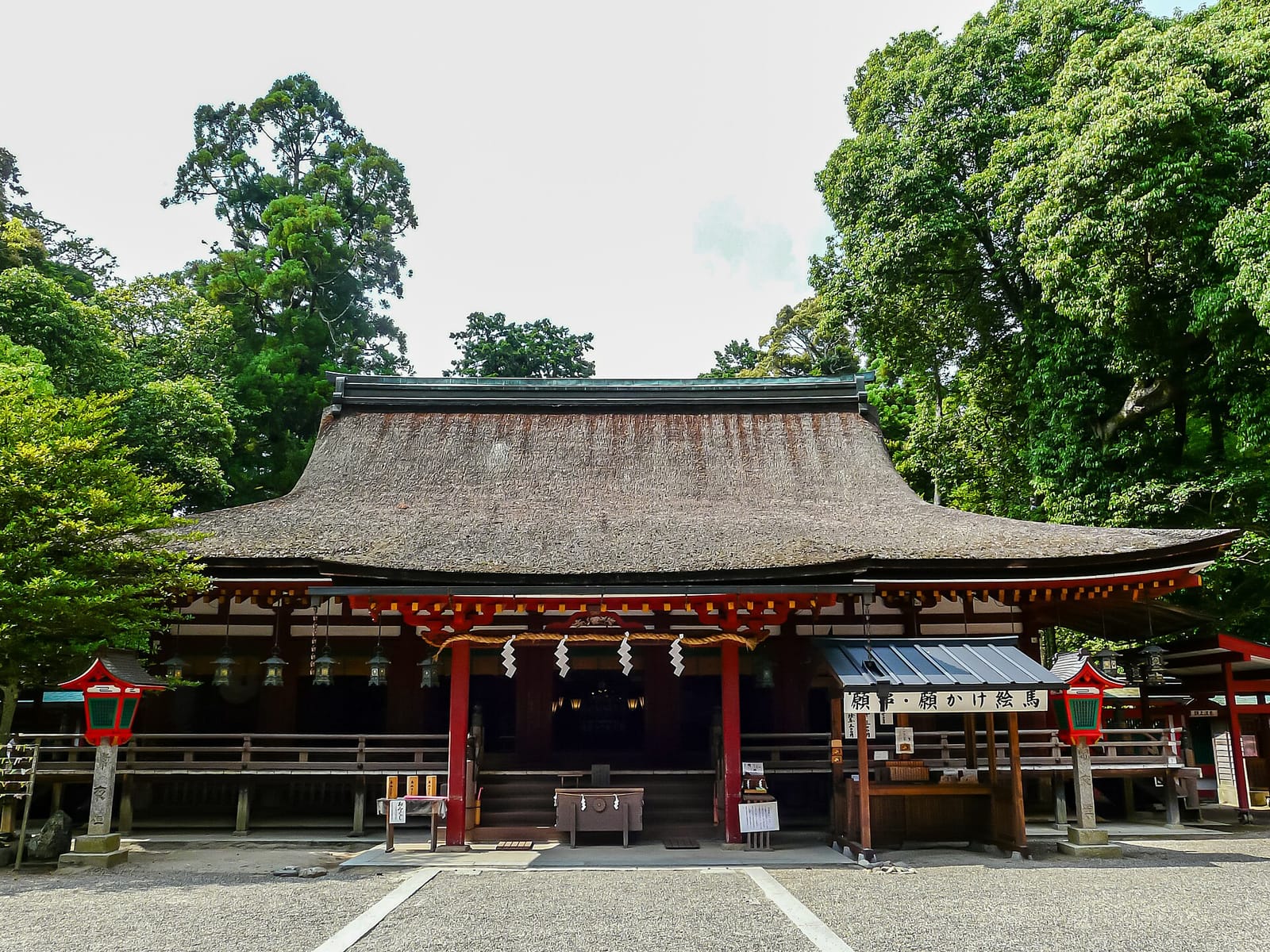
Isonokami Jingu
Photo: Naokijp / CC BY-SA 4.0 · Original · Resized and croppedKamakura period · Shrines · National Treasures
Isonokami Jingu
石上神宮 (いそのかみじんぐう)
At Isonokami Jingu you can see two National Treasures: the Worship Hall (Haiden), said to be the oldest surviving worship hall in Japan, and the Worship Hall of the subsidiary Izumotakeo Shrine, moved here from Uchiyama Eikyu-ji. The stone fence around the forbidden ground behind the hall and the chickens roaming the grounds are also worth seeing.
Key facts
- Designation
- National Treasures
- Era
- Kamakura period
- Type
- Shrines
- Location
- Tenri, Nara
- Address
- 奈良県天理市布留町
Before you go
- Opening hours
- Worship in front of the National Treasure worship hall is possible while the Romon gate is open, roughly 5:30 to 17:30 (times vary by season). The grounds are open to stroll freely.
- Closed
- Check the official site
- Admission (adults)
- Check the official site
- Time needed
- Check the official site
- Getting there
- About 30 minutes on foot or under 10 minutes by taxi (about ¥1,500) from Tenri Station (Kintetsu and JR). From Kintetsu Kyoto Station, an express bound for Tenri takes about 60 minutes. Free car parks around the shrine hold about 160 cars in total.
- Good to know
- As the worship hall is a National Treasure, you may not step inside without permission.
Checked against official information on November 12, 2026. Fees and hours can change, so please also check the official site before you go.
Sources for visitor information
Key facts
- Designation
- National Treasures
- Era
- Kamakura period
- Type
- Shrines
- Location
- Tenri, Nara
- Address
- 奈良県天理市布留町
About this place
Isonokami Jingu stands in Furu-cho, Tenri, Nara Prefecture, on high ground at the northwestern foot of Mt. Furu (266 meters above sea level), at the western foot of Mt. Ryuo. The shrine describes itself as one of the oldest shrines in Japan, and it has long been worshipped as the clan shrine of the Mononobe. According to the shrine's tradition, it began when its deities were enshrined at Furu no Takaniwa in Isonokami in the 7th year of Emperor Sujin, the 10th emperor. In the past it had no main sanctuary, and the forbidden ground behind the worship hall was itself revered as the seat of the deity.
Two of its buildings are National Treasures. According to the shrine, the Worship Hall (Haiden) is said to be the Shinkaden hall of the imperial palace, donated by Emperor Shirakawa in 1081 (Eiho 1) for the shrine's Chinkon-sai ritual. Judging from its architectural style, however, it is thought to date from the early Kamakura period, and the national cultural properties database also lists it as an early Kamakura building. It is said to be the oldest surviving worship hall in Japan. It is seven bays wide and four bays deep, with a hip-and-gable roof of cypress bark and a one-bay porch at the front. Six ridge tags recording later repairs also survive.
Behind the worship hall lies the forbidden ground, about 1,300 square meters in area and enclosed by a stone fence with sword-tip-shaped posts carved with the name "Furu-sha." When the chief priest Kan Masatomo investigated it in 1874 (Meiji 7), the sacred sword Futsu no Mitama came to light, and a main sanctuary to enshrine it was completed by 1913 (Taisho 2). The two-story Romon gate in front of the worship hall is an Important Cultural Property; an ink inscription on its ridge beam shows that it was built in 1318 (Bunpo 2), and the plaque on its upper story was written by Yamagata Aritomo.
The other National Treasure, the Worship Hall of the subsidiary Izumotakeo Shrine, was originally the worship hall of the Sumiyoshi shrine that protected Uchiyama Eikyu-ji, a large temple founded in the Eikyu era (1113-18). After the temple was abolished in 1876 (Meiji 9) as a result of the separation of Shinto and Buddhism, the hall was moved here in 1914 (Taisho 3). The shrine says it was first built in 1137 (Hoen 3) and reached its present form through two rebuildings in the 13th and 14th centuries, while the national database lists it as a late Kamakura building from 1300. It is five bays wide under a gabled roof, and the center serves as a passage topped by a karahafu (curved gable).
About 30 chickens live in the grounds, and the Totenko long-crowing roosters and silkies wandering the approach and the grounds are the shrine's favorites. Kagami Pond is home to a fish designated a Natural Monument of Nara Prefecture, and the Jingu Gaien Park just outside the main approach is planted mostly with cherry trees, which are at their best from late March to early April. On the evening of November 22, the Chinkon-sai ritual is held following a method handed down in the Mononobe clan. The shrine is the midpoint of the Yamanobe-no-michi trail linking Nara with Miwa and Sakurai, and the southern section toward Miwa and Sakurai is the one most people walk.
Buildings designated as National Treasures
Isonokami Jingu Worship Hall (Haiden)
- Era
- Early Kamakura period
- Structure
- seven bays wide, four bays deep, single-storied, hip-and-gable roof, one-bay front porch (kohai), cypress-bark roofing
- Designated
- March 20, 1954
Isonokami Jingu Subsidiary Izumotakeo Shrine Worship Hall
- Era
- Late Kamakura period
- Year
- 1300
- Structure
- five bays wide, one bay deep, single-storied, gabled roof, karahafu gable over the central passage, cypress-bark roofing
- Designated
- March 20, 1954
Sources and date checked
Facts such as eras, structures and locations are edited and translated by us from the Agency for Cultural Affairs’ database of nationally designated cultural properties. The Agency and the national government did not produce this page.
Database of nationally designated cultural properties- Agency for Cultural Affairs, Database of National Cultural Properties: Isonokami Jingu Worship Hall (Haiden)
- Agency for Cultural Affairs, Database of National Cultural Properties: Isonokami Jingu Subsidiary Izumotakeo Shrine Worship Hall
- Isonokami Jingu: History (Isonokami Jingu official)
- Isonokami Jingu: Shrine Grounds (Isonokami Jingu official)
- Isonokami Jingu: Festivals and Rituals (Isonokami Jingu official)
- Isonokami Jingu: Grounds Map, Chickens (Isonokami Jingu official)
- Isonokami Jingu: Grounds Map, Kagami Pond (Isonokami Jingu official)
- Isonokami Jingu: Grounds Map, Jingu Gaien Park (Isonokami Jingu official)
- Isonokami Jingu: Yamanobe-no-michi Trail (Isonokami Jingu official)
Checked on November 6, 2026
Report an error
If you notice a mistake, please tell us along with a source for the correct information.
Where to go next
Places you could see on the same day, and places worth comparing.
Nearby cultural heritage
Places within 10 km, nearest first. Distances are in a straight line.
More from Nara
Discover more of the same region on our sister sites.
Sake Tabi
Breweries and distilleries in Nara
- FARMENTRY
- Golden Rabbit Beer Taproom
- The GoodWolf Brewery
- Harushika Sake Brewery Shop (Imanishi Seibei Shoten)