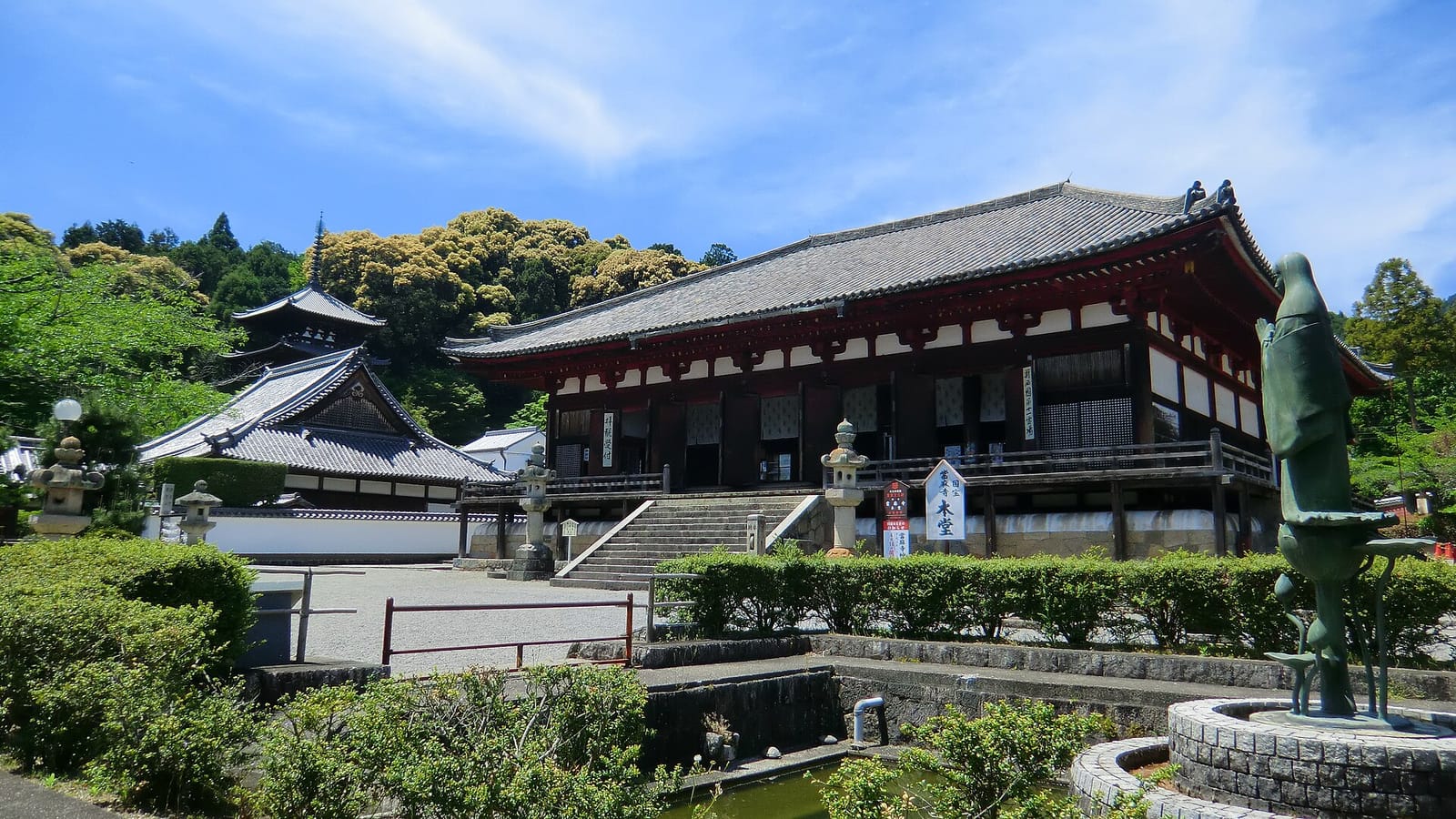
Taima-dera
Photo: 8-hachiro / CC BY-SA 4.0 · Original · Resized and croppedNara period · Temples · National Treasures
Taima-dera
當麻寺 (たいまでら)
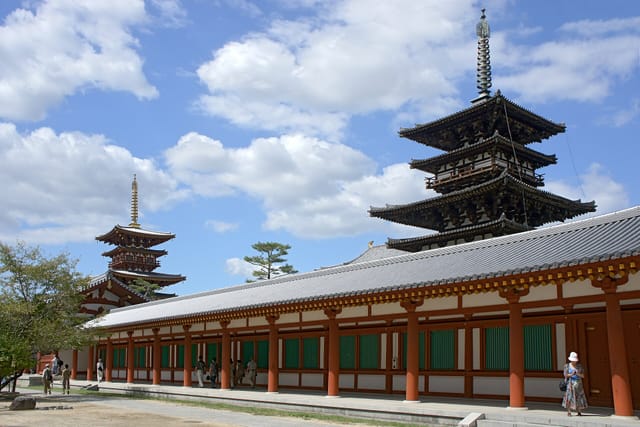
At Taima-dera you can see an ancient pair of three-story pagodas, the Nara-period East Pagoda and the early Heian West Pagoda, together with the late Heian Main Hall (Mandala Hall) that enshrines the Taima Mandala.
Key facts
- Designation
- National Treasures
- Era
- Nara period
- Type
- Temples
- Location
- Katsuragi, Nara
- Address
- 奈良県葛城市當麻
Before you go
- Opening hours
- The grounds and the three main halls (Main Hall, Kondo and Kodo) are open 9:00 to 17:00.
- Closed
- Check the official site
- Admission (adults)
- The grounds are free to walk around, and the National Treasure East and West Pagodas stand within them. A combined ticket for the three halls (Main Hall or Mandala Hall, Kondo and Kodo) costs 1,000 yen for adults, sold at the Main Hall (different on January 1-3). The Naka-no-bo sub-temple charges separately: 500 yen for adults (500 yen more from November 13 to 30, 2026, for a special opening).
- Time needed
- Check the official site
- Getting there
- Taimadera Station on the Kintetsu Minami-Osaka Line is about a 15-minute walk away. It is about 40 minutes by semi-express from Osaka-Abenobashi; from Nara or Kyoto, change at Kashiharajingu-mae. Drivers can use the municipal Taima sightseeing car park (7-8 minutes' walk to the grounds) or private lots in front of the Nio-mon gate. The temple-town street is narrow and parking is limited, so the temple recommends coming by train.
- Best time to visit
- Every April 14, the Nerikuyo-eshiki ceremony re-enacts the 25 bodhisattvas welcoming Princess Chujo to paradise (from 16:00). Naka-no-bo holds special openings, for example in late November.
- Good to know
- During the peony season cars are banned from the approach, so the temple asks visitors to come by train during Golden Week and on the day of the Nerikuyo ceremony. The Okuin car park behind the temple is only for Okuin visitors, and you cannot enter the main grounds free of charge through the Okuin entrance.
Checked against official information on November 13, 2026. Fees and hours can change, so please also check the official site before you go.
Sources for visitor information
Key facts
- Designation
- National Treasures
- Era
- Nara period
- Type
- Temples
- Location
- Katsuragi, Nara
- Address
- 奈良県葛城市當麻
About this place
Taima-dera is an old temple in Taima, Katsuragi, Nara Prefecture, with its halls spread out at the eastern foot of Mt. Nijo. According to the temple, it began in 612 as Manpozo-in, built in Kawachi by Prince Maroko, the third son of Emperor Yomei, following the teachings of his elder brother, Prince Shotoku. Later the prince's grandson, Taima no Kunimi, moved the temple to this site, and En no Gyoja donated the land. The temple dates the start of today's Taima-dera to 681, when the principal image, a statue of Miroku Buddha, was enshrined in the Kondo.
In the Nara period the East Pagoda, West Pagoda and the Senju Hall (today's Mandala Hall) were added, and the temple took shape. It is the only temple in Japan where an ancient pair of east and west three-story pagodas still stands. At its height in the Heian period it was a large temple with more than forty monks' residences, and 13 of them remain today. During the burning of the Nara temples in 1180, the Lecture Hall burned down completely and the Kondo was badly damaged, but both were rebuilt in the Kamakura period. Since Ojo-in (today's Oku-in) of the Jodo school was founded in 1370, the Shingon and Jodo schools have looked after the temple together.
The Main Hall (Mandala Hall), a National Treasure, is a large building seven bays wide and six bays deep with a hip roof covered in hongawara tiles. The temple explains that the inner sanctuary keeps the style of the Tenpyo period, and that in the Eiryaku era (end of the Heian period) the outer sanctuary and other parts were added, wrapping around the older hall. The national cultural properties database dates the building to 1161. The principal image, the Taima Mandala, is a huge hanging picture four meters square, known for the legend that Princess Chujo wove it in a single night; today a copy, the Bunki Mandala (an Important Cultural Property), is enshrined. The shrine cabinet that holds the mandala and the altar platform donated by Minamoto no Yoritomo are also National Treasures.
The East Pagoda and West Pagoda are both three-bay, three-story pagodas roofed with hongawara tiles. The East Pagoda, built first, dates from the Nara period and is the oldest building at the temple. The West Pagoda was built a little later, so its style also differs. The temple dates the West Pagoda to between the Nara and Heian periods, while the national cultural properties database gives the early Heian period. The Kondo (an Important Cultural Property) enshrines a seated Miroku Buddha (a National Treasure) said to be the oldest clay statue in Japan, and near the Nio Gate hangs a temple bell cast in the 680s that is said to be the oldest in Japan (a National Treasure).
The grounds are free to walk around, and you can see both pagodas up close from within them. The three main halls, the Main Hall, Kondo and Lecture Hall, are visited with a ticket bought at the Main Hall. The subtemple Naka-no-bo has a garden called Kogu-en that uses the East Pagoda as borrowed scenery, with a separate admission fee. Every year on April 14, the Nerikuyo-eshiki ceremony recreates the scene of twenty-five bodhisattvas welcoming Princess Chujo to paradise. From late April to early May, about 1,200 peony plants bloom at Naka-no-bo.
Buildings designated as National Treasures
Taima-dera East Pagoda
- Era
- Nara period
- Structure
- Three-bay, three-story pagoda, traditional tile roofing
- Designated
- March 29, 1952
Taima-dera West Pagoda
- Era
- Early Heian period
- Structure
- Three-bay, three-story pagoda, traditional tile roofing
- Designated
- March 29, 1952
Taima-dera Main Hall (Mandala Hall)
- Era
- Late Heian period
- Year
- 1161
- Structure
- 7 bays wide, 6 bays deep, single-story, hip roof, traditional tile roofing, including the akadana offering shelf
- Designated
- March 29, 1952
Sources and date checked
Facts such as eras, structures and locations are edited and translated by us from the Agency for Cultural Affairs’ database of nationally designated cultural properties. The Agency and the national government did not produce this page.
Database of nationally designated cultural properties- Agency for Cultural Affairs, Database of National Cultural Properties: Taima-dera East Pagoda
- Agency for Cultural Affairs, Database of National Cultural Properties: Taima-dera West Pagoda
- Agency for Cultural Affairs, Database of National Cultural Properties: Taima-dera Main Hall (Mandala Hall)
- Taima-dera: History (Taima-dera Naka-no-bo)
- Taima-dera: Founding and Relocation (Taima-dera Naka-no-bo)
- Taima-dera: Rise, Decline and Change (Taima-dera Naka-no-bo)
- Taima-dera: Visitor Guide (Taima-dera Naka-no-bo)
- Taima-dera Visitor Guide: Naka-no-bo (Taima-dera Naka-no-bo)
- Taima-dera Visitor Guide: The Three Main Halls (Taima-dera Naka-no-bo)
- Taima-dera Visitor Guide: Walking the Grounds (Taima-dera Naka-no-bo)
- Taima-dera: The Taima Mandala (Taima-dera Naka-no-bo)
- Taima-dera: News (Taima-dera Naka-no-bo)
Checked on November 6, 2026
Report an error
If you notice a mistake, please tell us along with a source for the correct information.
Where to go next
Places you could see on the same day, and places worth comparing.
Nearby cultural heritage
Places within 10 km, nearest first. Distances are in a straight line.
More from Nara
Discover more of the same region on our sister sites.
Sake Tabi
Breweries and distilleries in Nara
- FARMENTRY
- Golden Rabbit Beer Taproom
- The GoodWolf Brewery
- Harushika Sake Brewery Shop (Imanishi Seibei Shoten)