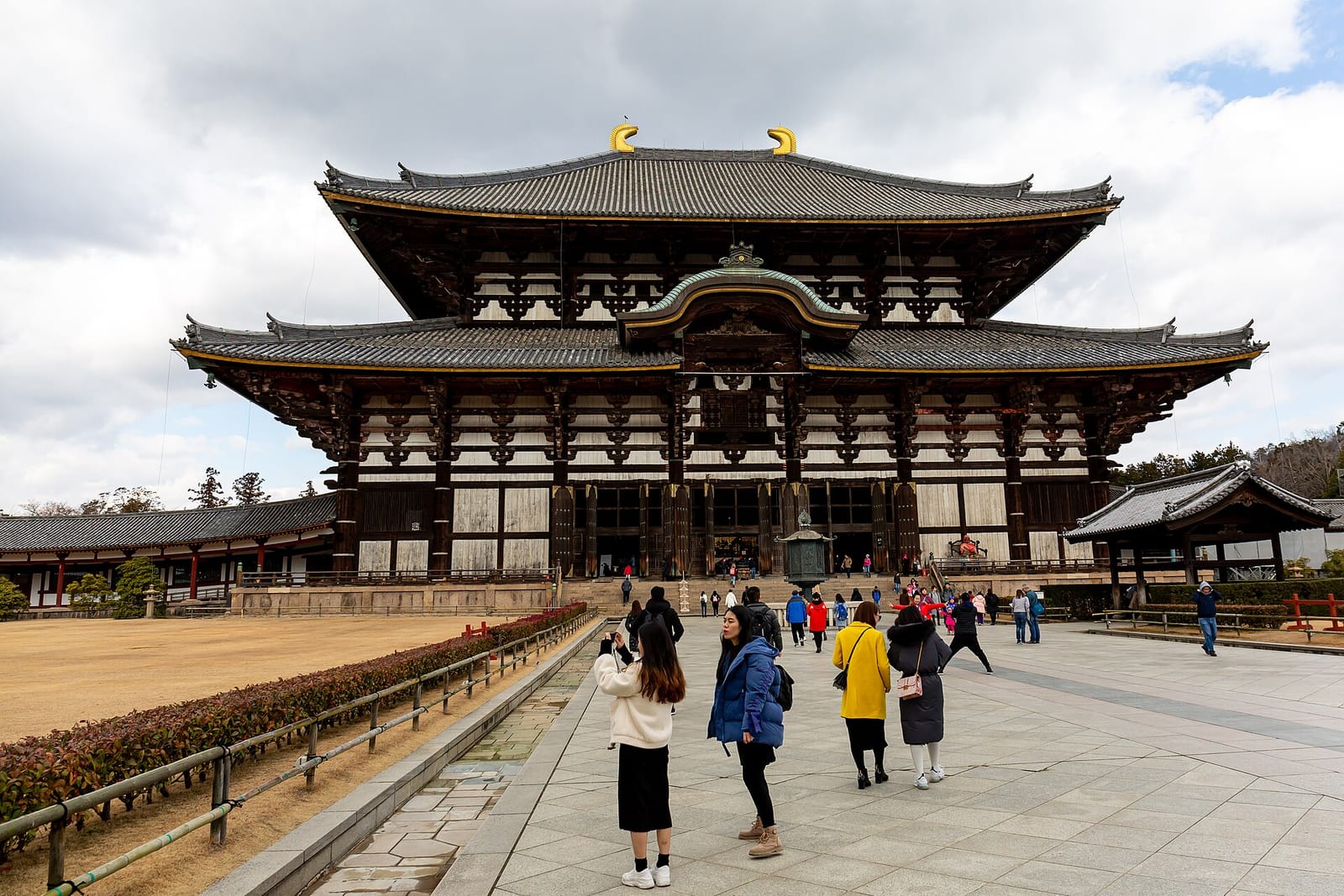
The Great Buddha Hall
Photo: Balon Greyjoy / CC0 · Original · Resized and croppedNara period · Temples · National Treasures
Todai-ji
東大寺 (とうだいじ)
Built around the Great Buddha commissioned by Emperor Shomu, Todai-ji has National Treasure buildings that trace its history of fire and rebuilding: the Edo-period Great Buddha Hall, the Nandaimon Gate rebuilt by Chogen in the Daibutsu style, and the Tenpyo-era Hokkedo.
Key facts
- Designation
- National Treasures
- Era
- Nara period
- Type
- Temples
- Location
- Nara, Nara
- Address
- 奈良県奈良市雑司町
Before you go
- Opening hours
- The Great Buddha Hall is open 7:30-17:30 from April to October and 8:00-17:00 from November to March. The Hokkedo (Sangatsudo) and Kaidando are open 8:30-16:00. The Todaiji Museum is open 9:30-17:30 from April to October (last entry 17:00) and 9:30-17:00 from November to March (last entry 16:30). The Nigatsudo can be visited 24 hours a day.
- Closed
- Open every day unless there is a special event or emergency.
- Admission (adults)
- The Great Buddha Hall, the Hokkedo (Sangatsudo), the Kaidando and the Todaiji Museum each charge ¥800 for adults. A combined ticket for the Great Buddha Hall and the museum is ¥1,200. Cash only.
- Time needed
- Check the official site
- Getting there
- From JR or Kintetsu Nara Station, take the city loop bus to Todaiji Daibutsuden Kasugataisha-mae and walk 5 minutes. From Kintetsu Nara Station it is about a 20-minute walk east along Noborioji Street. The temple has no car park of its own, so use a nearby paid one.
- Best time to visit
- The Shuni-e at the Nigatsudo, known as Omizutori, is held March 1-15. On August 7 the Great Buddha is ritually cleaned, and on August 13 and 14 the Great Buddha Hall opens free at night from 19:00 to 21:00. On New Year's Day the hall's Middle Gate opens from midnight to 8:00 for free visits.
- Good to know
- The Nigatsudo is open at night, but visitors are asked to keep quiet around the hall. On weekends and holidays in spring and autumn, Nara Prefecture runs free tourist car parks and the Gurutto Bus costs ¥100.
Checked against official information on November 12, 2026. Fees and hours can change, so please also check the official site before you go.
Sources for visitor information
Key facts
- Designation
- National Treasures
- Era
- Nara period
- Type
- Temples
- Location
- Nara, Nara
- Address
- 奈良県奈良市雑司町
About this place
Todai-ji grew around the great Vairocana Buddha that Emperor Shomu vowed to build. The temple's chronology says that after Fujiwara no Hirotsugu's rebellion in 740, Shomu left Heijo-kyo and moved the capital several times, and in 743 he issued the edict to build the great Buddha at Shigaraki. When he returned to Heijo-kyo in 745, work resumed on the grounds of Kinshozan-ji, the predecessor of Todai-ji. Casting of the Buddha's body finished in October 749, and the eye-opening ceremony took place in April 752. The temple honors four figures, Emperor Shomu, Gyoki, Roben and Bodhisena, as the "Four Saints" who built it.
Most of the halls and towers standing today, however, are not from the Nara period. In 1180 the fire set by Taira no Shigehira destroyed most of the complex, and Chogen was appointed head of fundraising the following year to lead the rebuilding. The Great Buddha Hall was dedicated in 1195 but burned again in 1567 in the fighting of Miyoshi and Matsunaga. In the Edo period Kokei pushed the restoration, and the hall's dedication took place in 1709. The temple explains that today's hall was built with its east-west width reduced to about 60 percent of the Nara and Kamakura originals. The National Treasure Golden Hall (Daibutsu-den) is dated to 1705, in the mid-Edo period.
The Nandaimon (Great South Gate) best conveys Chogen's rebuilding. Its ridgepole was raised in 1199 and the gate was completed in 1203 together with its guardian statues. It is built in the Daibutsu-yo style, influenced by Song China: a five-bay, three-door, two-story gate whose eighteen great pillars rise nearly to the roof's interior, with a height of 25.46 meters above the base. The Kongo Rikishi guardians on either side, the open-mouthed and closed-mouthed figures, each stand close to 8.4 meters; the temple records that Unkei, Kaikei and others carved them in 1203. Repairs from 1988 to 1993 revealed sutras and inked inscriptions naming the sculptors inside the statues.
Besides the Great Buddha Hall, the Hokke-do (Sangatsu-do) and Nigatsu-do deserve a visit. The Hokke-do is regarded as Todai-ji's oldest building, thought to date from the Tenpyo era. It consists of a main hall and a worship hall, and the present worship hall was newly built by Chogen in 1199. Ten Nara-period statues designated National Treasures are enshrined inside. The Nigatsu-do burned in 1667 during the Shuni-e rites, and the present building was rebuilt two years later. Its name comes from the fact that the Shuni-e is held in this hall in the second month of the old calendar. Buildings from the Nara to the Edo periods stand here, tracing the temple's history of fires and rebuilding.
Buildings designated as National Treasures
Todai-ji Great South Gate (Nandaimon)
- Era
- Early Kamakura period
- Year
- 1199
- Structure
- five-bay, three-door two-tiered gate (nijumon), hip-and-gable roof, tiled roofing (honkawara-buki)
- Designated
- June 9, 1951
Todai-ji Hokke-do Hall
- Era
- Nara period
- Structure
- front five bays, side eight bays, hip-and-gable roof at the front, hipped roof at the rear, tiled roofing (honkawara-buki)
- Designated
- June 9, 1951
Todai-ji Bell Tower
- Era
- Early Kamakura period
- Structure
- one bay wide, one bay deep, single-storied, hip-and-gable roof, tiled roofing (honkawara-buki)
- Designated
- June 9, 1951
Todai-ji Golden Hall (Daibutsu-den, Great Buddha Hall)
- Era
- Mid-Edo period
- Year
- 1705
- Structure
- five bays wide, five bays deep, single-storied with mokoshi (skirt roof), hipped roof, tiled roofing (honkawara-buki), with a karahafu gable on the front, copper-plate roofing
- Designated
- March 29, 1952
Todai-ji Founder's Hall (Kaizan-do)
- Era
- Early Kamakura period
- Structure
- three bays wide, three bays deep, single-storied, pyramidal roof (hogyo-zukuri), tiled roofing (honkawara-buki)
- Designated
- March 31, 1953
Todai-ji Tegai-mon Gate
- Era
- Nara period
- Structure
- three-bay, one-door eight-legged gate (yakyakumon), gabled roof, tiled roofing (honkawara-buki)
- Designated
- March 29, 1952
Todai-ji Honbo Sutra Storehouse
- Era
- Nara period
- Structure
- three bays wide, two bays deep, azekura log-walled storehouse, hipped roof, tiled roofing (honkawara-buki)
- Designated
- March 31, 1953
Todai-ji Nigatsu-do Hall
- Era
- Mid-Edo period
- Year
- 1669
- Structure
- kake-zukuri (built on stilts), ten bays wide, seven bays deep, single-storied, hipped roof, tiled roofing (honkawara-buki)
- Designated
- December 27, 2005
Sources and date checked
Facts such as eras, structures and locations are edited and translated by us from the Agency for Cultural Affairs’ database of nationally designated cultural properties. The Agency and the national government did not produce this page.
Database of nationally designated cultural properties- Agency for Cultural Affairs, Database of National Cultural Properties: Todai-ji Great South Gate (Nandaimon)
- Agency for Cultural Affairs, Database of National Cultural Properties: Todai-ji Hokke-do Hall
- Agency for Cultural Affairs, Database of National Cultural Properties: Todai-ji Bell Tower
- Agency for Cultural Affairs, Database of National Cultural Properties: Todai-ji Golden Hall (Daibutsu-den, Great Buddha Hall)
- Agency for Cultural Affairs, Database of National Cultural Properties: Todai-ji Founder's Hall (Kaizan-do)
- Agency for Cultural Affairs, Database of National Cultural Properties: Todai-ji Tegai-mon Gate
- Agency for Cultural Affairs, Database of National Cultural Properties: Todai-ji Honbo Sutra Storehouse
- Agency for Cultural Affairs, Database of National Cultural Properties: Todai-ji Nigatsu-do Hall
- Todai-ji official site: Founding in the Nara Period
- Todai-ji official site: Reconstruction in the Kamakura Period
- Todai-ji official site: Revival in the Edo Period
- Todai-ji official site: Nandaimon (Great South Gate)
- Todai-ji official site: Nigatsu-do
- Todai-ji official site: Hokke-do (Sangatsu-do)
Checked on November 6, 2026
Report an error
If you notice a mistake, please tell us along with a source for the correct information.
Where to go next
Places you could see on the same day, and places worth comparing.
Nearby cultural heritage
Places within 10 km, nearest first. Distances are in a straight line.
More from Nara
Discover more of the same region on our sister sites.
Sake Tabi
Breweries and distilleries in Nara
- FARMENTRY
- Golden Rabbit Beer Taproom
- The GoodWolf Brewery
- Harushika Sake Brewery Shop (Imanishi Seibei Shoten)