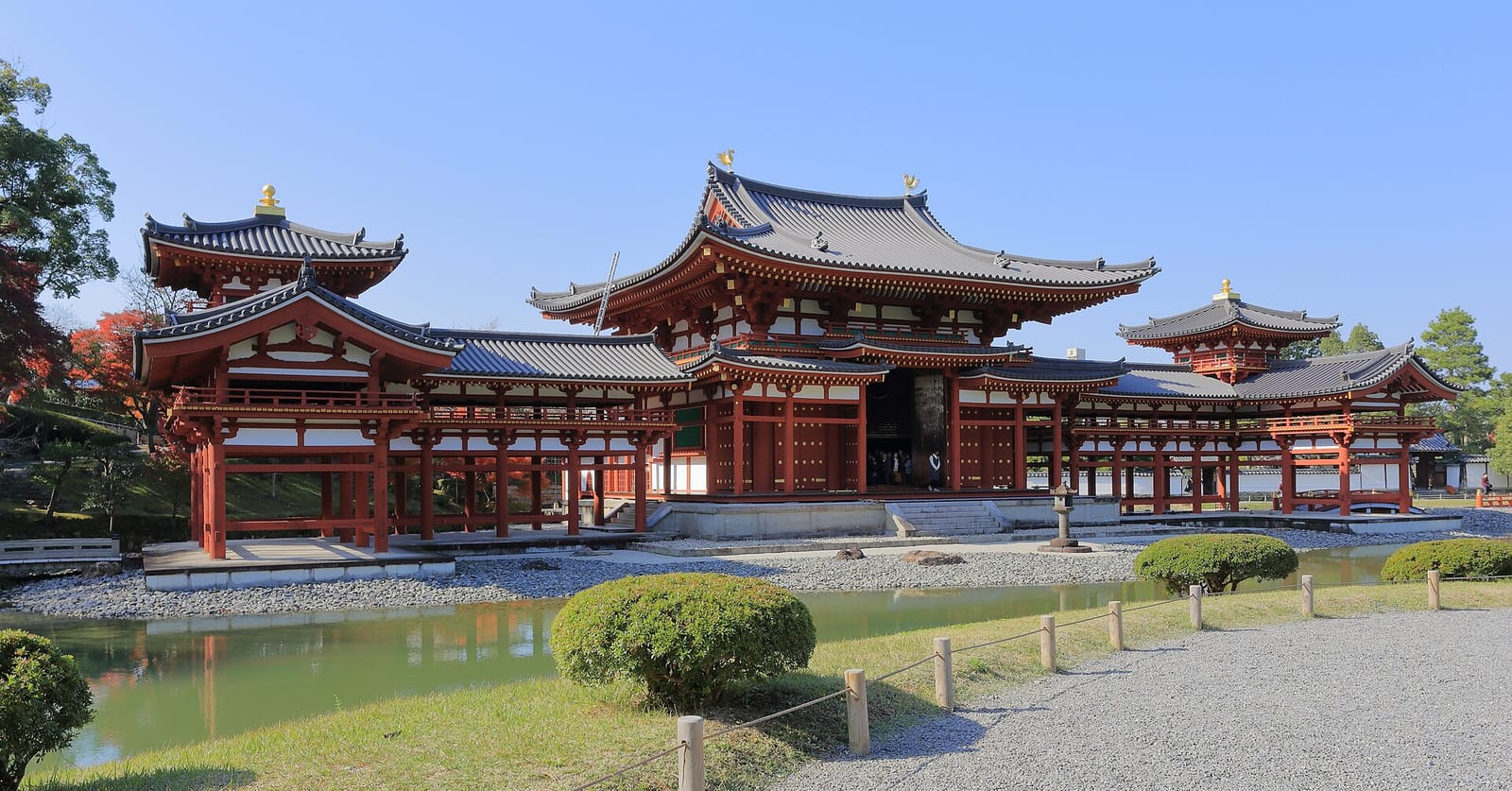
The Phoenix Hall
Photo: Martin Falbisoner / CC BY-SA 4.0 · Original · Resized and croppedHeian period · Temples · National Treasures
Byodo-in
平等院 (びょうどういん)
Built by Fujiwara no Yorimichi in 1053, the Phoenix Hall spreads its wing corridors out from a central hall enshrining Amida Buddha and is mirrored in the pond in front, a National Treasure familiar from the ¥10 coin. Inside you can see Jocho's seated Amida Buddha.
Key facts
- Designation
- National Treasures
- Era
- Heian period
- Type
- Temples
- Location
- Uji, Kyoto
- Address
- 京都府宇治市宇治蓮華
Before you go
- Opening hours
- The garden is open 8:45 to 17:30 (last entry 17:15) and the Hoshokan Museum 9:00 to 17:00 (last entry 16:45). Tours inside the Phoenix Hall run about every 20 minutes from 9:30 to 16:10, 35 people each; tickets are first come, first served from 9:10.
- Closed
- Open every day (garden and Hoshokan Museum).
- Admission (adults)
- ¥700 for adults for the garden and Hoshokan Museum. Entering the Phoenix Hall costs an extra ¥300 donation.
- Time needed
- About 40 minutes for the Phoenix Hall exterior and the Hoshokan Museum. Allow 90 to 120 minutes if you add the sub-temples, tea room and shop. The Phoenix Hall interior tour takes about 15 minutes, plus waiting time.
- Getting there
- From JR Kyoto Station, take the JR Nara Line (Miyakoji Rapid) about 17 minutes to Uji Station, then walk 10 minutes. From Keihan Gion-Shijo or Sanjo stations, take the Keihan Main Line to Chushojima, change to the Uji Line, and walk 10 minutes from Keihan Uji Station. The temple has no parking of its own; use nearby coin parking or the private Uji car park in front of the South Gate.
- Good to know
- From October 16, 2026, each Phoenix Hall interior tour takes only 35 people, and the temple warns of longer waits in the busy spring and autumn seasons. Tours may be suspended in bad weather or for temple events. Night viewings have been suspended since spring 2026.
Checked against official information on November 12, 2026. Fees and hours can change, so please also check the official site before you go.
Sources for visitor information
Key facts
- Designation
- National Treasures
- Era
- Heian period
- Type
- Temples
- Location
- Uji, Kyoto
- Address
- 京都府宇治市宇治蓮華
About this place
Byodo-in began in 1052 (Eisho 7), when the regent Fujiwara no Yorimichi turned a villa inherited from his father, Fujiwara no Michinaga, into a temple. That year is regarded as the first year of the Final Age of the Dharma (mappo), a time when faith in the Pure Land and a hope for paradise was spreading. In 1053 (Tengi 1) the Amida hall, that is, the Phoenix Hall, was completed, and a jo-roku seated Amida Tathagata made by the sculptor Jocho was enshrined inside. Keeping in mind that the temple began from both a noble's private residence and a hope for the afterlife helps explain why garden and building were designed as one.
Four buildings of the Phoenix Hall are designated National Treasures: the central hall, the north and south wing corridors, and the tail corridor, all dated to 1053. Wing corridors extend left and right from the central hall, and each ends in a two-story corner tower of three levels. The wings bend as they extend, eight bays in length and one bay deep, with the corridor part built as one story with an upper level. Behind it runs a seven-bay tail corridor, so the whole composition spreads horizontally from the central hall. When viewing the exterior, check how the roof lines of the central hall and the two wings overlap, together with their reflection on the pond.
In 1951 the Phoenix Hall and the seated Amida Tathagata were designated National Treasures, and in the same year the Phoenix Hall was adopted as the design on the 10-yen coin. Comparing a coin from your pocket with the real building is a pleasure you can only have here. The Phoenix Hall had a Meiji repair from 1902 to 1907 and a major Showa repair from 1950 to 1957; during the Meiji repair, the Bodhisattvas Amid the Clouds on the walls were also restored to their present appearance. The phoenixes on the roof, the bronze bell, and the doors' paintings of the central hall were replaced in turn between 1967 and 1972. So the details you see today mix Heian-period work and later additions.
The garden was reworked from 1990 to 2003, including the restoration of the pebble shoreline. In 1994 the temple was inscribed on the UNESCO World Heritage List as one of the Historic Monuments of Ancient Kyoto. The Hoshokan museum on the grounds displays temple treasures including National Treasures. Uji, where Byodo-in stands, is presented on the official site as a town tied to tea culture, and the official site also lists a tea room. Entering the Phoenix Hall interior is guided separately from viewing the exterior, so check the official site beforehand for the procedure.
Buildings designated as National Treasures
Byodo-in Phoenix Hall (Central Hall)
- Era
- Mid-Heian period
- Year
- 1053
- Structure
- central hall, two wing corridors, consisting of the tail corridor
- Designated
- June 9, 1951
Byodo-in Phoenix Hall (Wing Corridor, North)
- Era
- Mid-Heian period
- Year
- 1053
- Structure
- bent length of eight bays, one bays deep, corner towers with two roofs and three stories, pyramidal hip roof (hogyo-zukuri), corridors with one roof and two stories
- Designated
- June 9, 1951
Byodo-in Phoenix Hall (Wing Corridor, South)
- Era
- Mid-Heian period
- Year
- 1053
- Structure
- bent length of eight bays, one bays deep, corner towers with two roofs and three stories, pyramidal hip roof (hogyo-zukuri), corridors with one roof and two stories
- Designated
- June 9, 1951
Byodo-in Phoenix Hall (Tail Corridor)
- Era
- Mid-Heian period
- Year
- 1053
- Structure
- seven bays wide, one bays deep, single-story, gable roof, hongawara tile roofing
- Designated
- June 9, 1951
Sources and date checked
Facts such as eras, structures and locations are edited and translated by us from the Agency for Cultural Affairs’ database of nationally designated cultural properties. The Agency and the national government did not produce this page.
Database of nationally designated cultural properties- Agency for Cultural Affairs, Database of National Cultural Properties: Byodo-in Phoenix Hall (Central Hall)
- Agency for Cultural Affairs, Database of National Cultural Properties: Byodo-in Phoenix Hall (Wing Corridor, North)
- Agency for Cultural Affairs, Database of National Cultural Properties: Byodo-in Phoenix Hall (Wing Corridor, South)
- Agency for Cultural Affairs, Database of National Cultural Properties: Byodo-in Phoenix Hall (Tail Corridor)
- Byodo-in official site: History
- Byodo-in official site: English
Checked on November 6, 2026
Report an error
If you notice a mistake, please tell us along with a source for the correct information.
Where to go next
Places you could see on the same day, and places worth comparing.
Nearby cultural heritage
Places within 10 km, nearest first. Distances are in a straight line.
More from Kyoto
Discover more of the same region on our sister sites.
Matsuri Biyori
UNESCO-listed festivals in Kyoto
- Yamahoko, the float ceremony of the Kyoto Gion festival
- Kyoto no Rokusai Nenbutsu
- Yasuraibana
- Kuta no Hanagasa Odori
Meiga no Furusato
Paintings linked to Kyoto
- View of Amanohashidate
- Viewing Maple Leaves
- Scenes in and around Kyoto (Funaki Version)
- Morning View of Uji River