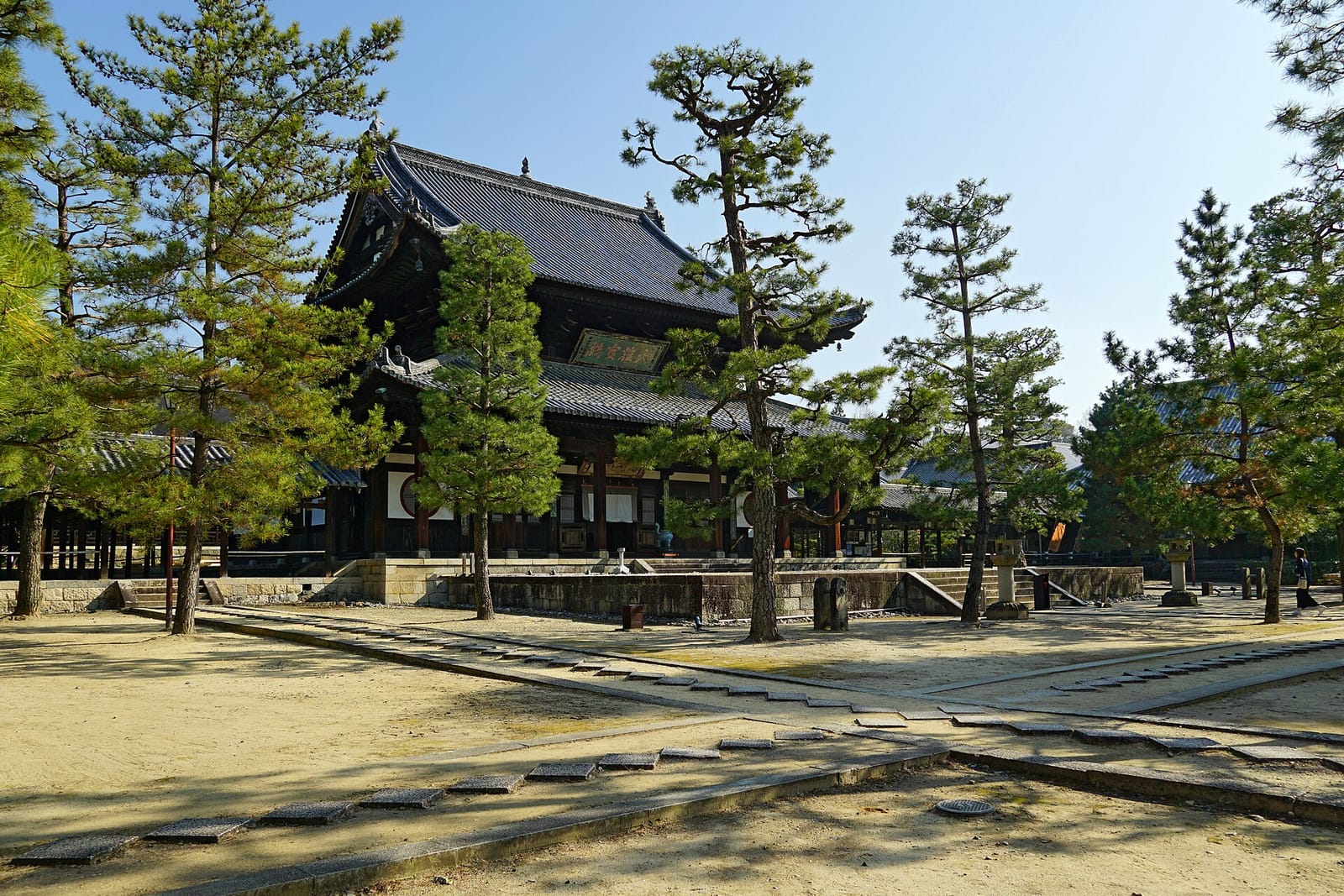
Manpuku-ji
Photo: 663highland / CC BY-SA 4.0 · Original · Resized and croppedEdo period · Temples · National Treasures
Manpuku-ji
萬福寺 (まんぷくじ)
The head temple of the Obaku school of Zen, founded by Yinyuan (Ingen), where three National Treasure halls in the Chinese Ming style, the Tennoden, the Daiyuhoden and the Hatto, stand in a straight line. You can see designs rarely found at other temples, such as the teak main hall and the arched Obaku ceilings.
Key facts
- Designation
- National Treasures
- Era
- Edo period
- Type
- Temples
- Location
- Uji, Kyoto
- Address
- 京都府宇治市五ヶ庄三番割
Before you go
- Opening hours
- 9:00 to 17:00 (last entry 16:30).
- Closed
- Check the official site
- Admission (adults)
- Admission is ¥500 for adults.
- Time needed
- Check the official site
- Getting there
- Obaku Station on the JR Nara Line and Keihan Uji Line is a 5-minute walk away. The temple's main car park to the south charges ¥600 for the first 90 minutes, then ¥200 per 30 minutes.
Checked against official information on November 12, 2026. Fees and hours can change, so please also check the official site before you go.
Sources for visitor information
Key facts
- Designation
- National Treasures
- Era
- Edo period
- Type
- Temples
- Location
- Uji, Kyoto
- Address
- 京都府宇治市五ヶ庄三番割
About this place
Manpuku-ji in Uji, Kyoto Prefecture, is the head temple of the Obaku school of Zen, and its mountain name is Obakusan. According to the temple, Zen master Yinyuan Longqi (Ingen Ryuki), abbot of Wanfu Temple on Mount Huangbo in Fujian, China, answered repeated invitations from Japan and arrived in 1654 at the age of 63 with 20 disciples. Gaining the reverence of the Retired Emperor Gomizuno-o and the Tokugawa shogunate, he was granted land in Uji and opened the temple in 1661, giving it the same name as his home temple in China. Obaku is one of Japan's three Zen schools, along with Rinzai and Soto, and it became an independent school in 1876 (Meiji 9).
The temple buildings follow the style of the late Ming dynasty in China and are laid out symmetrically, all facing west. The Somon gate, the Sanmon gate, the Tennoden, the Daiyuhoden and the Hatto stand on one straight line, and every hall is linked by roofed corridors. The national cultural properties database dates the Hatto to 1662 and the Tennoden and Daiyuhoden to 1668. According to the temple, the buildings use teak from South and Southeast Asia, and designs rarely seen at other Japanese temples appear throughout: railings with broken swastika patterns, round windows, peach-shaped ornaments called tofu on the doors, and the arched "Obaku ceilings."
In 2024, three buildings, the Tennoden, the Daiyuhoden and the Hatto, were designated National Treasures. The Tennoden, built in 1668 beyond the Sanmon gate, serves as the temple's entrance hall. This hip-and-gable building with hongawara tiles enshrines Maitreya, the Four Heavenly Kings and Skanda (Idaten), as Chinese temples do. The statue of Budai (Hotei), regarded as an incarnation of Maitreya, was made by Fan Daosheng in 1663, and the temple treats it as the Maitreya Buddha. The hall's railings have X-shaped lattices, a Chinese design that is unusual in Japan.
The Daiyuhoden, the main hall, dates from 1668 and is the largest building on the grounds. The temple describes it as the largest, and the only, historic building in Japan made with teak. From outside it seems to have two roofs, but the lower one is decorative and the interior is a single story. The principal image, Shakyamuni Buddha, is a wooden statue 250 cm tall made in 1669, flanked by the disciples Kasyapa and Ananda, with statues of the Eighteen Arhats lined up on both sides. Under the front eaves is the rounded Obaku ceiling, said to represent a dragon's belly. The Hatto at the very back, built in 1662, is the hall for sermons; inside there is only an altar platform, and the railings in front bear swastika and broken swastika patterns.
The paths on the grounds are of a distinctive kind, with square flagstones laid as diamonds and edged with stone strips, representing the scales on a dragon's back; only the abbot may stand on the diamond-shaped stones. Turning north from the path between the Sanmon gate and the Tennoden leads to the Kaisando, which enshrines Yinyuan. At the temple you can taste fucha ryori, the vegetarian cuisine he brought from China. On the second Sunday of every month except February and August, the "Hotei Matsuri" fair is held in honor of the Budai statue in the Tennoden, and on April 3 a memorial service is held for Yinyuan.
Buildings designated as National Treasures
Manpuku-ji Daiyuhoden (Main Hall)
- Era
- Mid-Edo period
- Year
- 1668
- Structure
- three bays wide, three bays deep, single-story with mokoshi (skirt roof), hip-and-gable roof, hongawara tile roofing, with a moon platform (gettai) at the front
- Designated
- December 9, 2024
Manpuku-ji Hatto (Dharma Hall)
- Era
- Mid-Edo period
- Year
- 1662
- Structure
- five bays wide, six bays deep, single-story, hip-and-gable roof, sangawara tile roofing
- Designated
- December 9, 2024
Manpuku-ji Tennoden (Hall of Heavenly Kings)
- Era
- Mid-Edo period
- Year
- 1668
- Structure
- five bays wide, three bays deep, single-story, hip-and-gable roof, hongawara tile roofing
- Designated
- December 9, 2024
Sources and date checked
Facts such as eras, structures and locations are edited and translated by us from the Agency for Cultural Affairs’ database of nationally designated cultural properties. The Agency and the national government did not produce this page.
Database of nationally designated cultural properties- Agency for Cultural Affairs, Database of National Cultural Properties: Manpuku-ji Daiyuhoden (Main Hall)
- Agency for Cultural Affairs, Database of National Cultural Properties: Manpuku-ji Hatto (Dharma Hall)
- Agency for Cultural Affairs, Database of National Cultural Properties: Manpuku-ji Tennoden (Hall of Heavenly Kings)
- About the Obaku School and Manpuku-ji (Manpuku-ji official site)
- Manpuku-ji Halls and Highlights (Manpuku-ji official site)
- Manpuku-ji Home Page (Manpuku-ji official site)
Checked on November 6, 2026
Report an error
If you notice a mistake, please tell us along with a source for the correct information.
Where to go next
Places you could see on the same day, and places worth comparing.
Nearby cultural heritage
Places within 10 km, nearest first. Distances are in a straight line.
More from Kyoto
Discover more of the same region on our sister sites.
Matsuri Biyori
UNESCO-listed festivals in Kyoto
- Yamahoko, the float ceremony of the Kyoto Gion festival
- Kyoto no Rokusai Nenbutsu
- Yasuraibana
- Kuta no Hanagasa Odori
Meiga no Furusato
Paintings linked to Kyoto
- View of Amanohashidate
- Viewing Maple Leaves
- Scenes in and around Kyoto (Funaki Version)
- Morning View of Uji River