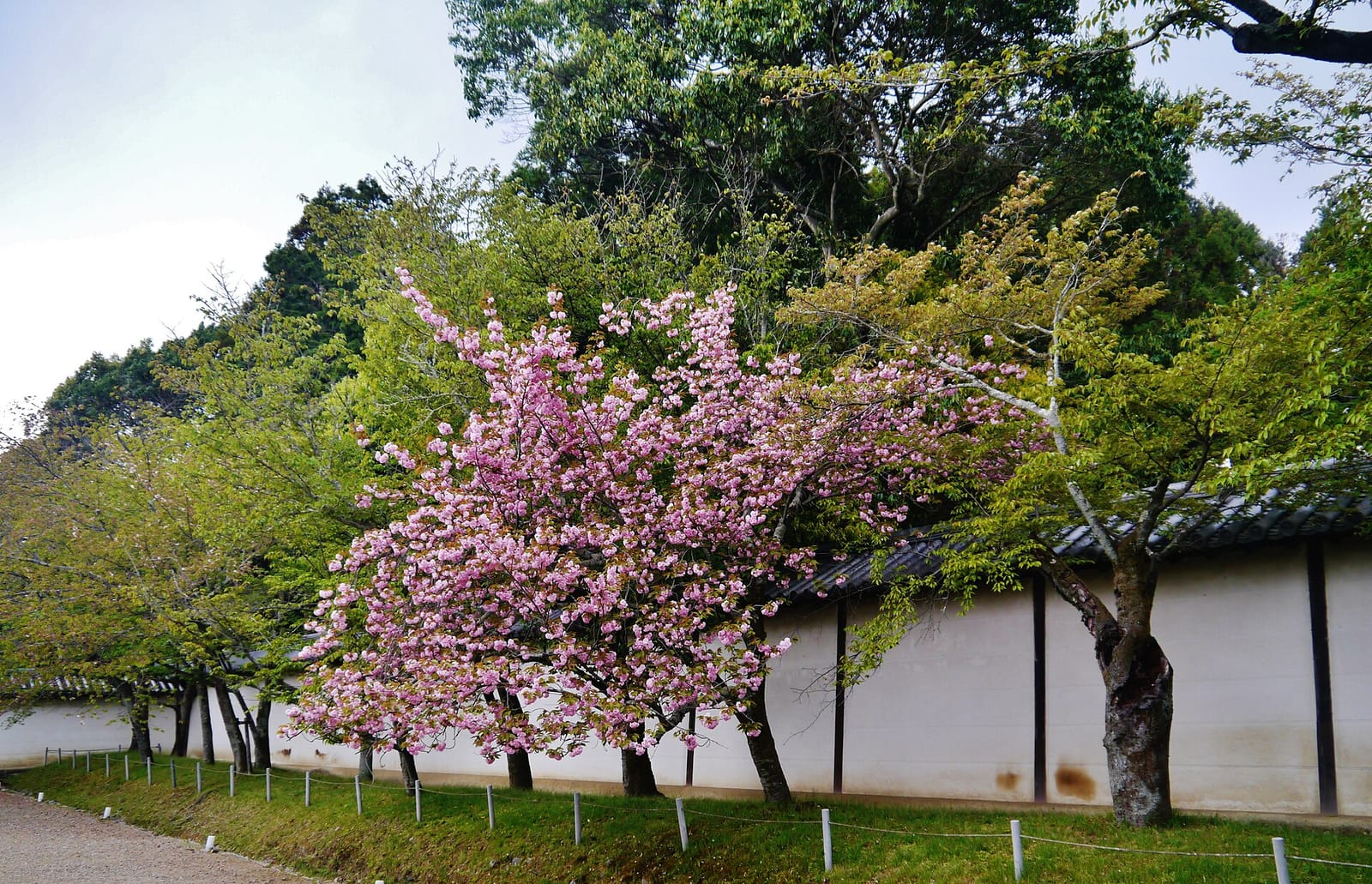
Daigo-ji
Photo: Zairon / CC BY-SA 4.0 · Original · Resized and croppedHeian period · Temples · National Treasures
Daigo-ji
醍醐寺 (だいごじ)
At Daigo-ji you can see the Five-Story Pagoda, said to be the oldest wooden building in Kyoto Prefecture, and the Kondo in the lower precinct, and the Yakushi Hall and the cliff-hung Seiryu-gu Worship Hall on the mountaintop at Kami-Daigo. The temple counts six National Treasure buildings in all; the two at Sanpo-in are covered on the Sanpo-in page.
Key facts
- Designation
- National Treasures
- Era
- Heian period
- Type
- Temples
- Location
- Kyoto, Kyoto
- Address
- 京都府京都市伏見区醍醐伽藍町
Before you go
- Opening hours
- 9:00 to 17:00 from March 1 to the first Sunday of December, and 9:00 to 16:30 from the following day to the end of February. Last admission is 30 minutes before closing (hours change in spring).
- Closed
- Check the official site
- Admission (adults)
- One of Sanpo-in, the Garan precinct or the Reihokan museum costs ¥600 for adults, any two ¥1,000 and all three ¥1,500. The National Treasure five-storied pagoda, Kondo hall and Seiryugu worship hall are in the Garan precinct. In spring (March 20 to the third Sunday of April) one site costs ¥800 and all three ¥1,800.
- Time needed
- Check the official site
- Getting there
- About 10 minutes on foot from Exit 2 of Daigo Station on the Tozai subway line. From the Hachijo exit of Kyoto Station, the Keihan bus Kyoto Daigoji Line takes about 30 minutes to the Daigoji stop. The south car park charges up to ¥600 during the day on weekdays (¥700 at weekends and on holidays), with different rates in the autumn foliage season.
- Good to know
- Tickets are sold at the Sanpo-in reception. Parking is scarce and roads are narrow, so public transport is requested, especially at weekends. Kami-Daigo on the mountaintop can only be reached on foot; entry is accepted 9:00 to 15:00 in summer and 9:00 to 14:00 in winter, and you must be back at the foot of the mountain by 17:00.
Checked against official information on November 12, 2026. Fees and hours can change, so please also check the official site before you go.
Sources for visitor information
Key facts
- Designation
- National Treasures
- Era
- Heian period
- Type
- Temples
- Location
- Kyoto, Kyoto
- Address
- 京都府京都市伏見区醍醐伽藍町
About this place
Daigo-ji is a temple in Fushimi Ward, Kyoto, whose grounds stretch from the east side of the Yamashina Basin up to the summit of Kasatori. The summit area is called Kami-Daigo (Upper Daigo) and the foot of the mountain Shimo-Daigo (Lower Daigo). According to the temple, it began in 874 when Shobo (Rigen Daishi) enshrined two Kannon images, Juntei and Nyoirin, at Kami-Daigo. Later, with the devotion of Emperor Daigo, the Yakushi Hall and the Godai Hall were built at Kami-Daigo, and a Shaka Hall was also built at Shimo-Daigo. The temple grounds were inscribed as a World Cultural Heritage site in 1994.
The temple counts six National Treasure buildings. Four of them, in the lower precinct and at Kami-Daigo, are covered here, and the two at Sanpo-in, which stands in a separate compound, are covered on the Sanpo-in page. The Five-Story Pagoda in the lower precinct was begun in 936 by Emperor Suzaku to pray for the repose of Emperor Daigo and was completed in the reign of Emperor Murakami. The temple gives the completion year as Tenryaku 5 (951), while the national cultural properties database gives 952. It is said to be the oldest wooden building in Kyoto Prefecture, and of its height of about 38 meters, the spire on top takes up about 13 meters. Inside the first story, the Mandalas of the Two Realms and the eight patriarchs of Shingon are painted, and these are said to be the source of Japanese esoteric Buddhist painting.
The Kondo (Golden Hall) at the center of the lower precinct began as a Shaka Hall built in 926, but it burned down twice. The present Kondo was planned to be moved from Yuasa in Kii Province on the orders of Toyotomi Hideyoshi and was completed in 1600 under his son Hideyori. Its main structure keeps the style of the end of the Heian period, and the national database also lists it as a late Heian building. The seated Yakushi Buddha inside is the principal image of Daigo-ji. The Saidaimon (Nio Gate) at the entrance to the precinct was rebuilt by Hideyori in 1605, and it holds a pair of guardian Nio statues made in 1134 (Important Cultural Properties).
Kami-Daigo is where the temple began, and it is reached by climbing a steep mountain path for nearly an hour from the Nyonin-do hall at the trailhead. The Yakushi Hall was founded in 913 as a hall for Emperor Daigo's prayers and stands at the center of the Kami-Daigo precinct. The present building dates from 1121 in the late Heian period, and the Yakushi triad that was its principal image, a National Treasure, has been moved to the Reihokan Museum. The Seiryu-gu Worship Hall is a mid-Muromachi building from 1434, built in the kakezukuri style: the hillside was cut back only slightly, and the front of the hall projects out over the slope. The Daigo spring, a famous water tied to the temple's founding, still flows today. Kami-Daigo can only be entered on foot, and there are set hours for entry and a set time by which you must come back down.
Sanpo-in, founded in 1115, serves as the head lodging of Daigo-ji, and its Omote Shoin and Karamon Gate are designated National Treasures. Its garden was designed in outline by Toyotomi Hideyoshi himself for the Daigo Cherry Blossom Viewing of 1598. The Reihokan Museum holds more than 75,000 temple treasures counting National Treasures and Important Cultural Properties alone, and holds special exhibitions in spring and autumn. The Reihokan grounds have more than 40 cherry trees, including the great Daigo weeping cherry, and in autumn the area around the Benten Hall is a well-known spot for fall leaves. The lower precinct, Sanpo-in and the Reihokan have combined tickets as well as single-site tickets, so it helps to plan your route in advance, including whether you will climb to Kami-Daigo.
Buildings designated as National Treasures
Daigo-ji Five-Story Pagoda
- Era
- Mid-Heian period
- Year
- 952
- Structure
- five-story pagoda, three bays square, hongawara tile roofing
- Designated
- June 9, 1951
Daigo-ji Seiryu-gu Worship Hall
- Era
- Mid-Muromachi period
- Year
- 1434
- Structure
- built on a platform of stilts (kake-zukuri), seven bays wide, three bays deep, single-story, hip-and-gable roof, entered from the gable end, three-bay front porch (kohai), karahafu gable on the eaves
- Designated
- March 20, 1954
Daigo-ji Yakushi Hall
- Era
- Late Heian period
- Year
- 1121
- Structure
- five bays wide, four bays deep, single-story, hip-and-gable roof, cypress-bark roofing
- Designated
- June 27, 1959
Daigo-ji Kondo (Golden Hall)
- Era
- Late Heian period
- Structure
- seven bays wide, five bays deep, single-story, hip-and-gable roof, hongawara tile roofing
- Designated
- March 20, 1954
Sources and date checked
Facts such as eras, structures and locations are edited and translated by us from the Agency for Cultural Affairs’ database of nationally designated cultural properties. The Agency and the national government did not produce this page.
Database of nationally designated cultural properties- Agency for Cultural Affairs, Database of National Cultural Properties: Daigo-ji Five-Story Pagoda
- Agency for Cultural Affairs, Database of National Cultural Properties: Daigo-ji Seiryu-gu Worship Hall
- Agency for Cultural Affairs, Database of National Cultural Properties: Daigo-ji Yakushi Hall
- Agency for Cultural Affairs, Database of National Cultural Properties: Daigo-ji Kondo (Golden Hall)
- Daigo-ji History and Origins (Daigo-ji official site)
- Daigo-ji Lower Precinct Halls (Daigo-ji official site)
- Daigo-ji Kami-Daigo (Daigo-ji official site)
- Daigo-ji Sanpo-in (Daigo-ji official site)
- Daigo-ji Reihokan Museum (Daigo-ji official site)
- Daigo-ji Visiting Hours and Fees (Daigo-ji official site)
Checked on November 6, 2026
Report an error
If you notice a mistake, please tell us along with a source for the correct information.
Where to go next
Places you could see on the same day, and places worth comparing.
Nearby cultural heritage
Places within 10 km, nearest first. Distances are in a straight line.
More from Kyoto
Discover more of the same region on our sister sites.
Matsuri Biyori
UNESCO-listed festivals in Kyoto
- Yamahoko, the float ceremony of the Kyoto Gion festival
- Kyoto no Rokusai Nenbutsu
- Yasuraibana
- Kuta no Hanagasa Odori
Meiga no Furusato
Paintings linked to Kyoto
- View of Amanohashidate
- Viewing Maple Leaves
- Scenes in and around Kyoto (Funaki Version)
- Morning View of Uji River