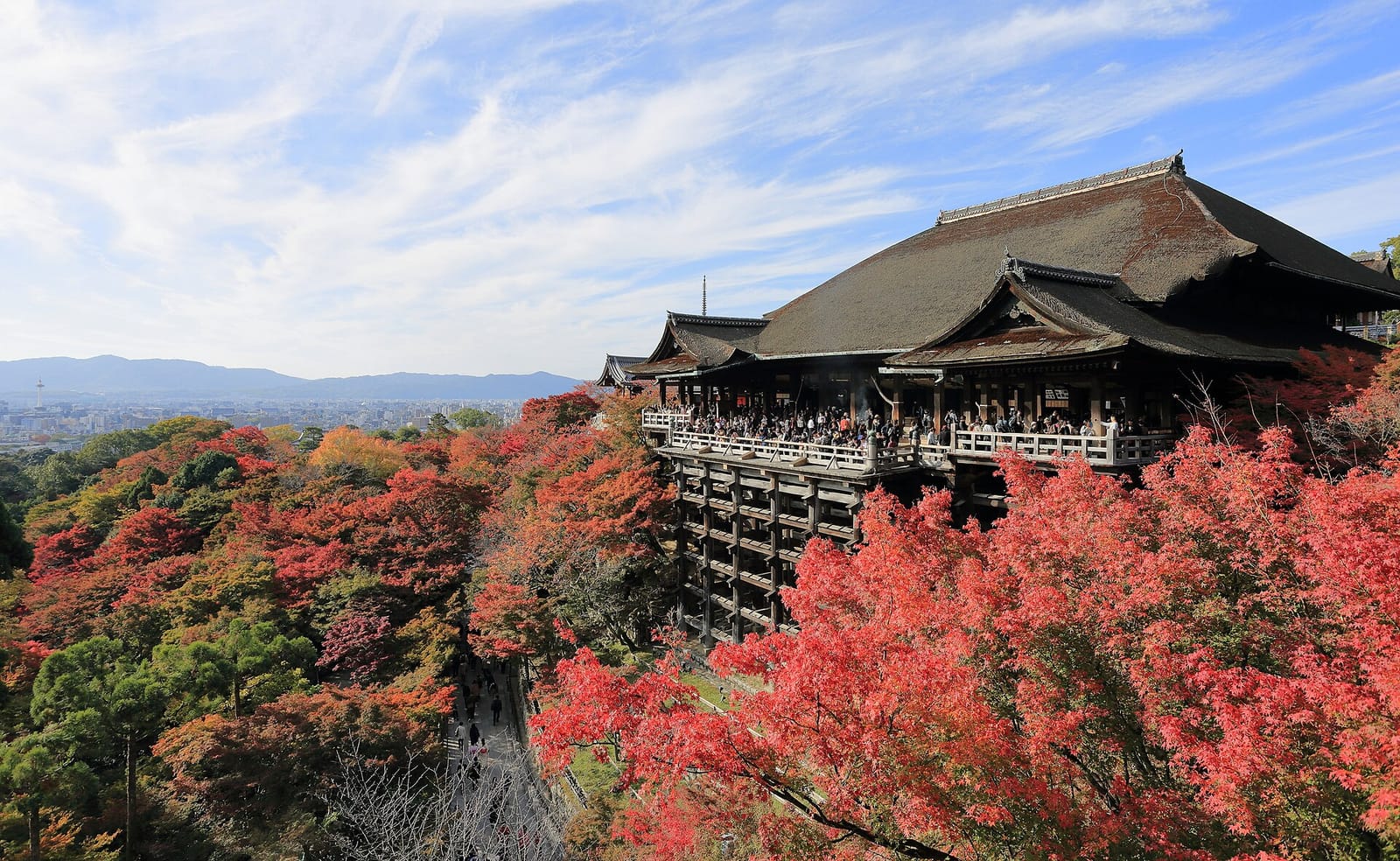
The main hall and its stage in autumn
Photo: Martin Falbisoner / CC BY-SA 4.0 · Original · Resized and croppedEdo period · Temples · National Treasures
Kiyomizu-dera
清水寺 (きよみずでら)
Kiyomizu-dera's main hall, rebuilt in 1633, juts out from the slope of Mount Otowa on 18 zelkova pillars in the kakezukuri style and is a National Treasure. Look out over Kyoto from its famous stage, then gaze up at the nail-free timber framing from below. The temple is part of the Historic Monuments of Ancient Kyoto World Heritage site.
Key facts
- Designation
- National Treasures
- Era
- Edo period
- Type
- Temples
- Location
- Kyoto, Kyoto
- Address
- 京都府京都市東山区清水一丁目
Before you go
- Opening hours
- 6:00 to 18:00 (until 18:30 from July 1 to August 31). During the spring, summer and autumn night viewings the gates stay open until 21:30, with last entry at 21:00 (in 2026: March 27 to April 5, August 14 to 16, and November 21 to 30).
- Closed
- Open every day.
- Admission (adults)
- Admission is ¥500 for adults. Jojuin, a sub-temple on the grounds, charges a separate ¥600 during its special openings.
- Time needed
- Check the official site
- Getting there
- From Kyoto Station, take Kyoto City Bus route 206 (toward Kitaoji Bus Terminal via Higashiyama-dori) or route 100 to the Gojozaka stop, then walk 10 minutes. From Keihan Kiyomizu-Gojo Station it is about 25 minutes on foot. The temple has no parking; there is the city-run Kiyomizuzaka tourist car park nearby, but public transport or a taxi is recommended in busy seasons.
- Best time to visit
- The grounds have about 1,500 cherry trees and about 1,000 maples. Night viewings are held in spring, summer and autumn, and in autumn the main hall and stage are lit up among the red leaves.
- Good to know
- Map apps sometimes suggest routes that do not lead into the temple. The only ways in are up Kiyomizuzaka to the Niomon Gate, or up Chawanzaka to the service road. Tripods, monopods and drones are not allowed.
Checked against official information on November 12, 2026. Fees and hours can change, so please also check the official site before you go.
Sources for visitor information
- Kiyomizu-dera official site: Visiting hours and access
- Kiyomizu-dera official site: FAQ
- Kiyomizu-dera official site: Autumn night viewing
- Kyoto City official travel guide: Early-morning temple experiences
- Kyoto City official travel guide: Kiyomizu-dera
- Kyoto City official travel guide: Autumn 2026 night viewings and illuminations
Key facts
- Designation
- National Treasures
- Era
- Edo period
- Type
- Temples
- Location
- Kyoto, Kyoto
- Address
- 京都府京都市東山区清水一丁目
About this place
Kiyomizu-dera is said to have begun in 778. A monk named Kenshin, later called Enchin, was training in Nara when a dream led him north. On Mt. Otowa he met a hermit named Gyoei Koji. Kenshin found a clear spring welling up on the mountain, Later Sakanoue no Tamuramaro came to the mountain hunting deer, met Kenshin and, together with his wife Miyoshi no Takako, worked to build the temple and enshrine an eleven-headed, thousand-armed Kannon as its main image. The Otowa Waterfall is said to be the spring Kenshin found, still flowing today. The temple was opened partway up the mountain, and about 1,250 years have passed since.
The present main hall and its stage were rebuilt in 1633. Only the main hall is designated a National Treasure, and it is built in the kake-zukuri method, in which pillars are assembled up the slope of the mountain to carry a raised floor. It has a hip roof of cypress bark, with skirt roofs on the east, west, and north sides, and the stage projects from the front. Eighteen pillars stand beneath the stage, made of zelkova more than 400 years old. The timbers are joined with interlocking joints, and not a single nail is used. The stage is about 13 meters high and has a floor area of about 200 square meters. Looking up from below, you can judge how large the framework is that juts out over the slope. The hall measures nine bays by seven and is a single-story building of the early Edo period.
Do not stop at the view from the stage; go around to the underside at least once and look at how the pillars are joined. The same building looks entirely different from the stage looking down on Kyoto and from the slope looking up at the timber frame. The precinct sits partway up Mt. Otowa, part of the Higashiyama range. The National Treasure main hall has wing corridors on both sides of the front stage and another on its west side. Besides the stage, try to see the overlapping roofs and the wing corridors as one outline from a little distance.
The main image, the eleven-headed, thousand-armed Kannon, is affectionately called Kiyomizu Kannon-san. In 1994 Kiyomizu-dera was inscribed on the UNESCO World Heritage List as one of the Historic Monuments of Ancient Kyoto. Sanjusangen-do is in the same ward, Higashiyama, so the two are easy to think of as a pair. Kiyomizu-dera is on a mountain slope, however, so expect slopes and stone steps. Allow time and walk the main hall, the stage, and the Otowa Waterfall in that order, as if tracing the temple's origins; the founding legend and the present architecture then read as one story.
Buildings designated as National Treasures
Kiyomizu-dera Main Hall
- Era
- Early Edo period
- Year
- 1633
- Structure
- built on a platform of stilts (kake-zukuri), nine bays wide, seven bays deep, single-story, hip roof, mokoshi on the east, west and north sides, with wing corridors on both sides at the front and a pent roof, with a wing corridor on the west, cypress-bark roofing, with a stage at the front
- Designated
- November 22, 1952
Sources and date checked
Facts such as eras, structures and locations are edited and translated by us from the Agency for Cultural Affairs’ database of nationally designated cultural properties. The Agency and the national government did not produce this page.
Database of nationally designated cultural properties- Agency for Cultural Affairs, Database of National Cultural Properties: Kiyomizu-dera Main Hall
- Kiyomizu-dera official site: History
- Kiyomizu-dera official site: English
Checked on November 6, 2026
Report an error
If you notice a mistake, please tell us along with a source for the correct information.
Where to go next
Places you could see on the same day, and places worth comparing.
Nearby cultural heritage
Places within 10 km, nearest first. Distances are in a straight line.
More from Kyoto
Discover more of the same region on our sister sites.
Matsuri Biyori
UNESCO-listed festivals in Kyoto
- Yamahoko, the float ceremony of the Kyoto Gion festival
- Kyoto no Rokusai Nenbutsu
- Yasuraibana
- Kuta no Hanagasa Odori
Meiga no Furusato
Paintings linked to Kyoto
- View of Amanohashidate
- Viewing Maple Leaves
- Scenes in and around Kyoto (Funaki Version)
- Morning View of Uji River