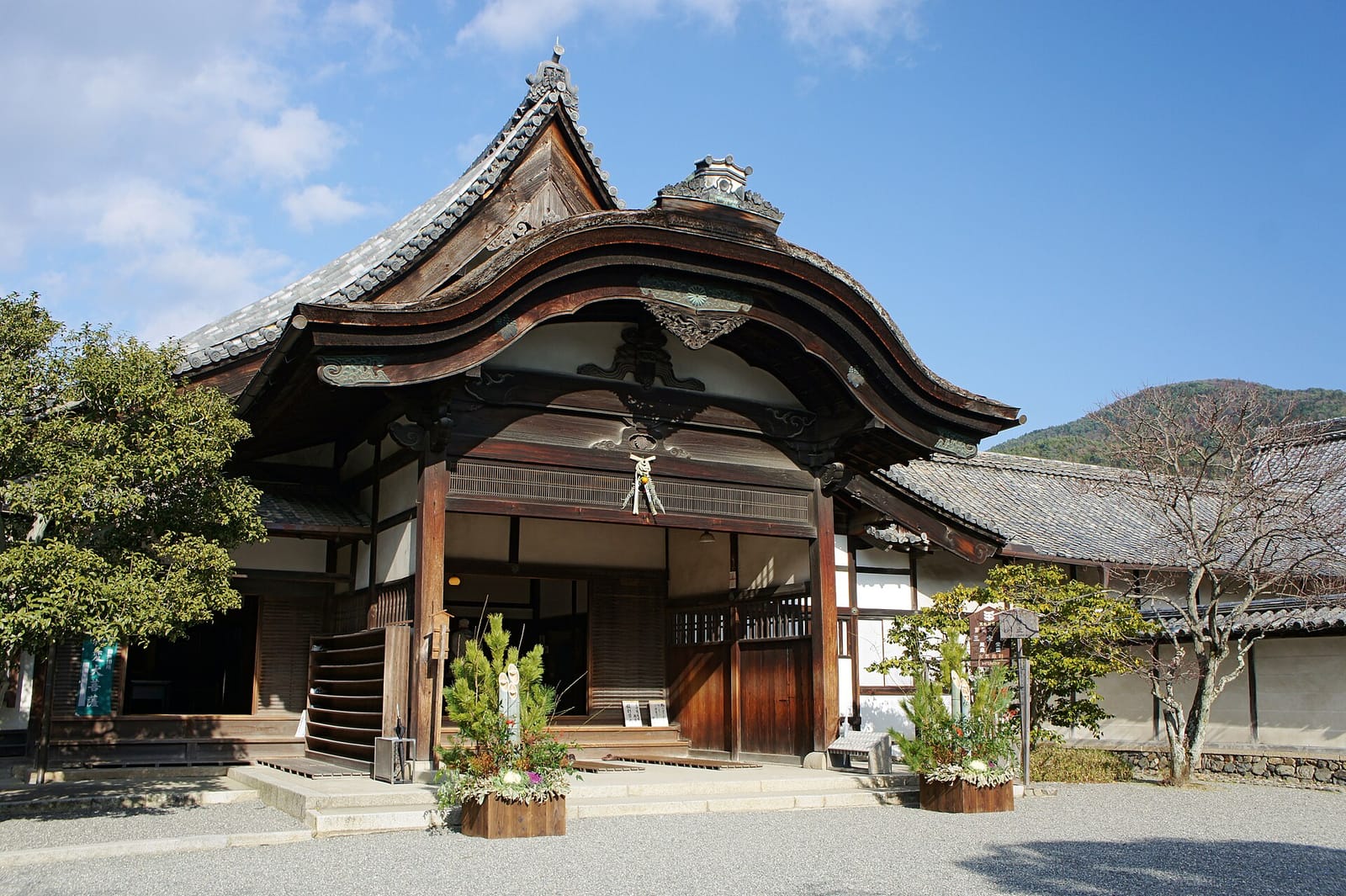
Sanpo-in
Photo: 663highland / CC BY 2.5 · Original · Resized and croppedMomoyama period · Temples · National Treasures
Sanpo-in
三宝院 (さんぼういん)
At Sanpo-in you can see the National Treasure Omote Shoin, which borrows from the shinden style, and the National Treasure Karamon Gate, its black lacquer set off by gold crests. In front of the Omote Shoin spreads the garden, a Special Place of Scenic Beauty whose basic design Toyotomi Hideyoshi drew up for the Daigo Cherry Blossom Viewing.
Key facts
- Designation
- National Treasures
- Era
- Momoyama period
- Type
- Temples
- Location
- Kyoto, Kyoto
- Address
- 京都府京都市伏見区醍醐東大路町
Before you go
- Opening hours
- 9:00 to 17:00 from March 1 to the first Sunday of December, and 9:00 to 16:30 from the following day to the end of February. Last admission is 30 minutes before closing (hours change in spring).
- Closed
- Check the official site
- Admission (adults)
- Sanpo-in costs ¥600 for adults on a single-site ticket (¥800 in spring), and combined tickets with Daigo-ji's Garan precinct and museum are available. The special viewing of the Sanpo-in palace rooms is an extra ¥500.
- Time needed
- Check the official site
- Getting there
- About 10 minutes on foot from Exit 2 of Daigo Station on the Tozai subway line. From the Hachijo exit of Kyoto Station, the Keihan bus Kyoto Daigoji Line takes about 30 minutes to the Daigoji stop. The south car park charges up to ¥600 during the day on weekdays (¥700 at weekends and on holidays), with different rates in the autumn foliage season.
- Good to know
- All Daigo-ji tickets are sold at the Sanpo-in reception. Parking nearby is scarce, so public transport is requested, especially at weekends.
Checked against official information on November 12, 2026. Fees and hours can change, so please also check the official site before you go.
Sources for visitor information
Key facts
- Designation
- National Treasures
- Era
- Momoyama period
- Type
- Temples
- Location
- Kyoto, Kyoto
- Address
- 京都府京都市伏見区醍醐東大路町
About this place
Sanpo-in, within Daigo-ji in Fushimi Ward, Kyoto, is the temple that serves as Daigo-ji's main residence, where successive head priests (zasu) have lived. According to the temple, it was founded in 1115 by Shokaku, the 14th head priest of Daigo-ji. In the Momoyama period, the head priest Gien won the devotion of Toyotomi Hideyoshi and used the Daigo Cherry Blossom Viewing as the occasion to revive Daigo-ji. Most of the present buildings are Important Cultural Properties, and of these the Omote Shoin and the Karamon Gate are designated National Treasures. The main precinct with the Five-Story Pagoda and Kondo, and Kami-Daigo, are covered on the Daigo-ji page.
The Omote Shoin is a building facing the garden, and the national cultural properties database dates it to 1598, in the Momoyama period. Although it is a shoin-style building, its veranda is lined with a railing and a pavilion called the Izumi-den is built into its southwest corner, showing how it adopts the shinden style of Heian-period residences. The roof is hip-and-gable with sangawara tiles, and the entrance porch on the west side has a karahafu gable roofed with cypress bark. The rooms are divided into lower, middle and upper rooms, and the lower room is also called the "Agebutai no Ma" because it becomes a Noh stage when the tatami mats are lifted. The middle and upper rooms are one step higher, so Noh and kyogen can be watched from above.
The sliding-door paintings of the Omote Shoin (Important Cultural Properties) take willows of the four seasons as their theme in the upper room and mountain and field scenery in the middle room, and are said to be the work of the Hasegawa Tohaku school. The lower room was painted by Ishida Yutei and shows peacocks and cycad palms. Sanpo-in has other rooms with sliding-door paintings too: the Chokushi no Ma has a Momoyama-period painting of birds and flowers in a bamboo grove said to be by the Tohaku school, the Aoi no Ma shows the Aoi Festival procession heading from Shimogamo Shrine to Kamigamo Shrine, and the Akikusa no Ma shows a wide landscape dotted with the seven autumn flowers.
The Karamon is an imperial messenger's gate whose doors are said to have been opened only when envoys from the imperial court were received. The national cultural properties database dates it to the Momoyama period; it is a flat karamon gate three bays wide with a single doorway, roofed with cypress bark. According to the temple, when it was built the whole gate was lacquered black and its four large chrysanthemum and paulownia crests were covered in gold leaf. Repairs lasting about a year and a half were completed in July 2010 and brought back this appearance, and its bold design conveys the spirit of the Momoyama period.
The Sanpo-in Garden is a national Special Historic Site and Special Place of Scenic Beauty, and Hideyoshi himself drew up its basic design for the Daigo Cherry Blossom Viewing in 1598. According to the temple's events page, for this viewing Hideyoshi planted 700 cherry trees brought from the Kinai region and built the buildings and garden of Sanpo-in. In the pond are the Turtle Island, covered by a five-needle pine said to be more than 600 years old, and the Crane Island just west of it, and at the center of the garden stands the Fujito Stone, which represents the Amida triad. A three-tiered waterfall lies in the southeast corner. The whole garden can be seen from the Omote Shoin. The Junjokan, the Hondo and the Okushinden are not normally open to the public; according to the temple, they are shown during special viewings.
Buildings designated as National Treasures
Sanpo-in Palace Buildings (Omote Shoin)
- Era
- Momoyama period
- Year
- 1598
- Structure
- upper room of 15 mats (with alcove and shelves), 18-mat room, anteroom of 27 mats, irigawa (inner veranda) on all four sides, Izumi-den pavilion, consisting of the entrance porch (kuruma-yose), single-story, hip-and-gable roof, Izumi-den pavilion with a gable roof, sangawara tile roofing, west-side entrance porch (kuruma-yose) in karahafu style, cypress-bark roofing
- Designated
- March 20, 1954
Sanpo-in Karamon Gate
- Era
- Momoyama period
- Structure
- flat karamon gate, three bays with one doorway, cypress-bark roofing
- Designated
- March 20, 1954
Sources and date checked
Facts such as eras, structures and locations are edited and translated by us from the Agency for Cultural Affairs’ database of nationally designated cultural properties. The Agency and the national government did not produce this page.
Database of nationally designated cultural properties- Agency for Cultural Affairs, Database of National Cultural Properties: Sanpo-in Palace Buildings (Omote Shoin)
- Agency for Cultural Affairs, Database of National Cultural Properties: Sanpo-in Karamon Gate
- Daigo-ji Sanpo-in (Daigo-ji official site)
- Daigo-ji History and Origins (Daigo-ji official site)
- Daigo-ji Hotaiko Hanami Procession (Daigo-ji official site)
Checked on November 6, 2026
Report an error
If you notice a mistake, please tell us along with a source for the correct information.
Where to go next
Places you could see on the same day, and places worth comparing.
Nearby cultural heritage
Places within 10 km, nearest first. Distances are in a straight line.
More from Kyoto
Discover more of the same region on our sister sites.
Matsuri Biyori
UNESCO-listed festivals in Kyoto
- Yamahoko, the float ceremony of the Kyoto Gion festival
- Kyoto no Rokusai Nenbutsu
- Yasuraibana
- Kuta no Hanagasa Odori
Meiga no Furusato
Paintings linked to Kyoto
- View of Amanohashidate
- Viewing Maple Leaves
- Scenes in and around Kyoto (Funaki Version)
- Morning View of Uji River