Sumiyoshi Taisha
Photo: Saigen Jiro / CC0 · Original · Resized and croppedEdo period · Shrines · National Treasures
Sumiyoshi Taisha
住吉大社 (すみよしたいしゃ)
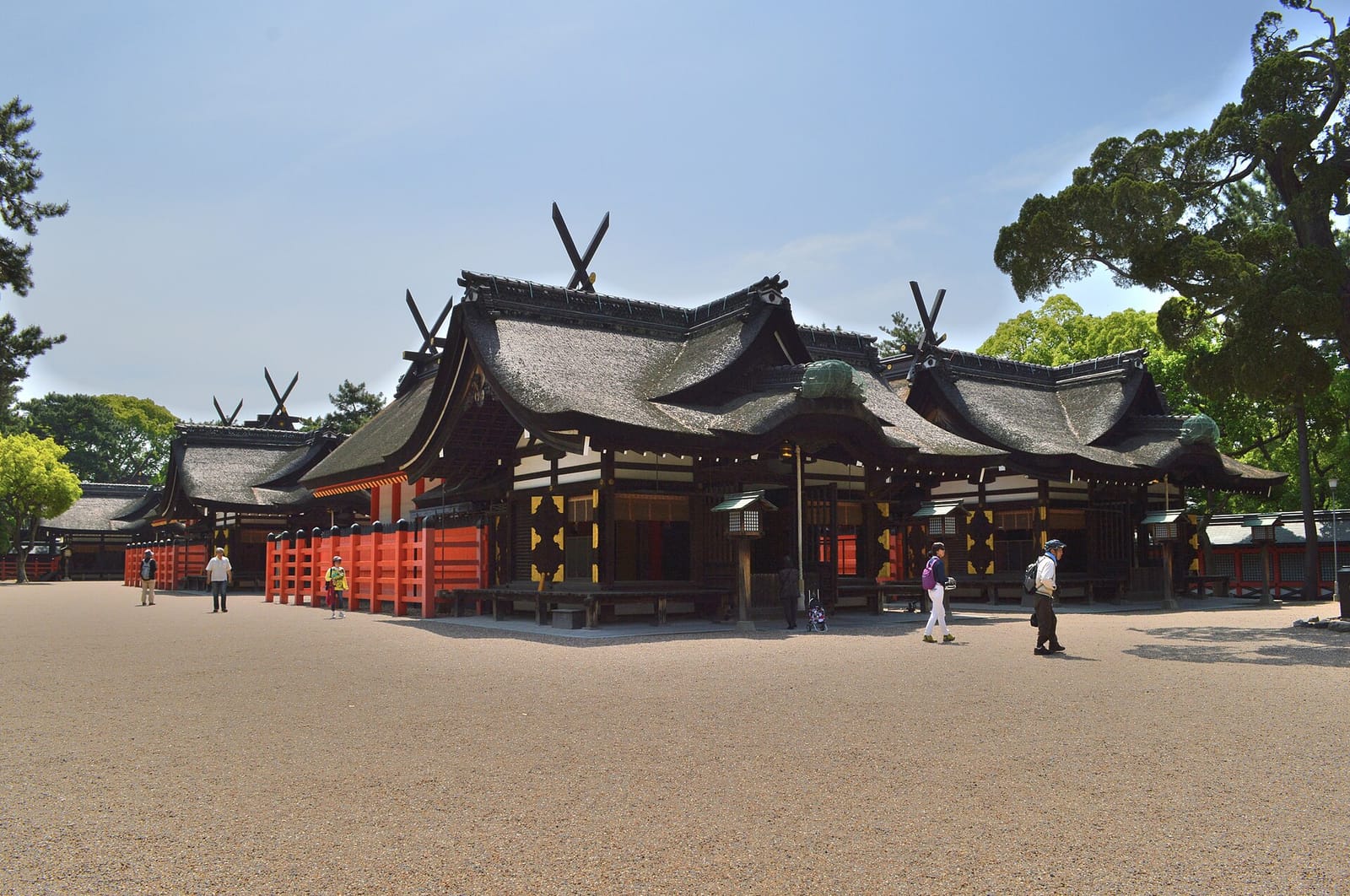
This is the head shrine of about 2,300 Sumiyoshi shrines across Japan, and its four main sanctuaries, built in 1810, are National Treasures. You can see the Sumiyoshi-zukuri style, counted among the oldest forms of shrine architecture, and the unusual layout of the halls, lined up like a fleet of ships.
Key facts
- Designation
- National Treasures
- Era
- Edo period
- Type
- Shrines
- Location
- Osaka, Osaka
- Address
- 大阪府大阪市住吉区住吉二丁目
Before you go
- Opening hours
- The gates open at 6:00 from April to September and 6:30 from October to March (6:00 on the 1st of each month and the first Dragon day). The outer gates close at 16:00 and the inner precinct at 17:00. Hours differ at New Year and during the Sumiyoshi summer festival.
- Closed
- Check the official site
- Admission (adults)
- Check the official site
- Time needed
- Check the official site
- Getting there
- Sumiyoshi-toriimae stop on the Hankai tram line is right outside. Sumiyoshitaisha Station on the Nankai Main Line is a 3-minute walk east, and Sumiyoshi-higashi Station on the Nankai Koya Line a 5-minute walk west.
- Good to know
- The car park is closed from December 31 to January 3, when traffic restrictions apply around the shrine. During the summer Sumiyoshi festival, roads are closed temporarily for the portable shrine procession.
Checked against official information on November 12, 2026. Fees and hours can change, so please also check the official site before you go.
Sources for visitor information
Key facts
- Designation
- National Treasures
- Era
- Edo period
- Type
- Shrines
- Location
- Osaka, Osaka
- Address
- 大阪府大阪市住吉区住吉二丁目
About this place
Sumiyoshi Taisha has long been cherished as the Ichinomiya, the leading shrine, of the old Settsu Province, and it is the head shrine of about 2,300 Sumiyoshi shrines across Japan. Its deities are the three gods Sokotsutsunoo, Nakatsutsunoo and Uwatsutsunoo, who emerged from the sea when the god Izanagi purified himself there, together with Empress Jingu. According to the shrine's tradition, the deities were enshrined here in the 11th year of Empress Jingu's regency, given as the year 211, following an oracle from the Sumiyoshi gods. After Emperor Nintoku opened the port of Suminoe, they were revered as guardians of sea voyages, protecting the envoys sent to Sui and Tang China.
The National Treasures are the four main sanctuaries, from the First to the Fourth Hall. All of them were built in 1810, the 7th year of the Bunka era in the Edo period, and they were designated National Treasures in 1953. The shrine's chronology records that its buildings burned in the great fire of 1802 and that the deities were moved into the new halls in 1810. The style of the sanctuaries is called Sumiyoshi-zukuri, and it is regarded as one of the oldest forms of shrine architecture.
A Sumiyoshi-zukuri hall has a gabled roof covered in cypress bark, with the entrance on the gable end, so that the end of the roof faces the front. The interior is divided into an outer and an inner chamber, and there is no surrounding corridor. The pillars are painted vermilion, the board walls are coated in white gofun made from ground shells, and gilded metal fittings set off the colors. It has also been pointed out that the floor plan resembles the Daijokyu, the halls built for the enthronement rite of the Daijosai.
Pay attention to how the four halls are arranged as well. All of the sanctuaries face west, toward Osaka Bay; the First, Second and Third Halls stand in a single line, one behind another, while the Third and Fourth Halls stand side by side. The shrine likens this layout to a fleet of ships sailing across the open sea. Sumiyoshi Taisha has carried out a rebuilding and renewal ceremony every 20 years since the Nara period, and the earliest record of one dates from 749. The cycle was broken for more than half a century during the Warring States period, but in 2011, marking 1,800 years since the founding, the 49th renewal was held, including the repainting of the National Treasure halls.
At the front of the approach, the Sorihashi, or Drum Bridge, arches about 20 meters long at a maximum slope of about 48 degrees. Its present stone piers are said to have been donated in the Keicho era by Yodo-dono, praying for the healthy growth of her son Toyotomi Hideyori. Goshogozen, south of the First Hall, is said to be the spot where the gods were first worshipped when the shrine was founded. The Rice Planting Ritual on June 14 is an Important Intangible Folk Cultural Property, and the Sumiyoshi Festival is held from Marine Day in July to August 1. The shrine is right next to Sumiyoshi-toriimae Station on the Hankai Line.
Buildings designated as National Treasures
Sumiyoshi Taisha Main Sanctuary (First Hall)
- Era
- Late Edo period
- Year
- 1810
- Structure
- Sumiyoshi-zukuri style, cypress-bark roofing
- Designated
- November 14, 1953
Sumiyoshi Taisha Main Sanctuary (Second Hall)
- Era
- Late Edo period
- Year
- 1810
- Structure
- Sumiyoshi-zukuri style, cypress-bark roofing
- Designated
- November 14, 1953
Sumiyoshi Taisha Main Sanctuary (Third Hall)
- Era
- Late Edo period
- Year
- 1810
- Structure
- Sumiyoshi-zukuri style, cypress-bark roofing
- Designated
- November 14, 1953
Sumiyoshi Taisha Main Sanctuary (Fourth Hall)
- Era
- Late Edo period
- Year
- 1810
- Structure
- Sumiyoshi-zukuri style, cypress-bark roofing
- Designated
- November 14, 1953
Sources and date checked
Facts such as eras, structures and locations are edited and translated by us from the Agency for Cultural Affairs’ database of nationally designated cultural properties. The Agency and the national government did not produce this page.
Database of nationally designated cultural properties- Agency for Cultural Affairs, Database of National Cultural Properties: Sumiyoshi Taisha Main Sanctuary (First Hall)
- Agency for Cultural Affairs, Database of National Cultural Properties: Sumiyoshi Taisha Main Sanctuary (Second Hall)
- Agency for Cultural Affairs, Database of National Cultural Properties: Sumiyoshi Taisha Main Sanctuary (Third Hall)
- Agency for Cultural Affairs, Database of National Cultural Properties: Sumiyoshi Taisha Main Sanctuary (Fourth Hall)
- Origins of Sumiyoshi Taisha (Sumiyoshi Taisha official site)
- Main Sanctuaries (Sumiyoshi Taisha official site)
- Architectural style (Sumiyoshi Taisha official site)
- History and rebuilding chronology (Sumiyoshi Taisha official site)
- Highlights of the shrine (Sumiyoshi Taisha official site)
- June events (Sumiyoshi Taisha official site)
- July events (Sumiyoshi Taisha official site)
- Access (Sumiyoshi Taisha official site)
Checked on November 6, 2026
Report an error
If you notice a mistake, please tell us along with a source for the correct information.
Where to go next
Places you could see on the same day, and places worth comparing.
More from Osaka
Discover more of the same region on our sister sites.
Meiga no Furusato
Paintings linked to Osaka
- Famous Places in the Sixty-odd Provinces: Kawachi Province: Otokoyama from Hirakata
- Famous Places in the Sixty-odd Provinces: Izumi Province: Takashi Beach
- Famous Places in the Sixty-odd Provinces: Settsu Province: Idemi Beach at Sumiyoshi
- Church / Alley in Paris
Sake Tabi
Breweries and distilleries in Osaka
- Katashimo Winery
- Naniwa Shuzo (Naniwa Masamune) Brewery Tour
- Suntory Yamazaki Distillery
- Banri no Haru Brewery Beer Hall