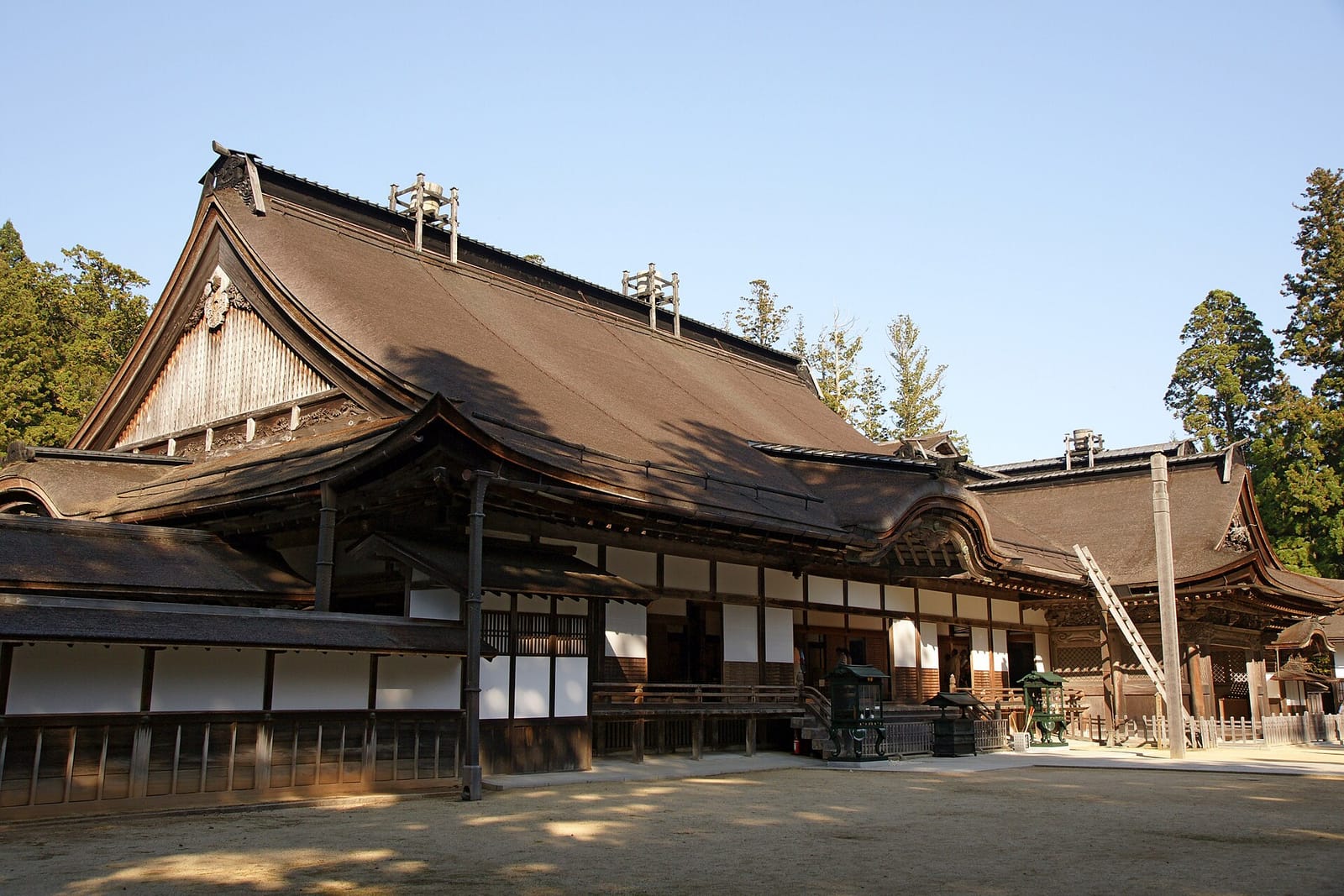
Kongobu-ji
Photo: 663highland / CC BY 2.5 · Original · Resized and croppedKamakura period · Temples · National Treasures
Kongobu-ji
金剛峯寺 (こんごうぶじ)
The National Treasure Fudo-do Hall stands in the Danjo Garan, the sacred core of Koyasan, the mountain opened by Kobo Daishi. You can see this Late Kamakura hall, whose four corners each differ in form, together with the Konpon Daito pagoda and the approach to Okunoin.
Key facts
- Designation
- National Treasures
- Era
- Kamakura period
- Type
- Temples
- Location
- Koya, Wakayama
- Address
- 和歌山県伊都郡高野町大字高野山
Before you go
- Opening hours
- Kongobu-ji, the Kondo hall and the Konpon Daito pagoda are open 8:30 to 17:00 (last entry 16:30). The Torodo lantern hall at Okunoin is open 6:00 to 17:00.
- Closed
- Check the official site
- Admission (adults)
- Kongobu-ji costs ¥1,000 for adults, the Kondo hall and Konpon Daito pagoda ¥500 each, and the Tokugawa mausoleum ¥200. A combined ticket for five sites including a precepts ceremony is ¥2,500.
- Time needed
- Check the official site
- Getting there
- Take the Nankai Koya Line to Gokurakubashi Station and change to the Koyasan cable car up the mountain. The usual route starts from Namba Station; from Kansai International Airport, change to the Koya Line at Tengachaya. The National Treasure Fudodo hall stands in the Danjo Garan precinct.
- Good to know
- Halls may be closed to visitors on ceremony days, so check the monthly visiting restrictions table published by Kongobu-ji before you go.
Checked against official information on November 12, 2026. Fees and hours can change, so please also check the official site before you go.
Sources for visitor information
Key facts
- Designation
- National Treasures
- Era
- Kamakura period
- Type
- Temples
- Location
- Koya, Wakayama
- Address
- 和歌山県伊都郡高野町大字高野山
About this place
Koyasan is a sacred place of Japanese Buddhism, opened at the beginning of the Heian period by Kobo Daishi, also known as Kukai. The name Kongobu-ji is said to have been taken by the Daishi from the title of a sutra. When people speak of the head temple Kongobu-ji, they mean not only its main hall complex but the whole of Koyasan, and the entire mountaintop is treated as the temple's precinct. There are 117 sub-temples on the mountain, and 51 of them offer lodging to visitors as temple inns.
The Danjo Garan is the place the Daishi began to develop first when he opened Koyasan, and it is said to represent the world of the Womb Realm Mandala. Together with Okunoin, where the Daishi entered eternal meditation, it has long been a center of faith. The Konpon Daito pagoda is said to have taken two generations, the Daishi and his successor Shinzen, to complete, from 816 to around 887, and it is regarded as the first pagoda of the tahoto type in Japan. A great fire in 1843 burned the complex except for the West Pagoda, and the present Kondo is its seventh rebuilding, completed in 1932.
The National Treasure Fudo-do Hall was built in 1197 by the monk Gyosho, at the wish of Hachijo-in, a daughter of the retired Emperor Toba. It first stood in the Isshin-in valley and was later moved to the Garan. The present building is a rebuilding from the first half of the 14th century, and the database of the Agency for Cultural Affairs dates it to the Late Kamakura period. It is a single-story hall three bays wide and four bays deep, with a hip-and-gable roof covered in cypress bark. It was designated a National Treasure in 1952.
Each of the four corners of the Fudo-do has a different form, which tradition explains by saying that four carpenters each built one corner as they pleased. Walk around the hall and compare the corners. It is thought to have begun as a hall for Amida, and later Fudo Myoo became its main image, attended by the Eight Youthful Attendants. These statues, well known as works of Unkei, are now kept in the Reihokan museum. Visitors are encouraged to pay their respects at the halls of the Garan in the order set out in a text handed down on Koyasan, the Ryodan Nyodo Shidai.
Beyond the Garan, there is much more to see on the mountain. Twelve buildings of the Kongobu-ji main complex, including the Great Main Hall, were designated Important Cultural Properties in January 2024, and in December of the same year 11 buildings of the Garan, including the Kondo and the Konpon Daito, followed. At Okunoin, an approach about 2 kilometers long runs from Ichinohashi bridge to the mausoleum, lined with more than 200,000 gravestones and monuments under tall cedars. The Daimon gate at the entrance to the mountain was rebuilt in 1705 and stands 25.1 meters high. To reach the mountaintop, change to the Koyasan Cable Car at Gokurakubashi Station on the Nankai Koya Line.
Buildings designated as National Treasures
Kongobu-ji Fudo-do Hall
- Era
- Late Kamakura period
- Structure
- three bays wide, four bays deep, single-storied, hip-and-gable roof, one-bay-wide lean-to eaves on the right side, one-bay-wide, three-bay-long lean-to eaves on the left side, sugaru-hafu gable style, one-bay front porch (kohai), cypress-bark roofing
- Designated
- March 29, 1952
Sources and date checked
Facts such as eras, structures and locations are edited and translated by us from the Agency for Cultural Affairs’ database of nationally designated cultural properties. The Agency and the national government did not produce this page.
Database of nationally designated cultural properties- Agency for Cultural Affairs, Database of National Cultural Properties: Kongobu-ji Fudo-do Hall
- About Kongobu-ji (Kongobu-ji official site)
- Highlights of Koyasan (Kongobu-ji official site)
- Guide to the temple interior (Kongobu-ji official site)
- Access (Kongobu-ji official site)
Checked on November 6, 2026
Report an error
If you notice a mistake, please tell us along with a source for the correct information.
Where to go next
Places you could see on the same day, and places worth comparing.
Nearby cultural heritage
Places within 10 km, nearest first. Distances are in a straight line.
More from Wakayama
Discover more of the same region on our sister sites.