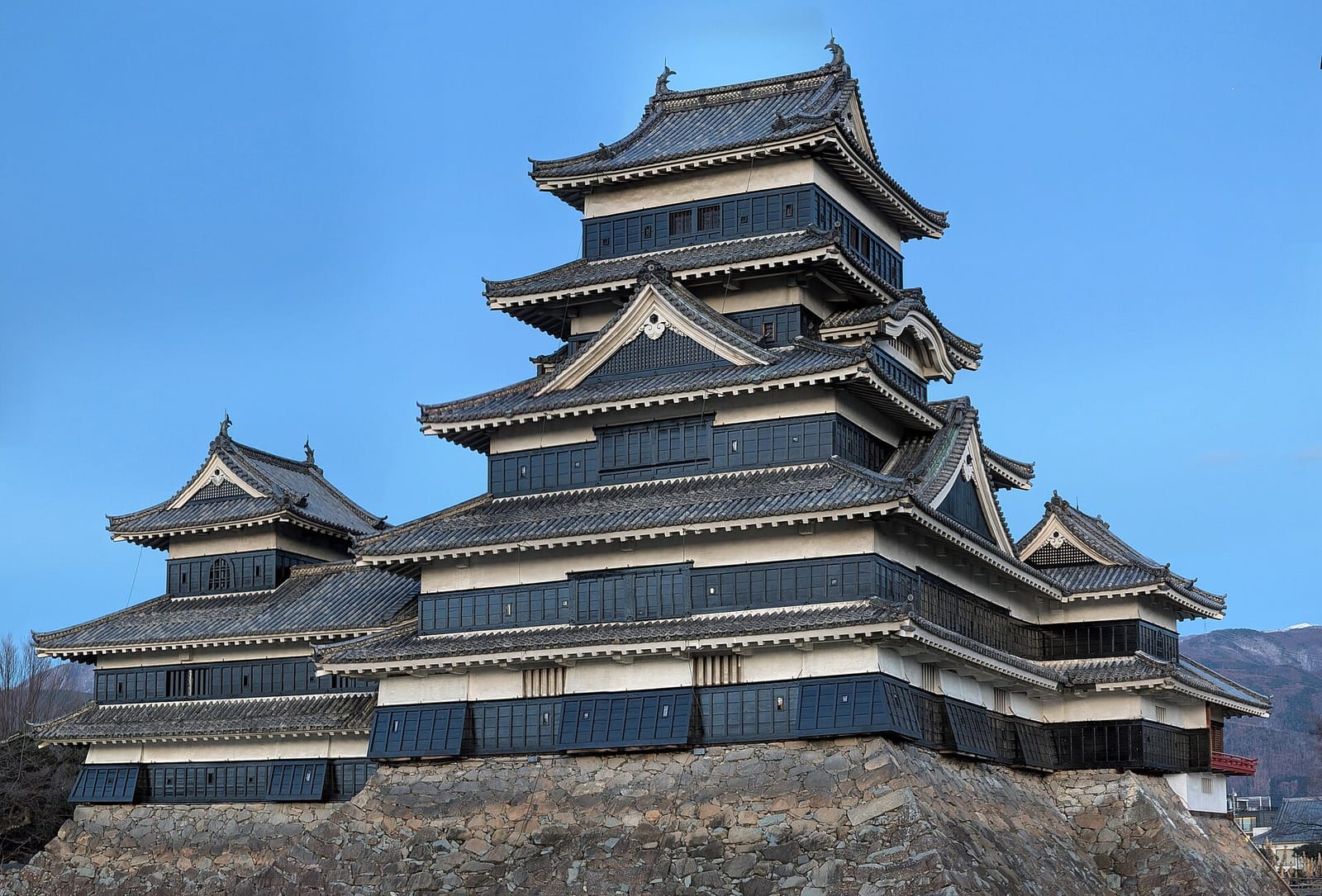
The keep complex
Photo: Syced / CC0 · Original · Resized and croppedMomoyama period · Castles · National Treasures
Matsumoto Castle
松本城 (まつもとじょう)
Five connected buildings form this National Treasure keep: the main keep, the Inui small keep and the linking turret, joined by the Tatsumi turret and the Moon-Viewing Turret. Wartime defenses of the late 16th century sit beside a peaceful early-Edo moon-viewing pavilion, and the main keep is considered the oldest surviving five-tier, six-floor keep in Japan.
Key facts
- Designation
- National Treasures
- Era
- Momoyama period
- Type
- Castles
- Location
- Matsumoto, Nagano
- Address
- 長野県松本市丸の内4番1号
Before you go
- Opening hours
- 8:30 to 17:00 (last entry 16:30). Hours are extended to 8:00 to 18:00 (last entry 17:30) during Golden Week, and are 10:00 to 15:30 (last entry 15:00) on January 1 to 3.
- Closed
- Open daily except December 29 to 31.
- Admission (adults)
- Admission to the paid area including the keep is ¥1,300 for adults (¥1,200 with an e-ticket).
- Time needed
- Touring the inside of the keep takes 30 to 40 minutes when it is quiet, and about 60 minutes when crowded.
- Getting there
- About a 20-minute walk from JR Matsumoto Station. Or take the Town Sneaker loop bus (North Course) from the Oshiro exit of Matsumoto Station for about 10 minutes to Matsumoto-jo Shiyakusho-mae bus stop. The castle has no free parking; the nearest city lots are Matsumoto-jo Kita Parking and Otemon Parking, about an 8-minute walk away.
- Best time to visit
- In spring, the Night Cherry Blossom event runs for eight days starting three days after the official bloom announcement. Summer brings the Matsumoto Castle Taiko Festival (July) and torch-lit Noh (August), and winter the Ice Sculpture Festival (late January).
- Good to know
- The keep's stairs are steep, about 140 steps with a maximum angle of about 61 degrees. Shoes must be removed inside, and wheelchairs cannot enter. Around Golden Week and Obon, entry may be limited and waits can be long.
Checked against official information on November 12, 2026. Fees and hours can change, so please also check the official site before you go.
Sources for visitor information
Key facts
- Designation
- National Treasures
- Era
- Momoyama period
- Type
- Castles
- Location
- Matsumoto, Nagano
- Address
- 長野県松本市丸の内4番1号
About this place
The keep complex of Matsumoto Castle consists of five linked structures: the Main Keep, the Inui Small Keep, the connecting turret, the Tatsumi Attached Turret and the Moon-Viewing Turret. The Main Keep and Inui Small Keep are joined by the connecting turret, and the Tatsumi and Moon-Viewing turrets are added to this, forming what is called a linked complex type. It is a National Treasure, and of the twelve surviving keeps it is considered the oldest in Japan with five roofs and six stories.
The point of interest is that buildings of different character stand together in one complex. According to the official site, the Main Keep, Inui Small Keep and connecting turret were built at the end of the Sengoku period with the role of keeping watch on Tokugawa Ieyasu in the Kanto region. These three have 115 gun and arrow loopholes and 11 stone-drop openings, and the keep walls on the first and second floors are about 29 centimeters thick. The Tatsumi Attached Turret and Moon-Viewing Turret, by contrast, are thought to be from the peaceful early Edo period and have almost no defensive features. The Moon-Viewing Turret has been described as built in the style of a palace hall. Tradition says the two were added by Matsudaira Naomasa, who entered the domain in the Kan'ei era.
The castle was built on flat ground in a basin 590 meters above sea level, surrounded by three concentric water moats, earthen ramparts and stone walls. Because the ground is soft, sixteen hemlock logs were set in a grid inside the keep's stone base, where they carried the weight of the roughly 1,000-ton Main Keep evenly into the ground. In the Showa-era major repairs, the keep's foundation was replaced with reinforced concrete. The base walls are of nozura-zumi, stacked from unworked natural stones, with a gentle slope. The eaves use tekisui roof tiles whose eaves-facing ends form an inverted triangle.
The castle's predecessor is said to be Fukashi Castle, which Takeda Shingen made his base in 1550 after driving out Ogasawara Nagatoki. Takeda rule lasted 32 years, and Ogasawara Sadayoshi later renamed Fukashi as Matsumoto. Ishikawa Kazumasa, who became lord in 1590, had been a senior retainer of Tokugawa Ieyasu before leaving for Osaka with his family in 1585 to serve Toyotomi Hideyoshi. His son Yasunaga carried on the work, building the keep, widening the outer moat and constructing the Kuro-mon and Taiko-mon gates. Yasunaga's domain was confiscated in 1613.
After the Meiji Restoration the keep faced demolition, like other castles. It escaped that fate, but was poorly maintained and its tiles and walls deteriorated. Kobayashi Unari, principal of Matsumoto Middle School, was troubled by this, appealed to the townspeople and formed a preservation society. Repairs ran from 1903 to 1913, with about 80 percent of the cost covered by donations. The Showa-era great repair of 1950 to 1955 then took the keep completely apart and removed the Meiji alterations, restoring its Edo-period form. It was redesignated a National Treasure in 1952. Besides the keep, the official site also lists the Kuro-mon and Taiko-mon gates and the sites of the Honmaru and Ninomaru palaces among the things to see.
Buildings designated as National Treasures
Matsumoto Castle Main Keep
- Era
- Early Edo period
- Structure
- five tiers, six stories, traditional flat-and-round tile roofing
- Designated
- March 29, 1952
Matsumoto Castle Main Keep (Inui Small Keep)
- Era
- Momoyama period
- Year
- 1592
- Structure
- three tiers, four stories, traditional flat-and-round tile roofing
- Designated
- March 29, 1952
Matsumoto Castle Main Keep (Connecting Turret)
- Era
- Early Edo period
- Structure
- two tiers, two stories, traditional flat-and-round tile roofing
- Designated
- March 29, 1952
Matsumoto Castle Main Keep (Tatsumi Attached Turret)
- Era
- Early Edo period
- Structure
- two tiers, two stories, traditional flat-and-round tile roofing
- Designated
- March 29, 1952
Matsumoto Castle Main Keep (Moon-Viewing Turret)
- Era
- Early Edo period
- Structure
- single-story, with one basement level, traditional flat-and-round tile roofing
- Designated
- March 29, 1952
Sources and date checked
Facts such as eras, structures and locations are edited and translated by us from the Agency for Cultural Affairs’ database of nationally designated cultural properties. The Agency and the national government did not produce this page.
Database of nationally designated cultural properties- Agency for Cultural Affairs, Database of National Cultural Properties: Matsumoto Castle Main Keep
- Agency for Cultural Affairs, Database of National Cultural Properties: Matsumoto Castle Main Keep (Inui Small Keep)
- Agency for Cultural Affairs, Database of National Cultural Properties: Matsumoto Castle Main Keep (Connecting Turret)
- Agency for Cultural Affairs, Database of National Cultural Properties: Matsumoto Castle Main Keep (Tatsumi Attached Turret)
- Agency for Cultural Affairs, Database of National Cultural Properties: Matsumoto Castle Main Keep (Moon-Viewing Turret)
- History of Matsumoto Castle (Matsumoto Castle official site)
- The Keep and Its Structure (Matsumoto Castle official site)
- National Treasure Designation and Repair History (Matsumoto Castle official site)
- Matsumoto Castle official site
Checked on November 6, 2026
Report an error
If you notice a mistake, please tell us along with a source for the correct information.
Where to go next
Places you could see on the same day, and places worth comparing.
Nearby cultural heritage
Places within 10 km, nearest first. Distances are in a straight line.
More from Nagano
Discover more of the same region on our sister sites.
Meiga no Furusato
Paintings linked to Nagano
- Mount Asama
- Thirty-six Views of Mount Fuji: Lake Suwa in Shinano Province
- The Sixty-nine Stations of the Kisokaido: Karuizawa
- The Sixty-nine Stations of the Kisokaido: Rain on the Hiratsuka Plain near Kutsukake Station
Sake Tabi
Breweries and distilleries in Nagano
- Chateau Mercian Kikyogahara Winery
- Hayashi Farm Goichi Wine Vineyard Visit
- Komoro Distillery
- Mars Komagatake Distillery (Hombo Shuzo)