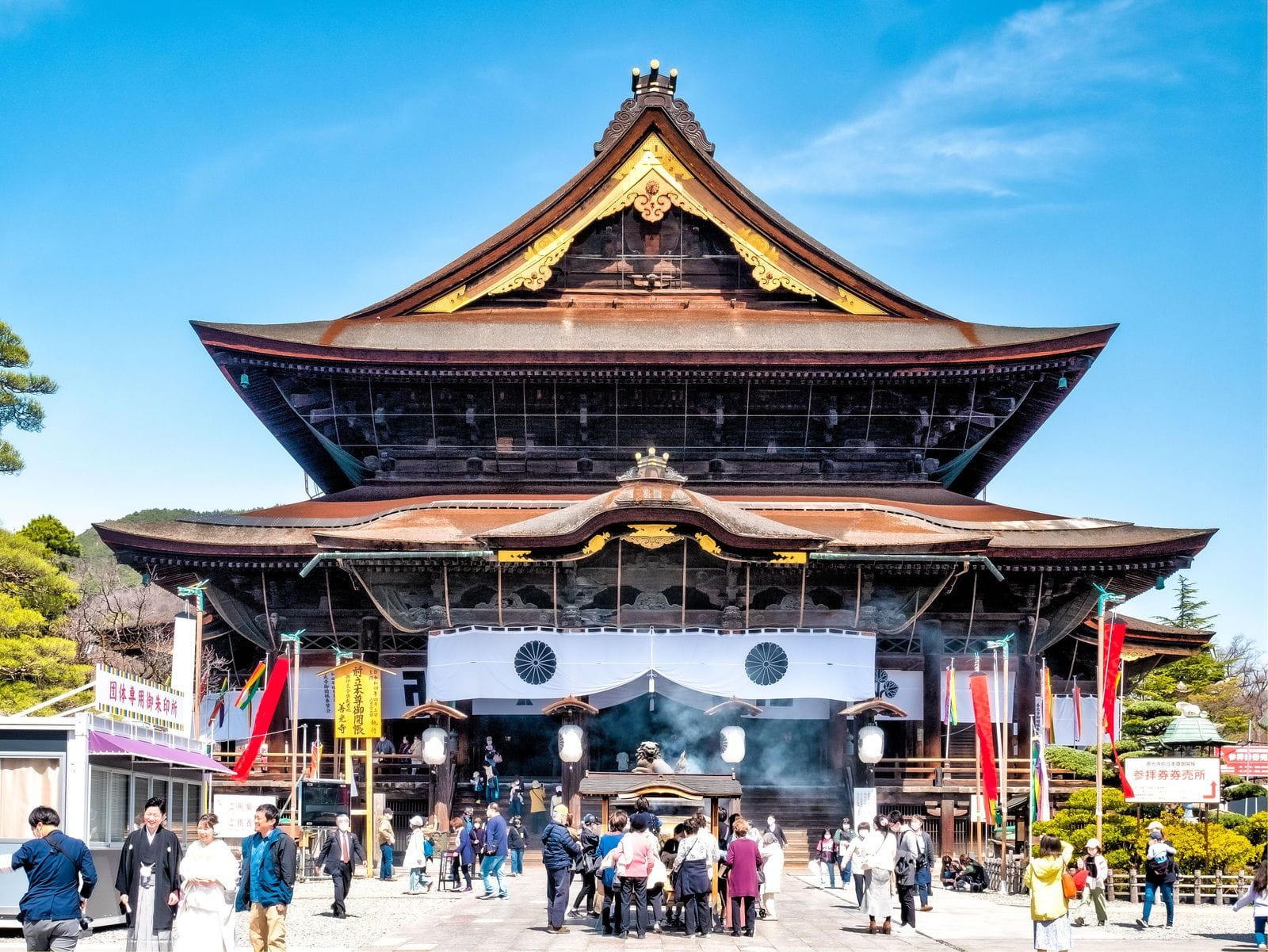
The main hall
Photo: くろふね / CC BY 4.0 · Original · Resized and croppedEdo period · Temples · National Treasures
Zenko-ji
善光寺 (ぜんこうじ)
The main hall, rebuilt in 1707 and now a National Treasure, stands about 27 meters tall with a T-shaped shumoku-zukuri roof, and is among the largest wooden National Treasure buildings in eastern Japan. The non-sectarian temple enshrines a triad of Amida Buddha in one halo, and visitors can walk the pitch-dark Okaidan passage beneath the inner sanctuary.
Key facts
- Designation
- National Treasures
- Era
- Edo period
- Type
- Temples
- Location
- Nagano, Nagano
- Address
- 長野県長野市大字長野元善町
Before you go
- Opening hours
- The inner sanctuary of the main hall opens one hour before the morning service (Oasaji) and closes at 16:30 from April to October, 16:15 in March and November, and 16:00 from December to February. The Sanmon gate, Kyozo sutra hall and history museum are open 9:00 to 16:00 (all close at 13:00 on December 31).
- Closed
- Check the official site
- Admission (adults)
- The Zenkoji set ticket, covering the inner sanctuary, the Okaidan passage, the Sanmon gate, the Kyozo sutra hall and the history museum, is ¥1,500 for adults. A ticket for the inner sanctuary and Okaidan passage only is ¥800.
- Time needed
- Check the official site
- Getting there
- From bus stop 1 at the Zenkoji exit of JR Nagano Station, a local bus takes about 15 minutes (¥190) to Zenkoji Daimon bus stop, then it is about a 5-minute walk to the main hall. The temple has paid parking for cars (¥600 for up to 2 hours, then ¥300 per hour).
- Best time to visit
- The Gokaicho, a grand ceremony held once every seven years, next takes place from April 4 to June 19, 2027.
- Good to know
- The morning service (Oasaji) begins in the main hall at sunrise every day. On the way to and from it, the head priests touch the heads of kneeling visitors with their prayer beads (Ojuzu chodai), and anyone may take part.
Checked against official information on November 12, 2026. Fees and hours can change, so please also check the official site before you go.
Sources for visitor information
Key facts
- Designation
- National Treasures
- Era
- Edo period
- Type
- Temples
- Location
- Nagano, Nagano
- Address
- 長野県長野市大字長野元善町
About this place
Zenko-ji is a temple whose principal image is the Ikko Sanzon Amida Nyorai. The type, with Amida Buddha at the center and the bodhisattvas Kannon and Seishi on either side within a single halo, is also called the "Zenko-ji style Amida triad." It is a non-denominational temple, and today its care and management are shared by the Tendai sect, with Daikanjin as its head temple, and the Jodo sect, with Daihongan as its head temple. According to the Zenko-ji Engi, the image reached Japan from Baekje in 552, and Honda Yoshimitsu of Shinano moved it to the present site in 642; the temple's name comes from his.
The National Treasure main hall dates from its rebuilding in 1707. Zenko-ji has suffered many great fires since its founding, the last in 1700. Rebuilding was funded by donations gathered on tours of the temple's image around the country, and for the present hall five years of such tours reportedly raised more than 20,000 ryo. The official site describes it as one of the largest wooden National Treasure buildings in eastern Japan, about 27 meters tall, 24 meters wide and 54 meters deep. It has 108 pillars, a number said to equal human worldly desires. From above, the ridge forms a T shape resembling the shumoku, the mallet used to strike a bell, hence the name shumoku-zukuri. The roof is cypress bark.
Inside, the hall is divided into the outer, inner and innermost sanctuaries, and the principal image is enshrined on the Ruri-dan at the far end. The hall is entered from the gable end, with a three-bay front porch and a curved karahafu gable over the eaves. The hanging curtains and many places in the grounds bear the standing-hollyhock crest of the Honda family, who founded Zenko-ji. The temple was also caught up in war. In 1555 Takeda Shingen moved the image and the priests to Kofu; the image passed to the Oda and Tokugawa, then to Toyotomi Hideyoshi, and returned to Shinano in 1598 after more than forty years. Afterward, Tokugawa Ieyasu granted the temple an estate of 1,000 koku and recovery advanced.
In the Edo period the saying "visit Zenko-ji once in a lifetime" spread, and as a temple that taught salvation for everyone regardless of sex or rank, it drew many women pilgrims. The tale "Led to Zenko-ji by an ox" also spread then. In the Kamakura period Minamoto no Yoritomo and the Hojo family were devoted patrons, and the official site records that Chogen, Shinran and Ippen also visited. When viewing the main hall, look not only at the front but also at the side porches. The front porch is three bays wide, and each side has a one-bay porch.
Buildings designated as National Treasures
Zenko-ji Main Hall
- Era
- Mid-Edo period
- Year
- 1707
- Structure
- fourteen bays wide, five bays deep, single-story with a mokoshi skirt roof, shumoku-zukuri (T-shaped) plan, entrance on the gable end, three-bay front porch (kohai), with a karahafu curved gable on the eaves, one-bay porches on each side, all-over cypress-bark roofing
- Designated
- March 31, 1953
Sources and date checked
Facts such as eras, structures and locations are edited and translated by us from the Agency for Cultural Affairs’ database of nationally designated cultural properties. The Agency and the national government did not produce this page.
Database of nationally designated cultural properties- Agency for Cultural Affairs, Database of National Cultural Properties: Zenko-ji Main Hall
- Zenko-ji official site: What Is Zenko-ji
- Zenko-ji official site: Main Hall
- Zenko-ji official site: Zenko-ji Engi (Origins)
Checked on November 6, 2026
Report an error
If you notice a mistake, please tell us along with a source for the correct information.
Where to go next
Places you could see on the same day, and places worth comparing.
More from Nagano
Discover more of the same region on our sister sites.
Meiga no Furusato
Paintings linked to Nagano
- Mount Asama
- Thirty-six Views of Mount Fuji: Lake Suwa in Shinano Province
- The Sixty-nine Stations of the Kisokaido: Karuizawa
- The Sixty-nine Stations of the Kisokaido: Rain on the Hiratsuka Plain near Kutsukake Station
Sake Tabi
Breweries and distilleries in Nagano
- Chateau Mercian Kikyogahara Winery
- Hayashi Farm Goichi Wine Vineyard Visit
- Komoro Distillery
- Mars Komagatake Distillery (Hombo Shuzo)