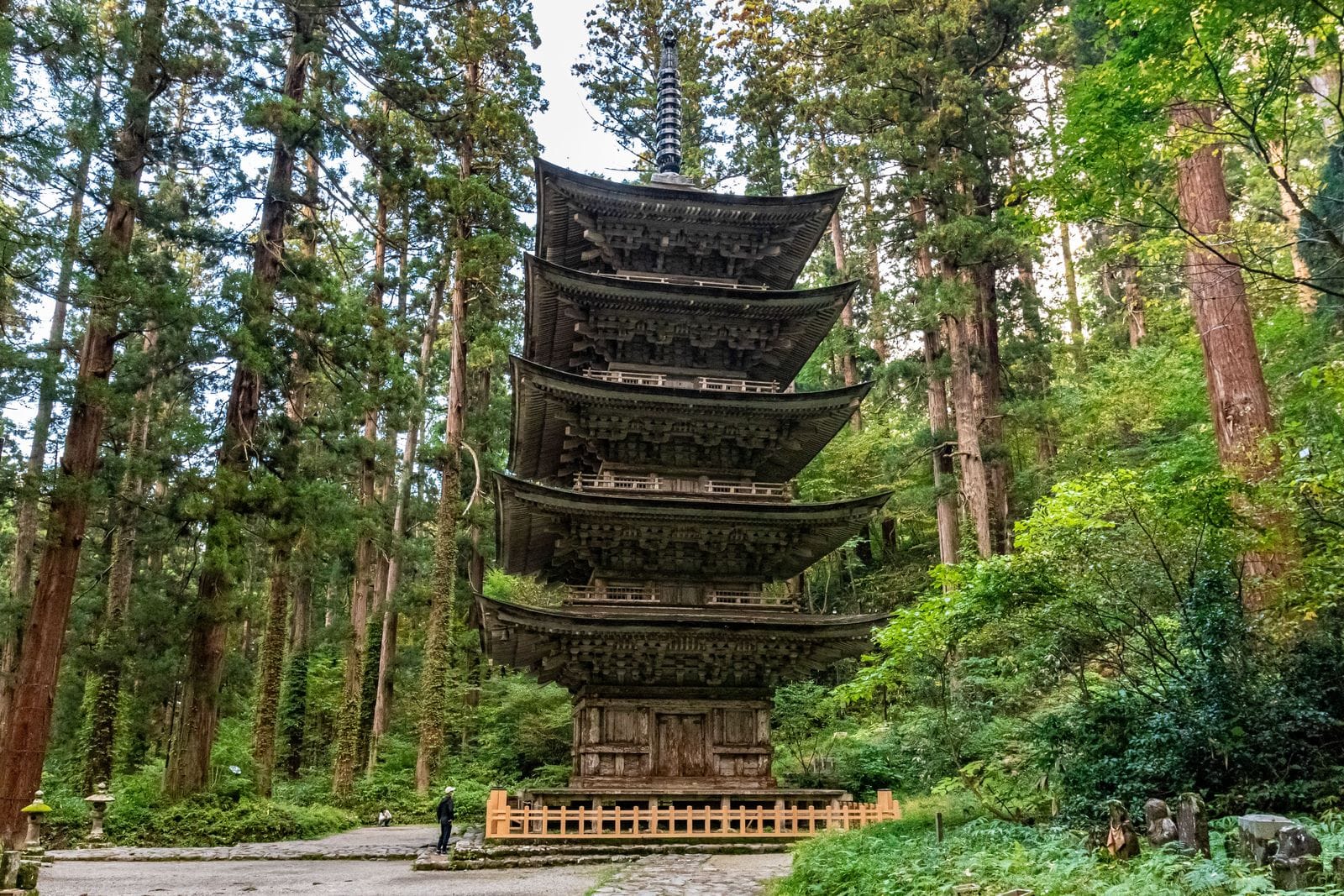
The five-story pagoda among cedars
Photo: くろふね / CC BY 4.0 · Original · Resized and croppedMuromachi period · Temples · National Treasures
Haguro-san Five-Story Pagoda
羽黒山五重塔 (はぐろさんごじゅうのとう)
A plain, unpainted five-story pagoda over 29 meters tall, standing among the cedar trees and stone steps of Mount Haguro's main approach. Built in 1372, it is best seen as part of the sacred path of the Dewa Sanzan mountains.
Key facts
- Designation
- National Treasures
- Era
- Muromachi period
- Type
- Temples
- Location
- Tsuruoka, Yamagata
- Address
- 山形県鶴岡市羽黒町大字手向
Before you go
- Opening hours
- Check the official site
- Closed
- Check the official site
- Admission (adults)
- Check the official site
- Time needed
- Check the official site
- Getting there
- From Tsuruoka, take the Shonai Kotsu bus bound for Hagurosan-cho (about 50 minutes to the last stop) and get off at Zuishinmon. From Zuishinmon gate, walk up the stone steps of the main approach for about 10 to 15 minutes to the pagoda. Drivers park at the lot at the foot of the mountain and walk from there.
- Good to know
- The stone steps get slippery in rain and snow and are steep in places, so wear sturdy walking shoes. There are no lights along the stone path, so night visits are not recommended. In winter the Haguro-san toll road is not cleared of snow early in the morning or at night, so drive it only while the toll gate is open.
Checked against official information on November 12, 2026. Fees and hours can change, so please also check the official site before you go.
Sources for visitor information
Key facts
- Designation
- National Treasures
- Era
- Muromachi period
- Type
- Temples
- Location
- Tsuruoka, Yamagata
- Address
- 山形県鶴岡市羽黒町大字手向
About this place
The Haguro-san Five-Story Pagoda stands on Mount Haguro in Tsuruoka, Yamagata Prefecture, partway along the main approach that climbs from the Zuishinmon gate to the summit. It is a little over 29 meters tall, left as unpainted bare wood, with a wooden-shingle roof. It was designated a National Treasure in 1966. Because it stands within an approach of cedars and stone steps, it makes more sense to treat the approach and the building as one place than to look at the pagoda alone.
Mount Haguro is one of the mountains known together with Gassan and Yudono-san as the Three Mountains of Dewa, and of the three it lies closest to human settlement. Yamagata Prefecture explains that Haguro is likened to the sun, Gassan to the moon and Yudono-san to the stars, and that the three have been revered as mountains of rebirth. Until the Edo period this was a mountain of Shugendo where kami and Buddhas were worshipped together; from the Meiji era on it became a Shinto mountain. That the pagoda originally belonged to a temple called Takimizu-dera also helps explain why a Buddhist pagoda stands on a shrine's approach.
The dates need some care. Shrine tradition says Taira no Masakado built a pagoda in the Johei era (931 to 938), but the structure standing today dates from 1372 (Oan 5), more than four hundred years after that tradition. It then went through several repairs in the early modern period. The frame of the first story, the bracket sets and eaves of the fourth and fifth stories, and the finial have been replaced, and the central pillar is said to have been cut at the second story during the 1608 (Keicho 13) repair. It is closer to the truth to see it as a building that has carried the form of an early Muromachi pagoda forward through repeated repair.
In its form, the things to look at are how the pagoda narrows and its roofs. Each story is three bays wide on every side with a veranda around it, and the bracket sets are of the three-step type. Going up, each story narrows by two rafter spacings in nearly equal steps, yet the size of that spacing differs from story to story. This is a method from before the system of proportions known as shiwari-sei took shape. The wide central bay and the gentle roof pitch show work even older than the early Muromachi period. Medieval buildings in the native wayo style are scarce in the Tohoku region, and this pagoda is one of the few examples.
The approach to the pagoda holds plenty to see as well. Along the road of about 2 kilometers from the Zuishinmon gate to the Sanjingosaiden hall on the summit, more than 550 cedars line both sides. The avenue is a Special Natural Monument, and tradition says it was planted in the Edo period by Ten'yu, the abbot who rebuilt Mount Haguro. The stone steps are said to number 2,446. Partway along, the Jijisugi is an old cedar that was growing before the avenue, said to be more than a thousand years old, with a root circumference of 10.5 meters and a height of 43 meters. The Babasugi that once stood nearby fell in a storm in 1902 (Meiji 35) and died.
When planning your route, keep in mind that the pagoda is on the foot-of-the-mountain side and the Sanjingosaiden is on the summit. That hall, an Important Cultural Property, was completed in 1818 after burning down in 1811, and enshrines the deities of all three mountains together so that worship and festivals for snowbound Gassan and Yudono-san can continue in winter. Whether to turn back at the pagoda or climb the stone steps to the summit depends on your stamina and the weather. Dewa Sanzan Shrine warns that some sections are quite steep and that the steps get slippery in rain and snow. The summit can also be reached by car on a toll road.
Buildings designated as National Treasures
Haguro-san Five-Story Pagoda
- Era
- Early Muromachi period
- Year
- 1372
- Structure
- Three-bay, five-story pagoda, wooden-shingle roofing
- Designated
- June 11, 1966
Sources and date checked
Facts such as eras, structures and locations are edited and translated by us from the Agency for Cultural Affairs’ database of nationally designated cultural properties. The Agency and the national government did not produce this page.
Database of nationally designated cultural properties- Agency for Cultural Affairs, Database of National Cultural Properties: Haguro-san Five-Story Pagoda
- Japan Heritage Portal Site: Haguro-san Five-Story Pagoda (Agency for Cultural Affairs)
- Japan Heritage Portal Site: Cedar Avenue of Haguro-san (Agency for Cultural Affairs)
- Japan Heritage Portal Site: Jijisugi (Grandfather Cedar) of Haguro-san (Agency for Cultural Affairs)
- Japan Heritage Portal Site: Haguro-san Sanjin Gosaiden (Agency for Cultural Affairs)
- Yamagata Prefecture: Dewa Sanzan
- Dewa Sanzan Shrine official website
- Dewa Sanzan Shrine: FAQ
Checked on November 6, 2026
Report an error
If you notice a mistake, please tell us along with a source for the correct information.
Where to go next
Places you could see on the same day, and places worth comparing.
More from Yamagata
Discover more of the same region on our sister sites.
Meiga no Furusato
Paintings linked to Yamagata
- Landscape of Mt. Kuriko
- Famous Places in the Sixty-odd Provinces: Dewa Province: Mogami River and a Distant View of Mount Gassan
Sake Tabi
Breweries and distilleries in Yamagata
- Dewazakura Sake Brewery
- Takahata Winery
- Toko no Sakagura Sake Museum (Kojima Sohonten)
- Dewanoyuki Brewing Museum (Watari Honten)