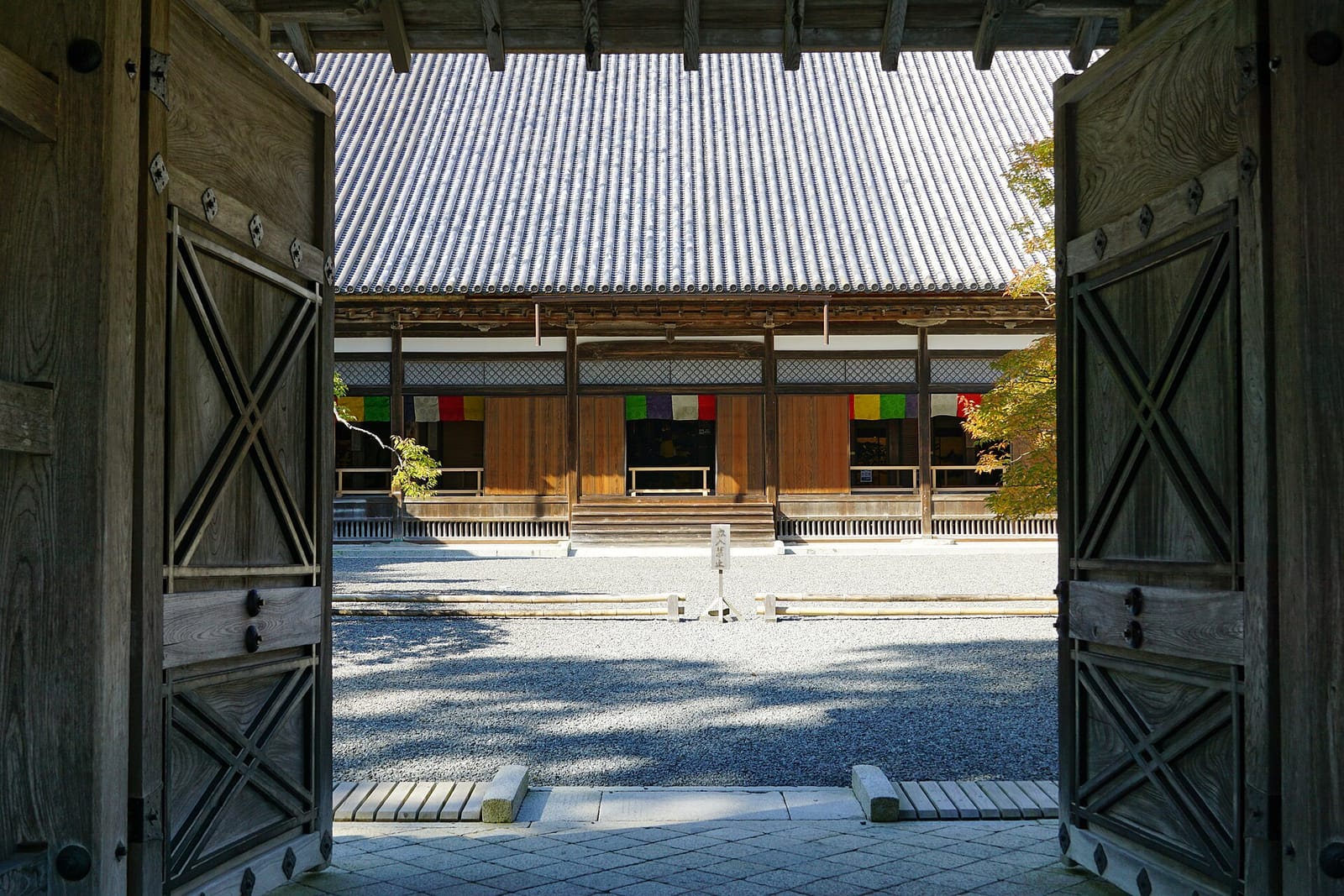
Zuiganji
Photo: 663highland / CC BY-SA 4.0 · Original · Resized and croppedMomoyama period · Temples · National Treasures
Zuiganji
瑞巖寺 (ずいがんじ)
At Zuiganji you can see the rooms adorned with sliding-door paintings and the Onari Genkan entrance in the National Treasure main hall completed by Date Masamune in 1609, and next to it the National Treasure Kuri with its bold arabesque carvings and great roof topped by a smoke vent.
Key facts
- Designation
- National Treasures
- Era
- Momoyama period
- Type
- Temples
- Location
- Matsushima, Miyagi
- Address
- 宮城県宮城郡松島町松島
Before you go
- Opening hours
- The gates open at 8:30 and close at different times by month (17:00 April to September, 16:30 in March and October, 16:00 in February and November, 15:30 in January and December). Last entry is 30 minutes before closing.
- Closed
- Check the official site
- Admission (adults)
- Admission is ¥1,000 for adults.
- Time needed
- The temple suggests allowing about 30 to 40 minutes.
- Getting there
- About 10 minutes on foot from Matsushima-Kaigan Station on the JR Senseki Line, or 25 minutes from Matsushima Station on the JR Tohoku Line. The temple has no car park of its own.
- Good to know
- The National Treasure main hall and kitchen hall are not wheelchair accessible; only the treasure museum is.
Checked against official information on November 12, 2026. Fees and hours can change, so please also check the official site before you go.
Sources for visitor information
Key facts
- Designation
- National Treasures
- Era
- Momoyama period
- Type
- Temples
- Location
- Matsushima, Miyagi
- Address
- 宮城県宮城郡松島町松島
About this place
Zuiganji is a Zen temple of the Myoshin-ji branch of the Rinzai school in Matsushima, Miyagi Prefecture; its formal name is Matsushima Seiryuzan Zuigan Enpuku Zenji. According to the temple, its predecessor was Enpuku-ji, a Tendai temple said to have been founded in the early 9th century by Jikaku Daishi Ennin. In the mid-13th century, Hojo Tokiyori, regent of the Kamakura shogunate, invited the Zen master Hosshin Shosai as founding abbot and made it the Rinzai temple Enpuku-ji, and in the Muromachi period it came to be ranked among the Ten Temples of the Kanto. It then gradually declined through the Warring States period.
The temple was restored to its present form by Date Masamune, who made Sendai his base after the Battle of Sekigahara. According to the temple, Masamune laid out the site himself, sought timber from Kumano in Kii Province, and brought in 130 master craftsmen from the Kinai region. The name Zuiganji first appears in the inscription on a temple bell cast in 1608, and the following year, 1609, the five-year construction was completed. As the family temple of the Date clan it became the foremost temple in the domain, and after decline in the Meiji era it completed the ten-year Heisei Great Restoration in 2018.
The National Treasure Main Hall (former Hojo) dates from 1609; the national cultural properties database dates it to the Momoyama period and describes it as 13 bays wide, single-story, with a hip-and-gable roof covered in tiles. According to the temple, it is 38 meters wide, 24.2 meters deep and 17.3 meters high at the ridge. Ten rooms, including the Butsuma (Buddha room), the Bunno Room, the Jodan Room and the Jojodan Room, are arranged around the central Shicchu, also called the Peacock Room, and the themes of the sliding-door paintings and the style of the ceilings change from room to room. The wall paintings were made from 1620 to 1622, and every room except the Sumie Room now holds finely made reproductions produced since 1985.
At the southwest corner of the main hall is the Onari Genkan, an entrance reserved for the emperor, the imperial family and the lord of the domain. Because of its bent shape it is also called the otsu-shaped entrance, and while most of its woodwork is left plain, key carvings are covered with gold leaf. The Kuri was the temple's kitchen. According to the temple, it is 13.8 meters wide and 23.6 meters deep, with a gable roof covered in tiles and a hip-and-gable smoke vent on top. Look for the beams and struts built up on the upper front and the bold arabesque carvings on the gable. The main hall was designated a National Treasure in 1953, and the Kuri and the corridors in 1959.
Along the right side of the approach runs a group of caves whose walls are carved with memorial towers and five-tiered stupas, recalling that Matsushima was a sacred site known as the Koya of Oshu. To the left of the reception office is Hosshin-kutsu, the cave where Hosshin and Hojo Tokiyori are said to have met. In front of the main hall, the Garyubai are red and white plum trees said to have been planted by Masamune himself to celebrate the raising of the ridgepole; they usually bloom from late March to early April. The main hall's Sumie Room cannot currently be seen because of a five-year project, begun in May 2026, to conserve its paintings and make reproductions; the restored originals will go to the temple's museum, and reproductions will be fitted in the room.
Buildings designated as National Treasures
Zuiganji Main Hall (former Hojo)
- Era
- Momoyama period
- Year
- 1609
- Structure
- 13 bays wide, 8 bays deep on the right side, 8 bays on the left side, single-story, hip-and-gable roof, traditional tile roofing, with an entrance porch attached
- Designated
- March 31, 1953
Zuiganji Kuri (Monastery Kitchen) and Corridor (main building)
- Era
- Momoyama period
- Structure
- 23.6 m wide, 13.8 m deep, single-story, gable roof, entered through the gable end, traditional tile roofing, including the entrance and two lean-tos on the north side
- Designated
- June 27, 1959
Zuiganji Kuri (Monastery Kitchen) and Corridor (corridors)
- Era
- Momoyama period
- Structure
- Entrance porch 2 bays long, east corridor 6 bays long, central corridor 11 bays long, west corridor 2 bays long, each 1 bay deep, single-story, hip-and-gable roof, traditional tile roofing
- Designated
- June 27, 1959
Sources and date checked
Facts such as eras, structures and locations are edited and translated by us from the Agency for Cultural Affairs’ database of nationally designated cultural properties. The Agency and the national government did not produce this page.
Database of nationally designated cultural properties- Agency for Cultural Affairs, Database of National Cultural Properties: Zuiganji Main Hall (former Hojo)
- Agency for Cultural Affairs, Database of National Cultural Properties: Zuiganji Kuri (Monastery Kitchen) and Corridor (main building)
- Agency for Cultural Affairs, Database of National Cultural Properties: Zuiganji Kuri (Monastery Kitchen) and Corridor (corridors)
- Zuiganji: History (Zuiganji official site)
- Zuiganji: Precinct guide, Main Hall (Zuiganji official site)
- Zuiganji: Precinct guide, Kuri (Zuiganji official site)
- Zuiganji: Precinct guide, Onari Genkan (Zuiganji official site)
- Zuiganji: Precinct guide, Garyubai plum trees (Zuiganji official site)
- Zuiganji: Precinct guide, Hosshin-kutsu cave (Zuiganji official site)
- Zuiganji: Precinct guide, cave remains (Zuiganji official site)
Checked on November 6, 2026
Report an error
If you notice a mistake, please tell us along with a source for the correct information.
Where to go next
Places you could see on the same day, and places worth comparing.
More from Miyagi
Discover more of the same region on our sister sites.