Zuiryu-ji
Photo: 柑橘類 (talk) / CC BY-SA 3.0 · Original · Resized and croppedEdo period · Temples · National Treasures
Zuiryu-ji
瑞龍寺 (ずいりゅうじ)
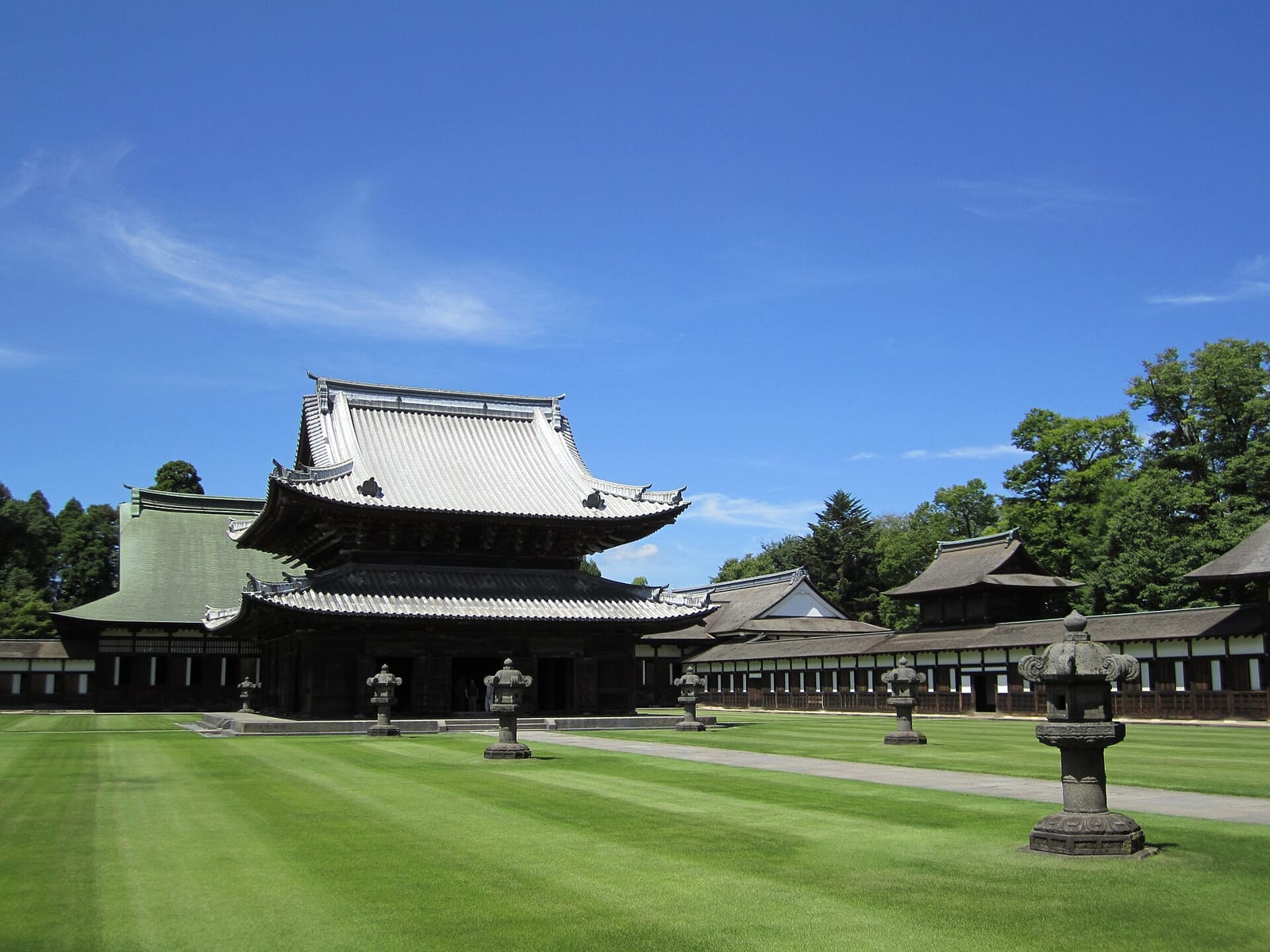
At Zuiryu-ji you can walk through an early Edo-period Zen temple compound where the gates and halls stand in a straight line, linked by corridors. Its three National Treasures are the Sanmon, about 18 meters tall and rebuilt in 1818, the lead-roofed Butsuden, and the Hatto, which holds Maeda Toshinaga's memorial tablet.
Key facts
- Designation
- National Treasures
- Era
- Edo period
- Type
- Temples
- Location
- Takaoka, Toyama
- Address
- 富山県高岡市関本町
Before you go
- Opening hours
- 9:00 to 16:30 (closing at 16:00 from December 10 to January 31); enter at least 30 minutes before closing. Entry is free on New Year's Eve night and New Year's Day.
- Closed
- Check the official site
- Admission (adults)
- Admission is ¥500 for adults.
- Time needed
- Check the official site
- Getting there
- About 10 minutes on foot from Takaoka Station (Ainokaze Toyama Railway and JR), or 15 minutes from Shin-Takaoka Station on the Hokuriku Shinkansen.
Checked against official information on November 12, 2026. Fees and hours can change, so please also check the official site before you go.
Sources for visitor information
Key facts
- Designation
- National Treasures
- Era
- Edo period
- Type
- Temples
- Location
- Takaoka, Toyama
- Address
- 富山県高岡市関本町
About this place
Zuiryu-ji is a Soto Zen temple in Sekihon-machi, Takaoka, Toyama Prefecture. It was built by Maeda Toshitsune, the third head of the Maeda family of the Kaga Domain, to pray for the repose of Maeda Toshinaga, the second head, who built a castle in Takaoka and died there. According to Takaoka City, its predecessor was Hoen-ji, a temple Toshinaga brought from Toyama when he founded the town of Takaoka; after Toshinaga died in 1614, it was renamed Zuiryu-ji after his Buddhist name. The temple says construction took about 20 years, from the Shoho era until 1663, the 50th anniversary of Toshinaga's death.
The layout follows temple architecture introduced from China in the Kamakura period: the Somon (outer gate), Sanmon (Main Gate), Butsuden (Buddha Hall) and Hatto (Dharma Hall) stand in a straight line, with the Zendo (meditation hall) and the Okuri (great kitchen) on either side, all linked by surrounding corridors. According to the temple, the corridors measure about 95 meters by about 59 meters. The master builder was Yamagami Zen'emon Yoshihiro, a Kaga Domain carpenter trusted by the Maeda family and skilled in the Zen style. In 1997 the Sanmon, Butsuden and Hatto were designated National Treasures, and the Somon, Zendo, Daisado (great tea hall) and corridors are also Important Cultural Properties.
The national cultural properties database dates the Sanmon to 1818. It is a two-story gate, three bays wide with one doorway, with a hip-and-gable roof of wooden shingles and side corridors on the left and right. According to Takaoka City, the first gate burned in the third year of the Enkyo era, in the mid-Edo period, in a fire that started in the bathhouse on its north side. Rebuilding was slow because of the domain's financial difficulties, but permission was granted at the townspeople's request, and with a descendant of the original master carpenter in charge, the gate was completed in Bunsei 1 (1818). It is about 18 meters tall; Shaka Nyorai and the Sixteen Arhats are enshrined in the upper story, and Kongo Rikishi guardian statues stand on both sides of the entrance.
The Butsuden dates from 1659 and enshrines the principal image, Shaka Nyorai, with the attendants Monju Bosatsu and Fugen Bosatsu. According to the temple, it is a Zen-style hall built entirely of zelkova; its upper rafters spread out radially in the fan pattern, while the lower rafters run parallel. The roof is covered with lead tiles weighing 47 tons in total. The Hatto, at the far end of the compound, dates from 1655. At the center of its inner sanctuary stands Maeda Toshinaga's memorial tablet, about 210 cm tall; the ceiling bears paintings of flowers of the four seasons by Kano Yasunobu, and the transom at the front is carved with phoenixes.
A visit runs straight from the Somon through the Sanmon and Butsuden to the Hatto, and walking the corridors shows the symmetry of the layout. According to Takaoka Kanko Navi, leaving the corridors on the south side of the Hatto brings you to five stone mausoleums, including those of Maeda Toshinaga, Maeda Toshiie and Oda Nobunaga. The upper story of the Sanmon is usually closed, but it opens during the treasure exhibition held every year in early November, when treasures donated by the Maeda family are also shown. Other events include the Toshinaga memorial on May 20 and the ringing of the temple bell on December 31.
Buildings designated as National Treasures
Zuiryu-ji Butsuden (Buddha Hall)
- Era
- Early Edo period
- Year
- 1659
- Structure
- 3 bays wide, 3 bays deep, single-story with a mokoshi (skirt roof), hip-and-gable roof, lead-tile roofing
- Designated
- December 3, 1997
Zuiryu-ji Hatto (Dharma Hall)
- Era
- Early Edo period
- Year
- 1655
- Structure
- 11 bays wide, 9 bays deep, single-story, hip-and-gable roof, copper-sheet roofing; front porch (kohai): 2 bays wide, 1 bay deep, single-story, curved karahafu gable over the front, copper-sheet roofing
- Designated
- December 3, 1997
Zuiryu-ji Sanmon (Main Gate)
- Era
- Late Edo period
- Year
- 1818
- Structure
- Three-bay, one-door, two-story gate, hip-and-gable roof, wooden-shingle roofing; flanking side corridors: each 3 bays wide, 1 bay deep, single-story, gable roof, wooden-shingle roofing
- Designated
- December 3, 1997
Sources and date checked
Facts such as eras, structures and locations are edited and translated by us from the Agency for Cultural Affairs’ database of nationally designated cultural properties. The Agency and the national government did not produce this page.
Database of nationally designated cultural properties- Agency for Cultural Affairs, Database of National Cultural Properties: Zuiryu-ji Butsuden (Buddha Hall)
- Agency for Cultural Affairs, Database of National Cultural Properties: Zuiryu-ji Hatto (Dharma Hall)
- Agency for Cultural Affairs, Database of National Cultural Properties: Zuiryu-ji Sanmon (Main Gate)
- Zuiryu-ji official site
- Zuiryu-ji: Temple layout (Zuiryu-ji official)
- Zuiryu-ji: Features of the temple (Zuiryu-ji official)
- Zuiryu-ji: Annual events (Zuiryu-ji official)
- Zuiryu-ji: Temple treasures (Zuiryu-ji official)
- Zuiryu-ji: Visitor guide by the chief priest (Zuiryu-ji official)
- Takaokasan Zuiryu-ji (Takaoka City)
- National Treasure Zuiryu-ji: Complete visitor guide (Takaoka Kanko Navi)
Checked on November 6, 2026
Report an error
If you notice a mistake, please tell us along with a source for the correct information.
Where to go next
Places you could see on the same day, and places worth comparing.
Nearby cultural heritage
Places within 10 km, nearest first. Distances are in a straight line.
More from Toyama
Discover more of the same region on our sister sites.
Matsuri Biyori
UNESCO-listed festivals in Toyama
- Takaoka Mikurumayama Festival Float Event
- Uozu Tatemon Event
- Johana Shinmeigu Shrine Festival Hikiyama Float Event
- Hojozu Hachimangu Shrine Festival Hikiyama and Tsukiyama Events
Sake Tabi
Breweries and distilleries in Toyama
- Mikuniharé Shuzo (Maboroshi no Taki) Brewery Visit
- Saburomaru Distillery (Wakatsuru Shuzo)
- Unazuki Beer Hall (Unazuki Bakushukan)
- BREWMIN' Main Shop