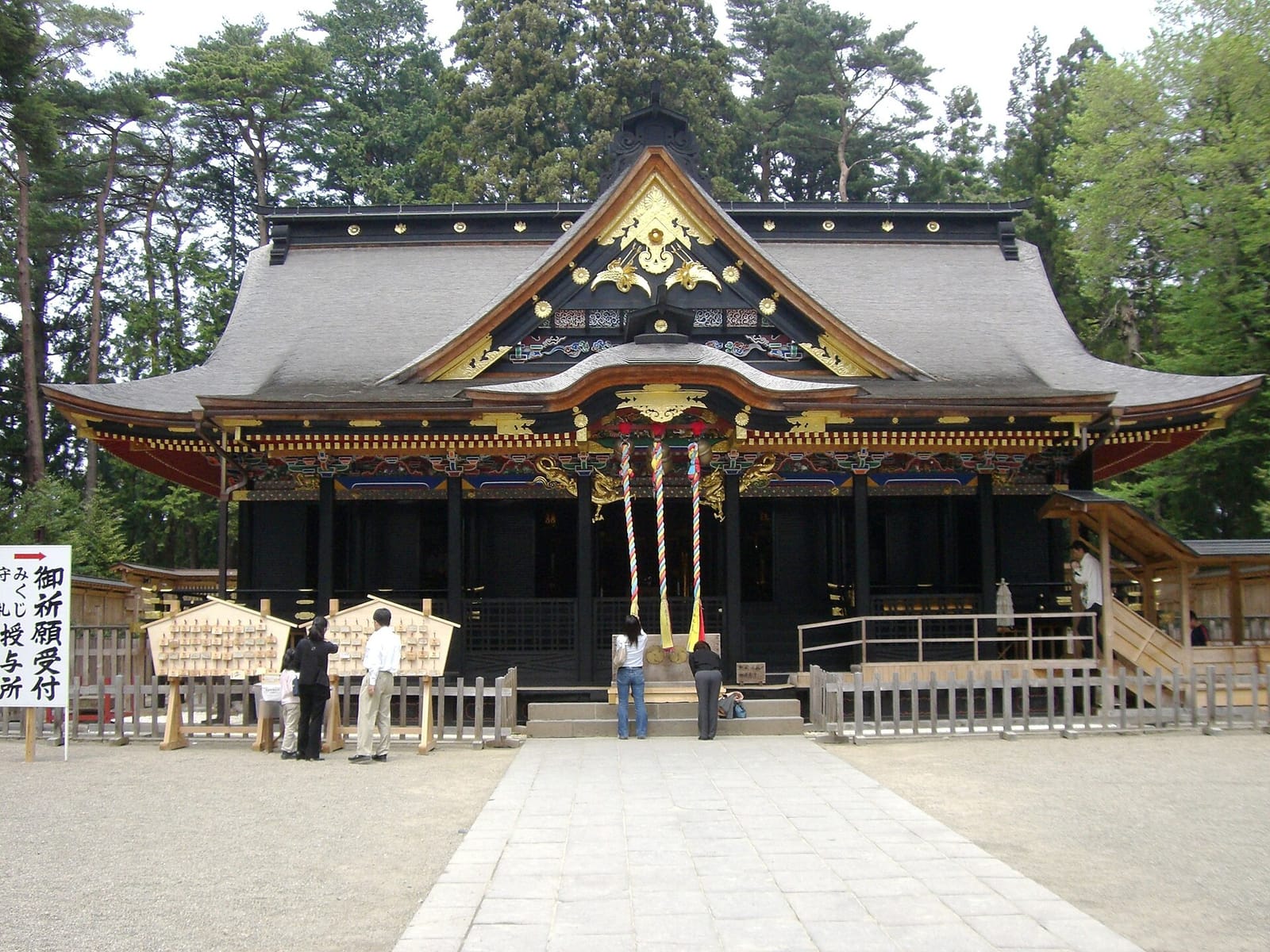
Osaki Hachimangu
Photo: ジダネ / Public domain · Original · Resized and croppedMomoyama period · Shrines · National Treasures
Osaki Hachimangu
大崎八幡宮 (おおさきはちまんぐう)
At Osaki Hachimangu you can see the shrine building completed for Date Masamune in 1607, an ishi-no-ma (gongen-zukuri) structure adorned with black lacquer and richly colored carvings. The contrast with the plain wooden Nagatoko hall in front of it is also worth a look.
Key facts
- Designation
- National Treasures
- Era
- Momoyama period
- Type
- Shrines
- Location
- Sendai, Miyagi
- Address
- 宮城県仙台市青葉区八幡四丁目
Before you go
- Opening hours
- Check the official site
- Closed
- According to Sendai's official tourism site, the shrine has no closing days.
- Admission (adults)
- Check the official site
- Time needed
- Check the official site
- Getting there
- From the bus terminal at the west exit of JR Sendai Station, take a Sendai city bus or the Loople Sendai sightseeing bus to Osaki Hachimangu-mae. There are steps from the bus stop up to the shrine buildings. Kunimi and Tohoku-Fukushi-Daimae stations on the JR Senzan Line are a 15-minute walk away. There is a free car park (40 cars, large buses accepted); wheelchair users are asked to use the north approach car park.
- Best time to visit
- At the Matsutaki Festival (Donto-sai) on January 14, New Year decorations and old talismans are burned, and the naked pilgrimage to the sacred fire is well known. The grand festival in September includes Noh kagura, a portable-shrine procession through the neighborhood and horseback archery (September 12-13 in 2026).
- Good to know
- Visitors are asked to take photos without disturbing other worshippers. Shoots with a hired photographer (for weddings, Shichi-Go-San and similar) must be registered at the prayer reception, and the shrine declines photo shoots made without a prayer. If personal photos are to be used for commercial or advertising purposes, contact the shrine office.
Checked against official information on November 13, 2026. Fees and hours can change, so please also check the official site before you go.
Sources for visitor information
Key facts
- Designation
- National Treasures
- Era
- Momoyama period
- Type
- Shrines
- Location
- Sendai, Miyagi
- Address
- 宮城県仙台市青葉区八幡四丁目
About this place
Osaki Hachimangu is a Shinto shrine in Hachiman, Aoba Ward, Sendai, enshrined to the northwest of Sendai Castle. According to the shrine's history, it began as Chinjufu Hachimangu, which Sakanoue no Tamuramaro founded in what is now Mizusawa, Iwate, by inviting the deity of Usa Hachimangu to pray for success in battle. In the Muromachi period the Osaki clan, the shogunate's governors of the north, moved it into their own domain and revered it as their guardian deity, and so it came to be called Osaki Hachimangu.
After the Osaki clan fell, Date Masamune moved the sacred object to a small shrine inside Iwadeyama Castle, and after founding the castle town of Sendai he enshrined it on the present site. At the same time he also enshrined Narushima Hachimangu, which the Date family had long revered in Yonezawa. Sendai's official tourism site describes the shrine as the Date family's guardian deity, originating from Narushima Hachiman, moved here from Iwadeyama. Revered by successive lords as the chief guardian shrine of the Sendai domain, it was called Osaki Hachiman Jinja from the Meiji era, but returned to its present name in 1997.
The National Treasure shrine building was built from 1604 to 1607 (Keicho 9-12) on Masamune's orders, with master craftsmen such as Umemura Hyuga-no-kami Ietsugu, who had served the Toyotomi family. The national cultural property database dates it to 1607, in the Momoyama period. It is in the ishi-no-ma style (gongen-zukuri), in which a hip-and-gable main sanctuary and a worship hall are joined by a stone-floored hall. Above the tie beams it is decorated with richly colored bracket sets and carvings on a white gofun base, while below it is finished in calm black lacquer. Look also for the large triangular chidori gable on the front of the worship hall, the curved karahafu gable over the entrance, and the wooden-shingle roof.
Inside the worship hall are wall paintings of Chinese lions by Sakuma Sakyo of the Kano school, and the coffered ceiling of the stone-floored hall is painted with 53 kinds of plants and flowers. The shrine calls the building the only surviving structure of its kind from the Azuchi-Momoyama period; it was designated a Specially Protected Building in 1903 and a National Treasure in 1952. The Nagatoko hall in front of it is an Important Cultural Property, and its plain unpainted wood makes a striking contrast with the ornate shrine. The stone torii gate is a prefectural Important Cultural Property. The shrine building was completed in autumn 2004 after about five years of conservation work.
At the Matsutaki Festival (Donto-sai) on January 14, New Year decorations and old talismans are burned, and the naked pilgrimage toward the sacred fire is a well-known sight of Sendai's winter. The Matsutaki Festival was designated an Intangible Folk Cultural Property of Sendai City in fiscal 2005. The grand festival in September includes Noh kagura, horseback archery, and a procession in which about 500 people accompany a large portable shrine, lacquered all in black like the shrine building, through the neighborhood. The Taigensha shrine within the grounds opens its doors on its festival day, August 1, when visitors can worship its sacred image.
Buildings designated as National Treasures
Osaki Hachimangu (Main Sanctuary)
- Era
- Momoyama period
- Year
- 1607
- Structure
- Main sanctuary: 5 bays wide, 3 bays deep, single-story, hip-and-gable roof, wooden-shingle roofing
- Designated
- November 22, 1952
Sources and date checked
Facts such as eras, structures and locations are edited and translated by us from the Agency for Cultural Affairs’ database of nationally designated cultural properties. The Agency and the national government did not produce this page.
Database of nationally designated cultural properties- Agency for Cultural Affairs, Database of National Cultural Properties: Osaki Hachimangu (Main Sanctuary)
- Osaki Hachimangu: History (Osaki Hachimangu official)
- Osaki Hachimangu: Subsidiary shrines (Osaki Hachimangu official)
- Osaki Hachimangu: Matsutaki Festival (Osaki Hachimangu official)
- Osaki Hachimangu: Grand Festival (Osaki Hachimangu official)
- Osaki Hachimangu (Sendai Tabi Biyori, Sendai official tourism site)
Checked on November 6, 2026
Report an error
If you notice a mistake, please tell us along with a source for the correct information.
Where to go next
Places you could see on the same day, and places worth comparing.
More from Miyagi
Discover more of the same region on our sister sites.