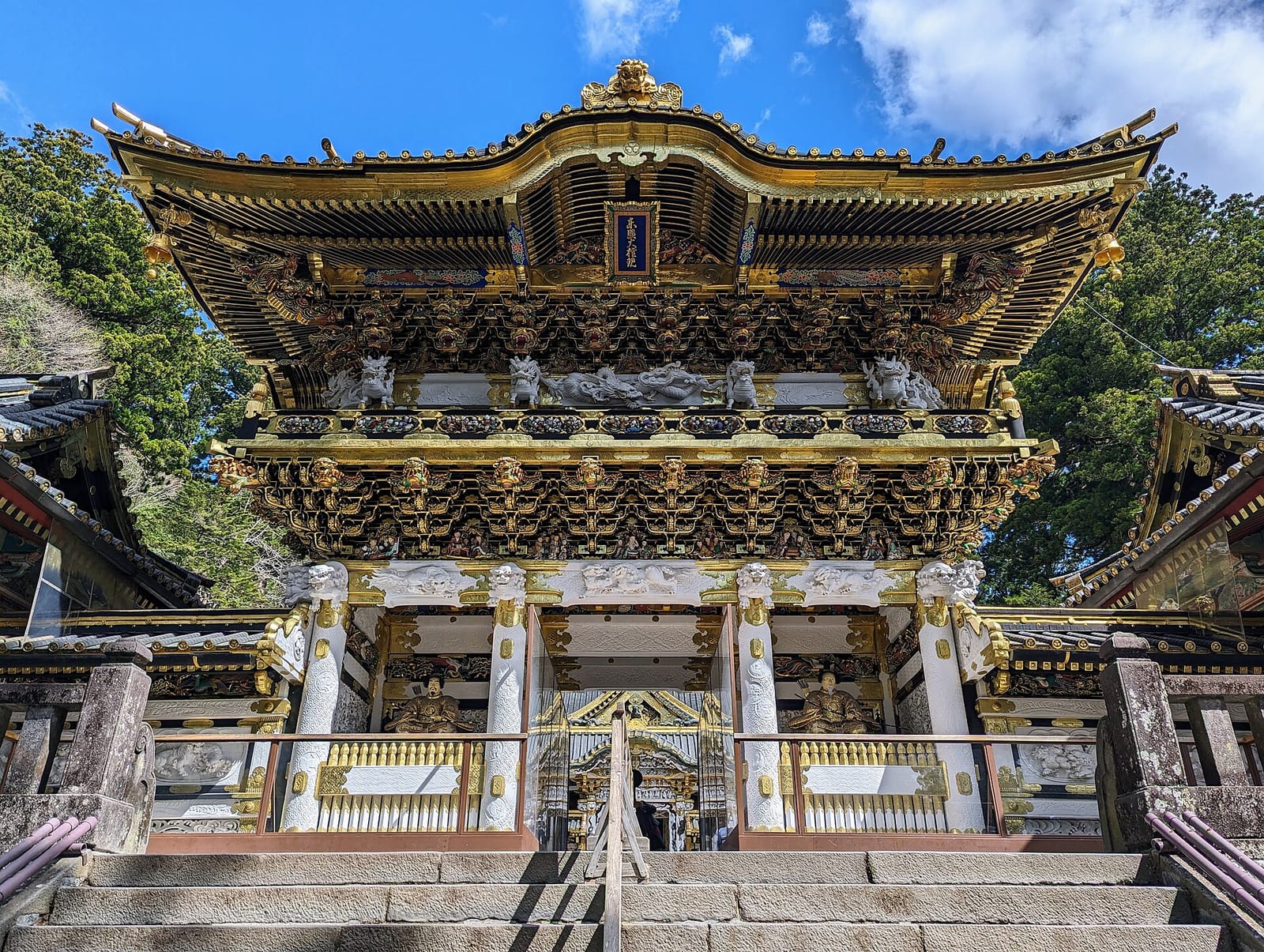
The Yomeimon gate
Photo: Jpatokal / CC BY-SA 4.0 · Original · Resized and croppedEdo period · Shrines · National Treasures
Nikko Toshogu
日光東照宮 (にっこうとうしょうぐう)
The shrine dedicated to Tokugawa Ieyasu, with buildings completed in 1636 in the great rebuilding ordered by the third shogun, Iemitsu. Eight structures are National Treasures, including the Yomeimon Gate, the gongen-style main sanctuary, the Karamon gates, the openwork fences and the corridors.
Key facts
- Designation
- National Treasures
- Era
- Edo period
- Type
- Shrines
- Location
- Nikko, Tochigi
- Address
- 栃木県日光市山内
Before you go
- Opening hours
- 9:00 to 17:00 from April 1 to October 31, and 9:00 to 16:00 from November 1 to March 31. Entry closes 30 minutes before the gates shut.
- Closed
- Check the official site
- Admission (adults)
- Admission to Nikko Toshogu is ¥1,600 for adults; a combined ticket with the Treasure Museum is ¥2,400.
- Time needed
- Check the official site
- Getting there
- From JR Nikko Station or Tobu-Nikko Station, take the World Heritage Sightseeing Bus for about 10 minutes to Omotesando bus stop, then walk about 5 minutes. Drivers can use the Toshogu main parking lot (200 cars, ¥600 per day, no reservation needed).
- Best time to visit
- At the Spring Grand Festival on May 17 and 18, horseback archery is held on the 17th and the Procession of 1,000 Samurai on the 18th. In autumn, horseback archery is on October 16 and the samurai procession of the Autumn Festival on October 17.
- Good to know
- Parts of the shrine may be closed to visitors during festivals, events or repair work.
Checked against official information on November 12, 2026. Fees and hours can change, so please also check the official site before you go.
Sources for visitor information
Key facts
- Designation
- National Treasures
- Era
- Edo period
- Type
- Shrines
- Location
- Nikko, Tochigi
- Address
- 栃木県日光市山内
About this place
Nikko Toshogu is a shrine dedicated to Tokugawa Ieyasu, the first Tokugawa shogun. Ieyasu died in 1616, was reburied at Nikko according to his will, and the Toshosha shrine was founded the following year, 1617 (Genna 3). According to the official site, the formal enshrinement took place on April 17 of that year. The splendid complex seen today does not date from then but was put in order by a later rebuilding. The great rebuilding ordered by the third shogun, Tokugawa Iemitsu, began in 1634 (Kan'ei 11), and the ridge-raising took place on April 8, 1636 (Kan'ei 13), bringing the halls and shrines close to their present form.
Eight buildings are designated National Treasures: the Honden, Ishi-no-ma, and Haiden; the front and rear Karamon gates; the east and west Sukibei fences; the Yomeimon; and the east and west corridors. All are dated to 1636. The Honden, Ishi-no-ma, and Haiden form a typical gongen-zukuri complex, in which three connected buildings make up a single sanctuary. The Honden is single-story, five bays square, with a hip-and-gable roof covered in copper tiles. The Yomeimon is a two-story gate three bays wide with a single door, a hip-and-gable roof, and curved karahafu gables on all four sides. The front Karamon also has karahafu gables on all four sides, and all of these have copper-tile roofs. The Honden has a one-bay porch (kohai) at the rear. The rear Karamon is a plain one-bay, one-door Hira-karamon, different in form from the front one. The Yomeimon has side walls to left and right.
The Sukibei are fences that bend as they run, recorded as 43 ken on the east and 44 on the west. The corridors run 54 ken on the east and 36 on the west, and the east corridor includes the Gokusho and its corridor. That half of the eight National Treasures are fences and corridors, which may look like supporting roles, shows that Toshogu is made not only of the sanctuary but of the whole composition, enclosure and circulation included. It is easy to be drawn to the carvings of each building, but walking with attention to which building your eye moves to next reveals the intent of the design. The Sukibei and the west corridor are also roofed in copper tiles, so the roofing of the whole complex matches.
The sacred stable in the grounds has carvings of the three monkeys that see no evil, speak no evil, and hear no evil. In 1999 Toshogu was inscribed on the UNESCO World Heritage List as one of the Shrines and Temples of Nikko. The shrines and temples of Nikko are listed together with their neighbors rather than Toshogu alone, so if you have time, it is worth visiting the surrounding shrines and temples as well. Check the official site for guidance on the grounds and current information, and decide on a route beforehand to miss less. It is located in Yamanouchi, Nikko, Tochigi Prefecture.
Buildings designated as National Treasures
Nikko Toshogu Honden, Ishi-no-ma and Haiden
- Era
- Early Edo period
- Year
- 1636
- Structure
- Main sanctuary: 5 bays wide, 5 bays deep, single-story, hip-and-gable roof, one-bay front porch (kohai) at the rear, copper-tile roofing
- Designated
- June 9, 1951
Nikko Toshogu Front Karamon Gate
- Era
- Early Edo period
- Year
- 1636
- Structure
- Front karamon gate: 1 bay wide, 1 bay deep, single-story, karahafu gables on all four sides, copper-tile roofing
- Designated
- June 9, 1951
Nikko Toshogu Rear Karamon Gate
- Era
- Early Edo period
- Year
- 1636
- Structure
- Rear karamon gate: one-bay, one-door flat-gabled karamon, copper-tile roofing
- Designated
- June 9, 1951
Nikko Toshogu East Sukibei (Open Fence)
- Era
- Early Edo period
- Year
- 1636
- Structure
- Bent corridor, 43 bays in total length, copper-tile roofing
- Designated
- June 9, 1951
Nikko Toshogu West Sukibei (Open Fence)
- Era
- Early Edo period
- Year
- 1636
- Structure
- Bent corridor, 44 bays in total length, copper-tile roofing
- Designated
- June 9, 1951
Nikko Toshogu Yomeimon Gate
- Era
- Early Edo period
- Year
- 1636
- Structure
- Three-bay, one-door, two-story tower gate, hip-and-gable roof, with karahafu eaves on all four sides, copper-tile roofing, with side wing walls
- Designated
- June 9, 1951
Nikko Toshogu East Cloister
- Era
- Early Edo period
- Year
- 1636
- Structure
- Bent corridor, 54 bays in total length, 1 bay deep, including the Gokusho offering hall and its corridor
- Designated
- June 9, 1951
Nikko Toshogu West Cloister
- Era
- Early Edo period
- Year
- 1636
- Structure
- Bent corridor, 36 bays in total length, 1 bay deep, each single-story, hip-and-gable roof, copper-tile roofing
- Designated
- June 9, 1951
Sources and date checked
Facts such as eras, structures and locations are edited and translated by us from the Agency for Cultural Affairs’ database of nationally designated cultural properties. The Agency and the national government did not produce this page.
Database of nationally designated cultural properties- Agency for Cultural Affairs, Database of National Cultural Properties: Nikko Toshogu Honden, Ishi-no-ma and Haiden
- Agency for Cultural Affairs, Database of National Cultural Properties: Nikko Toshogu Front Karamon Gate
- Agency for Cultural Affairs, Database of National Cultural Properties: Nikko Toshogu Rear Karamon Gate
- Agency for Cultural Affairs, Database of National Cultural Properties: Nikko Toshogu East Sukibei (Open Fence)
- Agency for Cultural Affairs, Database of National Cultural Properties: Nikko Toshogu West Sukibei (Open Fence)
- Agency for Cultural Affairs, Database of National Cultural Properties: Nikko Toshogu Yomeimon Gate
- Agency for Cultural Affairs, Database of National Cultural Properties: Nikko Toshogu East Cloister
- Agency for Cultural Affairs, Database of National Cultural Properties: Nikko Toshogu West Cloister
- Nikko Toshogu official site
- Kotobank: Nikko Toshogu
- Nikko Toshogu official site: Precinct Guide
Checked on November 6, 2026
Report an error
If you notice a mistake, please tell us along with a source for the correct information.
Where to go next
Places you could see on the same day, and places worth comparing.
Nearby cultural heritage
Places within 10 km, nearest first. Distances are in a straight line.
More from Tochigi
Discover more of the same region on our sister sites.
Sake Tabi
Breweries and distilleries in Tochigi
- Watanabe Sahei Shoten (Nikko Homare)
- Coco Farm & Winery
- Ishii Brewing Brewery Shop
- Katayama Shuzo (Kashiwazakari)