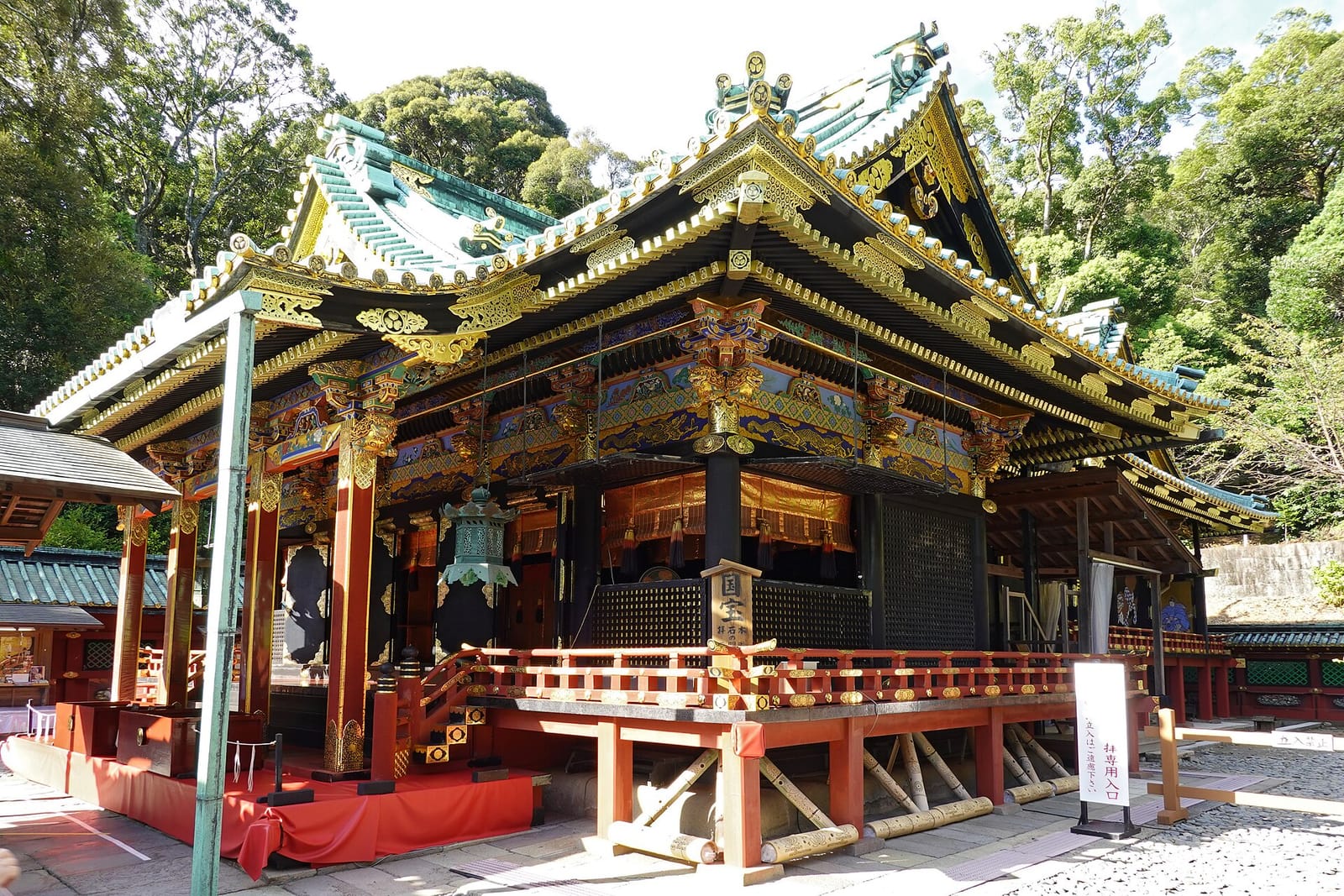
Kunozan Toshogu
Photo: 663highland / CC BY-SA 4.0 · Original · Resized and croppedEdo period · Shrines · National Treasures
Kunozan Toshogu
久能山東照宮 (くのうざんとうしょうぐう)
At Kunozan Toshogu you can see the National Treasure shrine buildings (Honden, Ishi-no-ma and Haiden), built in 1617 on Mount Kuno where Ieyasu was buried, whose gongen-zukuri style became the model for Toshogu shrines across Japan. You can also take in the black and red lacquer and flower-and-bird carvings, the stone-step approach overlooking Suruga Bay, and Ieyasu's tomb.
Key facts
- Designation
- National Treasures
- Era
- Edo period
- Type
- Shrines
- Location
- Shizuoka, Shizuoka
- Address
- 静岡県静岡市駿河区根古屋
Before you go
- Opening hours
- 9:00 to 17:00; please enter at least 10 minutes before closing.
- Closed
- Open every day of the year.
- Admission (adults)
- The shrine buildings cost ¥700 for adults, the museum ¥600, or ¥1,200 for both.
- Time needed
- Check the official site
- Getting there
- No road reaches the shrine. Either ride the ropeway from Nihondaira (5 min, ¥1,250 return for adults) or climb the 1,159 stone steps from the foot of Mount Kuno (about 20 min). From JR Shizuoka Station, the Shizutetsu Justline Nihondaira bus reaches the Nihondaira Ropeway terminus in about 45 minutes. There is a free car park (200 cars) on the summit of Nihondaira.
- Good to know
- The only way to the shrine buildings is by stone steps, with no ramps, so they cannot be reached by wheelchair.
Checked against official information on November 12, 2026. Fees and hours can change, so please also check the official site before you go.
Sources for visitor information
Key facts
- Designation
- National Treasures
- Era
- Edo period
- Type
- Shrines
- Location
- Shizuoka, Shizuoka
- Address
- 静岡県静岡市駿河区根古屋
About this place
Kunozan Toshogu is a shrine dedicated to Tokugawa Ieyasu on top of Mount Kuno in Suruga Ward, Shizuoka City. The 216-meter mountain faces Suruga Bay, with views east to the Izu Peninsula and west as far as Cape Omaezaki. According to the shrine's history, the mountain was a sacred site of Kunoji, a temple said in the Kunoji Engi (the temple's founding chronicle) to have been founded around the 7th century, and in 1568 Takeda Shingen moved the temple elsewhere and built a castle here. Ieyasu died at Sunpu Castle on April 17, 1616, and was buried on Mount Kuno according to his last wishes; the castle was abolished and the Toshosha shrine (later Toshogu) was founded.
The National Treasure shrine buildings are in the gongen-zukuri style, with the Honden (main sanctuary), the Ishi-no-ma and the Haiden (worship hall) joined in a straight line. According to the shrine, on the orders of the second shogun Hidetada, Tokugawa Yorinobu, later the founder of the Kii Tokugawa family, served as chief commissioner, and Nakai Masakiyo, the shogunate's master carpenter, carried out the construction. Work began in May 1616 and was completed in December 1617, a short period of one year and seven months, 19 years before Nikko Toshogu. As the oldest Toshogu building, which became the model for the Toshogu shrines built across Japan, it was designated a National Treasure in 2010.
The Honden is three bays square with a hip-and-gable roof covered in copper tiles, and chigi and katsuogi finials on the ridge; its front bay is the outer sanctuary, and the inner sanctuary behind it sits one step higher. The Ishi-no-ma, a tatami-floored building with a low floor, links the Honden and the Haiden. The Haiden is five bays wide with a hip-and-gable roof, a chidori-hafu gable and a three-bay porch on the front. The posts and eaves are finished in black lacquer and the verandas in red lacquer, and the frog-leg struts (kaerumata) are filled with openwork carvings of flowers and birds. The Haiden porch has a carving of Sima Guang breaking the water jar, and the fence around the buildings holds 106 openwork carved panels, 45 of which show small birds.
From the stone torii at the foot of the mountain, the main approach climbs 1,159 steps with 17 turns to the shrine. The Romon Gate bears a plaque reading "Tosho Daigongen" in the hand of Emperor Gomizunoo, and is also called the Chokugaku Gomon (Gate of the Imperial Plaque). A five-story pagoda about 30 meters high, completed in 1636 on the orders of the third shogun Iemitsu, once stood in the precinct, but it was removed in the separation of Shinto and Buddhism in the Meiji period, and only its foundation stones remain. About 40 steps up from the Byomon Gate behind the Honden is the tomb where Ieyasu was buried; the 5.5-meter stone pagoda that Iemitsu built to replace the original in 1640 faces west, as Ieyasu wished.
To reach the shrine, either climb the stone steps from the foot of the mountain or ride the ropeway across from Nihondaira. Visitors normally pray in front of the Haiden; entering it is limited to prayer ceremonies and weddings. The attached Kunozan Toshogu Museum holds more than 2,000 treasures, including Ieyasu's personal belongings such as the Western clock given to him by the King of Spain, as well as armor and weapons of successive shoguns. The Kuno plum grove near the start of the main approach has about 130 plum trees, so in early spring you can enjoy blossoms partway up the steps. If you want to see both the shrine and the museum, allow plenty of time for your visit.
Buildings designated as National Treasures
Kunozan Toshogu Main Sanctuary, Ishi-no-ma and Worship Hall
- Era
- Early Edo period
- Year
- 1617
- Structure
- Main sanctuary: three bays wide, three bays deep, single-story, hip-and-gable roof, copper-tile roofing
- Designated
- December 24, 2010
Sources and date checked
Facts such as eras, structures and locations are edited and translated by us from the Agency for Cultural Affairs’ database of nationally designated cultural properties. The Agency and the national government did not produce this page.
Database of nationally designated cultural properties- Agency for Cultural Affairs, Database of National Cultural Properties: Kunozan Toshogu Main Sanctuary, Ishi-no-ma and Worship Hall
- History of Mount Kuno (Kunozan Toshogu official site)
- National Treasure Shrine Buildings (Kunozan Toshogu official site)
- Guide to the Precincts (Kunozan Toshogu official site)
- Kunozan Toshogu Museum (Kunozan Toshogu official site)
- Bunka Isan Online: Kunozan Toshogu Main Sanctuary, Ishi-no-ma and Worship Hall (Agency for Cultural Affairs)
- Shizuoka Cultural Properties Navi: Kunozan Toshogu Main Sanctuary, Ishi-no-ma and Worship Hall (Shizuoka Prefecture)
Checked on November 6, 2026
Report an error
If you notice a mistake, please tell us along with a source for the correct information.
Where to go next
Places you could see on the same day, and places worth comparing.
More from Shizuoka
Discover more of the same region on our sister sites.
Meiga no Furusato
Paintings linked to Shizuoka
- View of Mt. Fuji under Takahashi Bridge
- Miho no Matsubara
- Thirty-six Views of Mount Fuji: Fine Wind, Clear Morning (Red Fuji)
- Thirty-six Views of Mount Fuji: Thunderstorm Beneath the Summit
Sake Tabi
Breweries and distilleries in Shizuoka
- Fuji Takasago Sake Brewery
- Hananomai Brewing
- Kirin Fuji Gotemba Distillery
- Nakaizu Winery Hills (Chateau T.S)