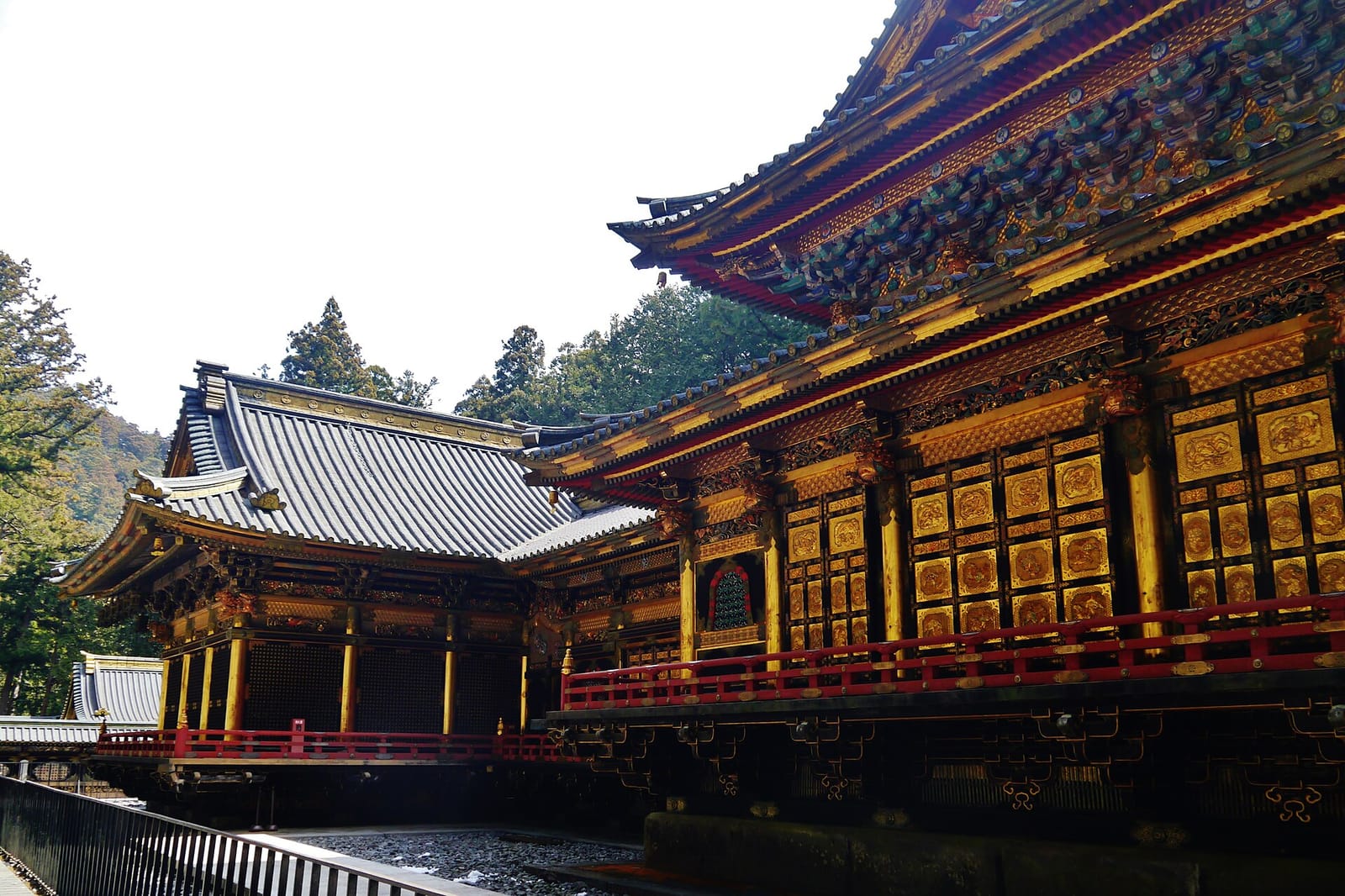
Rinno-ji Taiyuin
Photo: Zairon / CC BY-SA 4.0 · Original · Resized and croppedEdo period · Temples · National Treasures
Rinno-ji Taiyuin
輪王寺大猷院 (りんのうじたいゆういん)
At Rinno-ji Taiyuin, the mausoleum of the third Tokugawa shogun Iemitsu, you can see the National Treasure mausoleum (Haiden, Ai-no-ma and Honden) finished in gold and black, and the approach through the Niomon, Nitenmon and Yashamon gates. The precinct is lined with 315 lanterns, and inside the mausoleum you can see Chinese lions by Kano Tan'yu and dragon paintings on the ceiling.
Key facts
- Designation
- National Treasures
- Era
- Edo period
- Type
- Temples
- Location
- Nikko, Tochigi
- Address
- 栃木県日光市山内
Before you go
- Opening hours
- 8:00 to 17:00 from April to October and 8:00 to 16:00 from November to March; last entry is 30 minutes before closing.
- Closed
- On April 18 to 20, May 17 and July 14 to 15, the Taiyuin worship hall is closed for part of the day for ceremonies.
- Admission (adults)
- A Taiyuin ticket is ¥550 for adults; the Rinno-ji ticket covering both Sanbutsudo hall and Taiyuin is ¥900.
- Time needed
- The official guide is 30 minutes to 1 hour for Taiyuin alone, or 1 hour 30 minutes to 2 hours together with Sanbutsudo hall.
- Getting there
- From the Nikko stations, the Tobu "World Heritage Tour" bus is the easiest way in. Rinno-ji's car parks 1 and 2 charge ¥500 to ¥1,000 per car depending on the season, accepting cars 7:30 to 16:00 from April to October and 7:30 to 15:00 from November to March.
- Good to know
- Sales of the Rinno-ji combined ticket end early: 14:30 from April to October and 13:30 from November to March.
Checked against official information on November 12, 2026. Fees and hours can change, so please also check the official site before you go.
Sources for visitor information
Key facts
- Designation
- National Treasures
- Era
- Edo period
- Type
- Temples
- Location
- Nikko, Tochigi
- Address
- 栃木県日光市山内
About this place
Rinno-ji Taiyuin is a part of Rinno-ji in the Sannai area of Nikko, Tochigi, and is the mausoleum of Tokugawa Iemitsu (1604-1651), the third Tokugawa shogun. According to the temple, Nikko-zan is a sacred site opened by the monk Shodo in 766, and in the Edo period Iemitsu's Taiyuin mausoleum was built here along with the Toshogu shrine dedicated to Ieyasu. The temple says the mausoleum was built at Nikko in accordance with Iemitsu's will, on a site chosen close to the grave of his grandfather Ieyasu. The national cultural properties database dates the mausoleum buildings to Joo 2 (1653).
According to the temple, the Taiyuin precinct holds 22 National Treasures and Important Cultural Properties in all, along with 315 lanterns. The lanterns were presented by the feudal lords of the time, and some were donated by the imperial family. Three gates with guardian figures follow one after another along the approach. First, at the Niomon Gate, the Kongo Rikishi guardians greet you, one with an open mouth (agyo) and one with a closed mouth (ungyo). The next gate, the Nitenmon, is the largest gate in the Nikko precincts; it holds the guardian kings Jikokuten and Zochoten, and the plaque on its front was written by the retired Emperor Gomizunoo. From the viewpoint beyond the gate you can look down on the rows of stone lanterns below.
The third gate, the Yashamon, takes its name from the four yasha guardians it holds to protect the mausoleum, and because of its peony carvings it is also called the Botanmon (Peony Gate). Of the four, Umarokya is said to be a figure rarely found anywhere in Japan. Through this gate is the National Treasure mausoleum. Its Haiden, Ai-no-ma and Honden are joined in a single row in the gongen-zukuri style, and because so much gold is used, it is also called the Kinkakuden. The Honden is single-story, three bays square, with a mokoshi (skirt roof) and a hip-and-gable roof. The Ai-no-ma has a simple two-sided roof, and the Haiden is seven bays wide with a hip-and-gable roof, a chidori-hafu gable on the front, and a curved karahafu gable over its three-bay porch. All of the roofs are covered with copper tiles.
According to the temple, Iemitsu left word that his mausoleum must not outshine his grandfather's, so the Taiyuin has a heavy, calm design based on gold and black. Inside the mausoleum building you can see Chinese lions painted by Kano Tan'yu, 140 dragon paintings on the ceiling, and armor worn by Iemitsu. Behind the mausoleum stands the Kokamon Gate, built in the Ming Chinese ryugu-zukuri style and also called the Ryugumon, and beyond it lies Iemitsu's grave. According to the Japan Tourism Agency, Kaji Sadayoshi, a loyal retainer of Iemitsu, lived at Ryukoin in the precinct as guardian of the grave and is said to have kept preparing Iemitsu's meals every day.
The temple describes the route from the Niomon to the Haiden and Honden as feeling like an ascent into the heavens. Comparing the guardian figures and carvings of the three gates as you go, and looking down on the rows of lanterns from the viewpoint, helps you see how the mausoleum is laid out. On days with temple ceremonies there are times when the Haiden cannot be entered, so if you want to see the interior, it is wise to check in advance. If you plan to visit together with the Sanbutsudo hall, note that sales of the combined ticket end early in the afternoon.
Buildings designated as National Treasures
Rinno-ji Taiyuin Mausoleum (Honden, Ai-no-ma and Haiden)
- Era
- Early Edo period
- Year
- 1653
- Structure
- Main sanctuary: 3 bays wide, 3 bays deep, single-story with a mokoshi (skirt roof), hip-and-gable roof, copper-tile roofing
- Designated
- November 22, 1952
Sources and date checked
Facts such as eras, structures and locations are edited and translated by us from the Agency for Cultural Affairs’ database of nationally designated cultural properties. The Agency and the national government did not produce this page.
Database of nationally designated cultural properties- Agency for Cultural Affairs, Database of National Cultural Properties: Rinno-ji Taiyuin Mausoleum (Honden, Ai-no-ma and Haiden)
- Rinno-ji: Taiyuin (Nikko-zan Rinno-ji official site)
- About Rinno-ji (Nikko-zan Rinno-ji official site)
- Taiyuin Mausoleum (Nikko-zan Rinno-ji official site)
- History (Nikko-zan Rinno-ji official site)
- Taiyuin (Japan Tourism Agency, Multilingual Explanation Text Database)
- Ryukoin, in the Taiyuin precinct (Japan Tourism Agency, Multilingual Explanation Text Database)
- Visitor information (Nikko-zan Rinno-ji official site)
Checked on November 6, 2026
Report an error
If you notice a mistake, please tell us along with a source for the correct information.
Where to go next
Places you could see on the same day, and places worth comparing.
Nearby cultural heritage
Places within 10 km, nearest first. Distances are in a straight line.
More from Tochigi
Discover more of the same region on our sister sites.
Sake Tabi
Breweries and distilleries in Tochigi
- Watanabe Sahei Shoten (Nikko Homare)
- Coco Farm & Winery
- Ishii Brewing Brewery Shop
- Katayama Shuzo (Kashiwazakari)