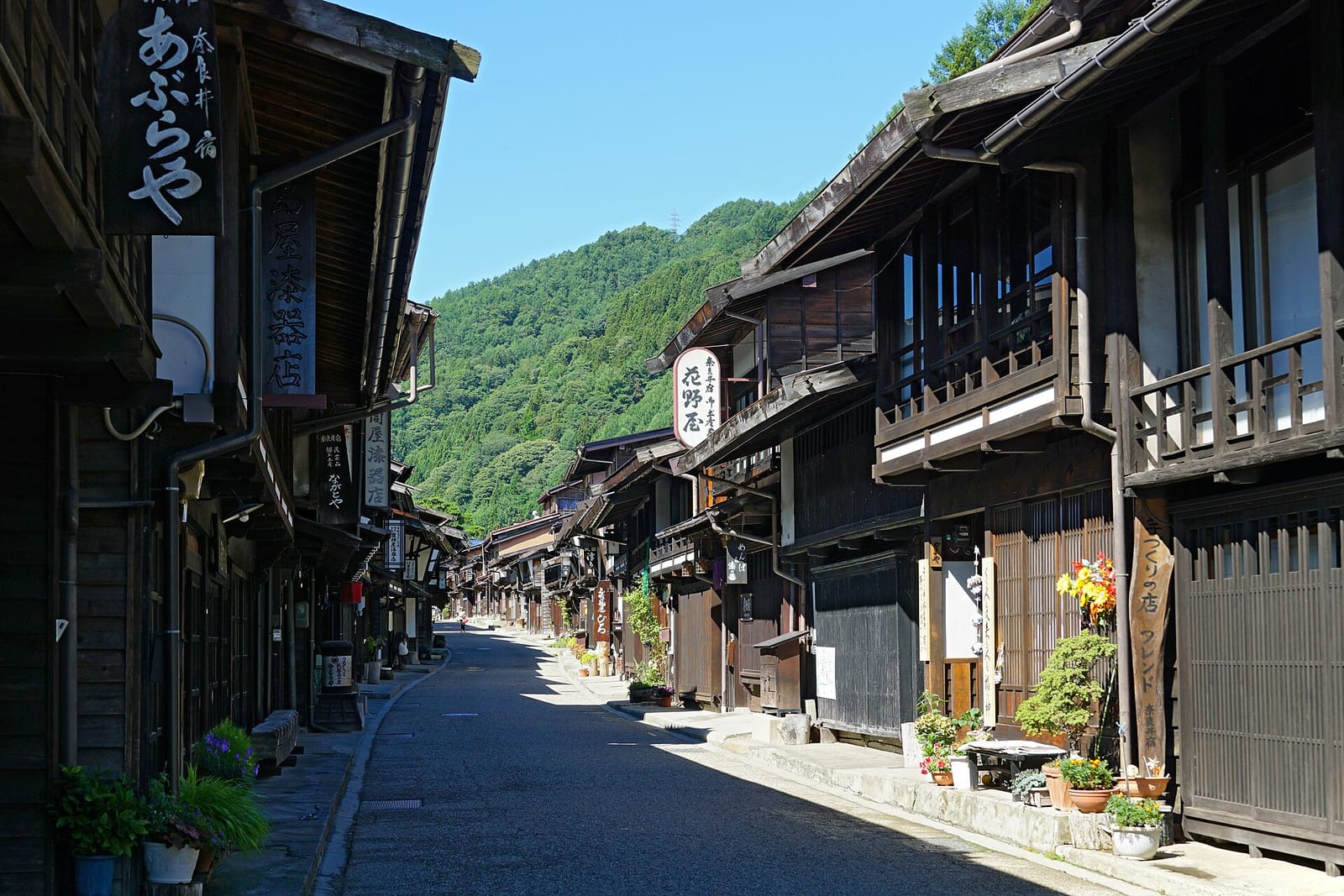
The Narai-juku street
Photo: 663highland / CC BY-SA 4.0 · Original · Resized and croppedHistoric districts
Narai-juku, Shiojiri
塩尻市奈良井 (しおじりしならい)
A post town on the Nakasendo at the foot of Torii Pass, said to have been the largest of the eleven Kiso post towns. Townhouses with overhanging upper floors line the old highway, and the town still keeps its traditions of lacquerware and bentwood crafts.
Key facts
- Designation
- Important Preservation Districts for Groups of Traditional Buildings
- Type
- Historic districts
- Location
- Shiojiri, Nagano
- Address
- 長野県塩尻市
Before you go
- Opening hours
- Check the official site
- Closed
- Check the official site
- Admission (adults)
- Check the official site
- Time needed
- Allow 3 to 4 hours, including a meal and souvenir shopping.
- Getting there
- Narai Station on the JR Chuo Line is about a 3-minute walk away. By car it is about 35 minutes from Shiojiri IC on the Nagano Expressway; cars cannot enter the post town, so park at the free Michi-no-Eki Narai Kiso-no-Ohashi lot or the Narai Gonbe lot (¥500 per car).
- Best time to visit
- The Narai-juku Festival with its tea-jar procession is held on the first Saturday and Sunday of June, the Shizume Shrine summer festival on August 12, the Ice Candle Festival on February 3, and the Tomyo lantern festival from mid to late February.
- Good to know
- Only local residents may drive cars or motorbikes into the post town. You may photograph the streets freely, but ask permission before shooting inside shops or homes; drones are banned. Roads around the town get congested during the long holidays and the Obon period.
Checked against official information on November 12, 2026. Fees and hours can change, so please also check the official site before you go.
Sources for visitor information
- Narai-juku Tourist Association: Access
- Shiojiri City: Narai-juku parking information
- Narai-juku Tourist Association: FAQ
- Narai-juku Tourist Association: Events
- Go! NAGANO (Nagano Prefecture official tourism site): Narai-juku
- Go! NAGANO (Nagano Prefecture official tourism site): Exploring Narai-juku on the Nakasendo
Key facts
- Designation
- Important Preservation Districts for Groups of Traditional Buildings
- Type
- Historic districts
- Location
- Shiojiri, Nagano
- Address
- 長野県塩尻市
About this place
Narai in Shiojiri is a post-town preservation district at the foot of Torii Pass on the Nakasendo, covering about 17.6 hectares. It is said to have been the largest of the eleven Kiso post towns on the Nakasendo. It was selected as an Important Preservation District for Groups of Traditional Buildings in 1978, and townhouses from the late Edo period to the Meiji period still line the road.
A clue for looking at the buildings is the "dashibari-zukuri" style, in which the second floor projects forward beyond the first. Most townhouses face the road and stand across the full frontage of their plots, and this style is common among them. The eaves are deep and the roofs gently pitched. These roofs were originally wooden shingle roofs weighted with stones, but most are now iron sheet.
In Narai, lacquerware and bentwood crafts are known as traditional industries. Within the same city of Shiojiri lies Kisohirasawa, a lacquer-making town that prospered from the Edo period on lacquerware centered on everyday utensils, and which was selected as a separate preservation district in 2006. Its characteristic arrangement puts the main house facing the street and, across a courtyard, a lacquering workshop called a nurigura. Setting the post town of Narai beside the craftsmen's town of Hirasawa shows two faces of a roadside town. The Kisohirasawa district covers about 12.5 hectares, and lacquerware shops line the Nakasendo.
Preservation began early. The Narai-juku Preservation Society was founded in 1971, which means it had been active for about seven years before selection in 1978. From 1988 a project to relocate utility poles proceeded, and in 2007 the Tezuka residence in the district was designated a national Important Cultural Property. From selection through fiscal 2025, a total of 445 works have been carried out: 266 repairs and 179 landscape improvements. In Kisohirasawa, repair and landscape work began in fiscal 2007, and through fiscal 2025 there have been 45 repairs and 24 landscape improvements, 69 in all.
For walking the town, the preservation societies have made hand-drawn "tekuteku maps" that are handed out free, the city explains. Events such as the spring festival, the Tomyo lantern festival and the Ochatsubo Dochu procession are also held. In 2011 the town was used as a filming location for the NHK morning drama "Ohisama." Under use of the district and community building, the city lists continuing preservation by using vacant houses, and improving Wi-Fi and multilingual explanations. The city's material also mentions a shuttle bus that circulates among the preservation districts.
About the district
- Type of district
- post town
- Area
- 17.6 hectares
- Selected
- May 31, 1978
Sources and date checked
Facts such as eras, structures and locations are edited and translated by us from the Agency for Cultural Affairs’ database of nationally designated cultural properties. The Agency and the national government did not produce this page.
Database of nationally designated cultural properties- Agency for Cultural Affairs, Database of National Cultural Properties
- Shiojiri City Narai and Kiso-Hirasawa (prepared by Shiojiri City, published by Agency for Cultural Affairs)
Checked on November 6, 2026
Report an error
If you notice a mistake, please tell us along with a source for the correct information.
Where to go next
Places you could see on the same day, and places worth comparing.
Nearby cultural heritage
Places within 10 km, nearest first. Distances are in a straight line.
More from Nagano
Discover more of the same region on our sister sites.
Meiga no Furusato
Paintings linked to Nagano
- Mount Asama
- Thirty-six Views of Mount Fuji: Lake Suwa in Shinano Province
- The Sixty-nine Stations of the Kisokaido: Karuizawa
- The Sixty-nine Stations of the Kisokaido: Rain on the Hiratsuka Plain near Kutsukake Station
Sake Tabi
Breweries and distilleries in Nagano
- Chateau Mercian Kikyogahara Winery
- Hayashi Farm Goichi Wine Vineyard Visit
- Komoro Distillery
- Mars Komagatake Distillery (Hombo Shuzo)