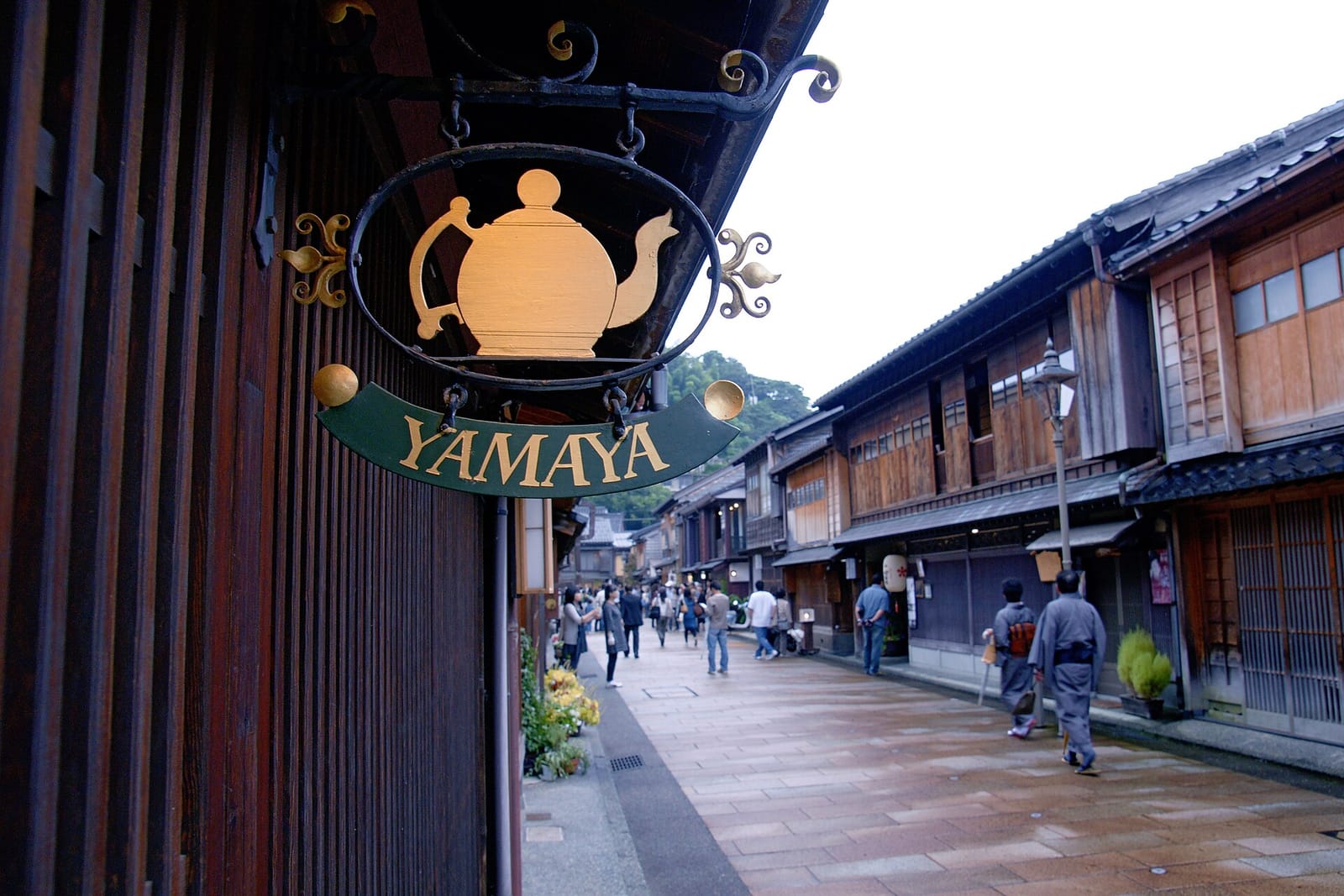
The Higashiyama Higashi teahouse street
Photo: 663highland / CC BY 2.5 · Original · Resized and croppedHistoric districts
Higashiyama Higashi (Higashi Chaya), Kanazawa
金沢市東山ひがし (かなざわしひがしやまひがし)
A geisha teahouse district in Kanazawa laid out in 1820, with a rare concentration of teahouses from the late Edo to early Meiji periods. Matching houses with projecting lattices on the ground floor and tall second-floor banquet rooms line both sides of the street, carrying Kanazawa's teahouse culture into the present.
Key facts
- Designation
- Important Preservation Districts for Groups of Traditional Buildings
- Type
- Historic districts
- Location
- Kanazawa, Ishikawa
- Address
- 石川県金沢市
Before you go
- Opening hours
- Most shops are open from 10:00 to 17:00.
- Closed
- Check the official site
- Admission (adults)
- The district is free to walk around, with no opening hours or admission fee.
- Time needed
- About 1 hour just to see the streets, or around 2 hours if you stop at shops.
- Getting there
- Take a bus from Kanazawa Station (about 7 minutes) to Hashibacho bus stop, then walk about 5 minutes; the Kanazawa Loop Bus, Hokutetsu buses and West JR buses all stop there. Walking from Kanazawa Station takes about 30 minutes. Parking such as the Higashiyama Tourist Parking lot (15 cars) is limited, so buses or walking are recommended.
- Best time to visit
- In spring, cherry blossoms line the Asano River banks and the nearby Kazuemachi district, lit by paper lanterns during the blossom season. The snowy streets in winter and the gas-lit lanes at night are also recommended.
- Good to know
- Eating while walking is not allowed inside the preservation district, so eat at the shop where you bought the food. The teahouses keep a no-introduction, no-entry custom, so you cannot go inside without a referral. Hashibacho bus stops are in quite different places depending on the route; if you get lost, head for Asanogawa Ohashi Bridge.
Checked against official information on November 12, 2026. Fees and hours can change, so please also check the official site before you go.
Sources for visitor information
Key facts
- Designation
- Important Preservation Districts for Groups of Traditional Buildings
- Type
- Historic districts
- Location
- Kanazawa, Ishikawa
- Address
- 石川県金沢市
About this place
Higashiyama Higashi is a teahouse district east of the Asano River in Kanazawa, Ishikawa Prefecture. It was selected as an Important Preservation District for Groups of Traditional Buildings on 14 November 2001 and covers about 1.8 hectares. Kanazawa City's material says that teahouse buildings from the late Edo to the early Meiji period remain clustered in the district.
The teahouse district opened in 1820 (Bunsei 3), and at the time it also went by the names Utatsu teahouse district and Asano River teahouse district. Set the town plans from before and after side by side and you can see that the division of the town was remade at that moment. Its path was not smooth: it was abolished in 1831 (Tenpo 2), and official recognition returned only in 1867 (Keio 3). From the Meiji period it was known as Higashi Shinchi or Higashi, ranking first among the city's teahouse districts in both standing and liveliness, and it links Kanazawa's teahouse culture to the present. The National Council of Traditional Building Preservation Districts notes that few districts in Japan keep the atmosphere of a teahouse town so well, and counts this as one of them.
Two clues to the buildings are the lattice (de-goshi) projecting on the ground floor facing the street, and the taller second floor, where the tatami rooms are placed. Teahouse-style townhouses line the street, and the individual buildings keep a similar composition. The 1820 plan replaced an irregular layout with regular blocks, and the way both sides of the street look aligned is one of the district's features.
On preservation, Kanazawa enacted a preservation ordinance in 1976 and set up a subsidy system for restoring teahouse-quarter streetscapes in 1984. The Higashiyama Higashi district was selected as a national district in 2001, the same year a survey report was compiled. Kazuemachi, also in Kanazawa, is a teahouse district too and was selected in 2008 (about 0.6 hectares). Kanazawa City says that historic townscapes, represented by these districts, are popular with visitors. It also makes the conservation and use of machiya the core of its heritage-based town planning, and opened the Kanazawa Machiya Information Bank in fiscal 2005. The Kanazawa Craftsmen University, which passes on traditional skills, opened in 1996.
If you combine it with its surroundings, Kazuemachi, with the Asano River flowing in front of it, is a natural next stop, and there are other districts such as the Utatsuyama foothills and Teramachidai. According to the city material, these are temple towns selected in 2011 and 2012 respectively, and their feature is the combination of temples and shrines with townhouses. Walking in succession through districts of different character, teahouse and temple towns, gives a three-dimensional picture of how the castle town of Kanazawa was put together. Preservation activities are carried out by residents' groups such as the Society to Protect the Townscape and Culture of Kanazawa Higashiyama Higashi.
About the district
- Type of district
- teahouse district
- Area
- 1.8 hectares
- Selected
- November 14, 2001
Sources and date checked
Facts such as eras, structures and locations are edited and translated by us from the Agency for Cultural Affairs’ database of nationally designated cultural properties. The Agency and the national government did not produce this page.
Database of nationally designated cultural properties- Agency for Cultural Affairs, Database of National Cultural Properties
- Kanazawa City: Higashiyama Higashi, Kazuemachi, Utatsuyama-roku and Teramachidai (Agency for Cultural Affairs, Preservation and Utilization of Important Preservation Districts for Groups of Traditional Buildings, document by Kanazawa City)
- National Council for Preservation of Historic Districts: Kanazawa City Higashiyama Higashi
- National Council for Preservation of Historic Districts: Kanazawa City Kazuemachi
Checked on November 6, 2026
Report an error
If you notice a mistake, please tell us along with a source for the correct information.
Where to go next
Places you could see on the same day, and places worth comparing.
Nearby cultural heritage
Places within 10 km, nearest first. Distances are in a straight line.
More from Ishikawa
Discover more of the same region on our sister sites.
Ikimono Kokuho
Natural Monument animals of Ishikawa
- Japanese Serow
- Bean Goose (including Taiga and Tundra Bean Geese)
- Greater White-fronted Goose
- Hokuriku Salamander
Meiga no Furusato
Paintings linked to Ishikawa
- Famous Places in the Sixty-odd Provinces: Kaga Province: Fishing Fires on Lake Renko, One of the Eight Views of Kanazawa
- Famous Places in the Sixty-odd Provinces: Noto Province: Bay of Waterfalls
Sake Tabi
Breweries and distilleries in Ishikawa
- Fukumitsuya (Kanazawa Brewery Tour)
- BREW CLASSIC Taproom
- Heart & Beer Nihonkai Club (Okunoto Beer)
- KOMATSU BREWING