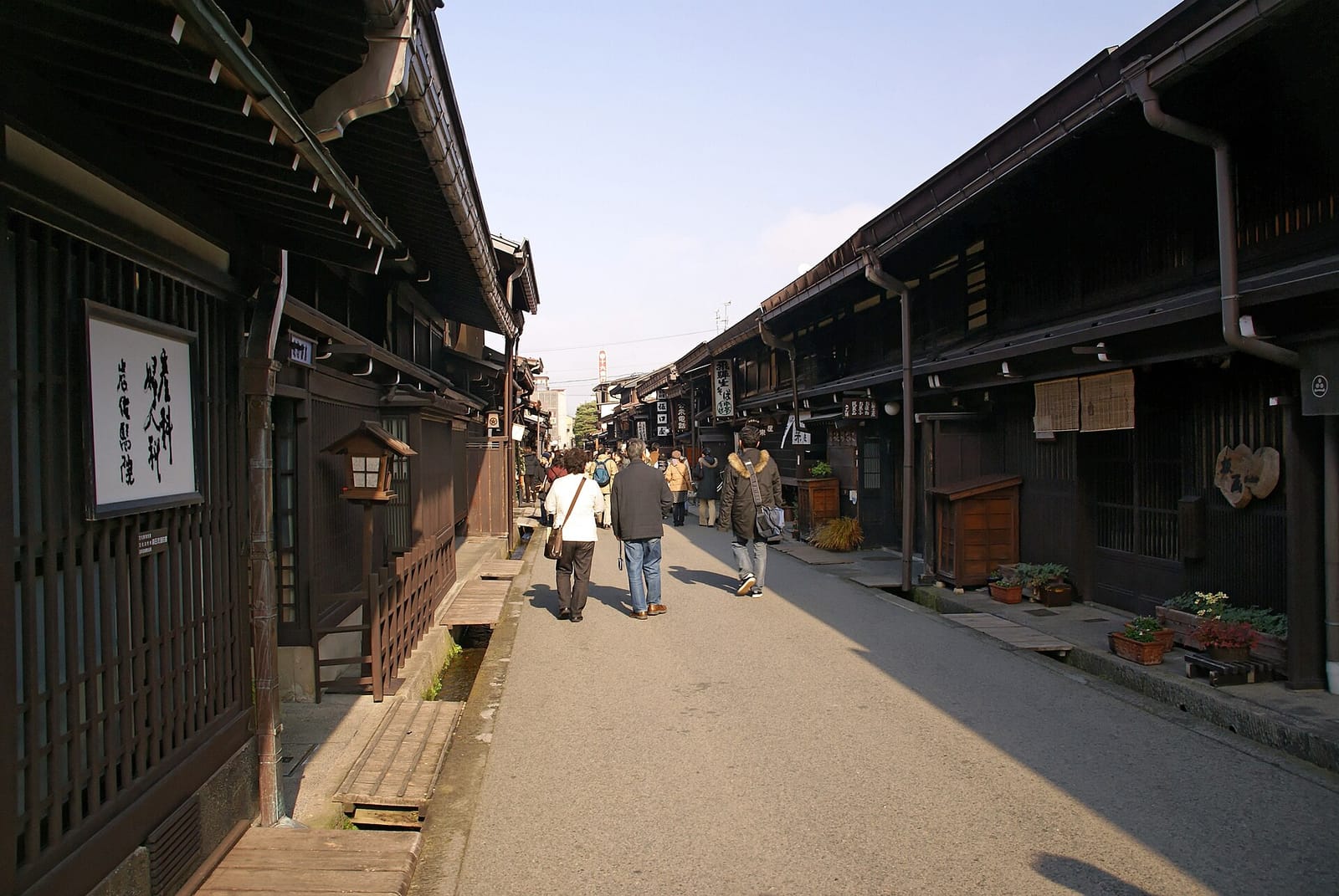
The Sanmachi street
Photo: 663highland / CC BY 2.5 · Original · Resized and croppedHistoric districts
Sanmachi, Takayama
高山市三町 (たかやましさんまち)
The merchant quarter of Takayama, a town ruled directly by the shogunate from the late 1600s. Townhouses with gently sloping roofs, deep eaves and fine wooden lattices line the three streets of Ichinomachi, Ninomachi and Sannomachi, backed by storehouses that served as firebreaks.
Key facts
- Designation
- Important Preservation Districts for Groups of Traditional Buildings
- Type
- Historic districts
- Location
- Takayama, Gifu
- Address
- 岐阜県高山市
Before you go
- Opening hours
- Shops are generally open from around 9:00 to around 18:00 (varies by shop).
- Closed
- Many shops close on Tuesdays or Wednesdays (varies by shop).
- Admission (adults)
- Check the official site
- Time needed
- Check the official site
- Getting there
- It is a 15-minute walk from JR Takayama Station. Drivers can use paid city parking lots: Shinmei parking is a 1-minute walk from the old town and Soramachi parking is a 5-minute walk (¥150 per 30 minutes from 8:00 to 20:00).
- Best time to visit
- The town fills with festival floats during the Spring Takayama Festival on April 14-15 and the Autumn Takayama Festival on October 9-10 each year.
- Good to know
- City parking lots near the old town are small and cannot be reserved. If you park at the Tenman or Fudobashi lots and ride the Takumi Bus, parking for regular cars is free for 3 hours. Traffic is restricted in the festival area on Takayama Festival days.
Checked against official information on November 12, 2026. Fees and hours can change, so please also check the official site before you go.
Sources for visitor information
Key facts
- Designation
- Important Preservation Districts for Groups of Traditional Buildings
- Type
- Historic districts
- Location
- Takayama, Gifu
- Address
- 岐阜県高山市
About this place
Sanmachi is a merchant town at the heart of the castle town of Takayama, Gifu Prefecture. It was selected as an Important Preservation District for Groups of Traditional Buildings on 3 February 1979 and covers 4.4 hectares. According to the Takayama City preservation plan, the district centers on Ichibancho, Nibancho and Sanbancho (later Ichinomachi, Ninomachi and Sannomachi), the first merchant quarters to be laid out, and includes part of Katahara-machi. Its area was enlarged in 1997.
The town began in 1586 (Tensho 14), when Kanamori Nagachika entered Hida. Toyotomi Hideyoshi had granted him the whole province of Hida, assessed at 38,000 koku, and he began building Takayama Castle, which was completed in 1605 (Keicho 10). The castle town was built in an area of about 500 meters east to west and 600 meters north to south, enclosed by the Ena River and the Miya River, with the high ground to the east for samurai, the low ground to the west for townspeople, and temples gathered across the Ena River. When the sixth lord, Kanamori Yoritoki, was transferred to Kaminoyama in Dewa in 1692 (Genroku 5), Takayama became shogunate land. The samurai quarter shrank, the townspeople's area expanded, Takayama Jin'ya was placed on the west bank of the Miya River, and the castle was demolished. The merchant town that Sanmachi shows belongs to this period as shogunate-governed Takayama.
The great fire of 1832 (Tenpo 3) also damaged Kami-Ichinomachi, Kami-Ninomachi and Kami-Sannomachi, but rebuilding followed the inherited style. As a result, the look of a merchant district that prospered until recent times is still strong. The preservation plan sees the value of the district in a combination of things. First, street lines almost unchanged since the town was laid out. Next, townhouses of similar design along those streets, with gentle roof pitches, long low eaves, short lean-to roofs at an even height and aligned façades. And finally, the row of storehouses running behind them.
To read a townhouse, first look at the half-story upper floor and the small roof attached at its waist. Following the details with the plan as a guide, the eaves are deep enough to reach out over the street, while the lean-to roof beneath them is very short and nearly even in height. Most of the ground-floor front is fine-barred lattice, and many houses are said to have once had shitomi shutters. On the second floor, the front is opened widely between the posts, and most houses fit it with board lattice or board slats. Gentle roofs, deep eaves and fine lattice together give the row of townhouses its unity. The standards for new construction build on this form: buildings on the street must have eaves projecting at least 1 meter, with eave height kept within 4.5 meters of the road surface as far as possible.
Do not overlook the storehouses behind. Since the Edo period they have served as firebreaks protecting residents. Because wooden buildings stand densely together, the plan makes disaster prevention a priority and also uses the passages between storehouses as evacuation routes. Katahara-machi forms the riverside landscape on the right bank of the Miya River, and its streetscape is made of the storehouses behind Kami-Sannomachi and the buildings facing the river. Go beyond the front of the street to the Miya River and check its position relative to the west bank where Takayama Jin'ya stood, and the change from castle town to shogunate-governed town becomes easier to understand.
About the district
- Type of district
- merchant town
- Area
- 4.4 hectares
- Selected
- February 3, 1979
Sources and date checked
Facts such as eras, structures and locations are edited and translated by us from the Agency for Cultural Affairs’ database of nationally designated cultural properties. The Agency and the national government did not produce this page.
Database of nationally designated cultural properties- Agency for Cultural Affairs, Database of National Cultural Properties
- Takayama City Sanmachi Preservation District for Groups of Traditional Buildings: Preservation Plan (Takayama City Board of Education)
- National Council for Preservation of Historic Districts: Takayama City Sanmachi
Checked on November 6, 2026
Report an error
If you notice a mistake, please tell us along with a source for the correct information.
Where to go next
Places you could see on the same day, and places worth comparing.
Nearby cultural heritage
Places within 10 km, nearest first. Distances are in a straight line.
More from Gifu
Discover more of the same region on our sister sites.
Matsuri Biyori
UNESCO-listed festivals in Gifu
- Takayama Festival Yatai Float Event
- Furukawa Festival Okoshi-daiko and Yatai Float Event
- Ogaki Festival Yama Float Event
- Gujo Odori
Meiga no Furusato
Paintings linked to Gifu
- The Sixty-nine Stations of the Kisokaido: Magome Station: Distant View from the Pass
- The Sixty-nine Stations of the Kisokaido: Ochiai
- The Sixty-nine Stations of the Kisokaido: Nakatsugawa (Fair Weather)
- The Sixty-nine Stations of the Kisokaido: Oi
Sake Tabi
Breweries and distilleries in Gifu
- Chicory Village Chicochico Shochu Distillery
- Kamo Shuzojo (Shiramayumi)
- 104BREWERY
- Blade Factory Brewing TAPROOM