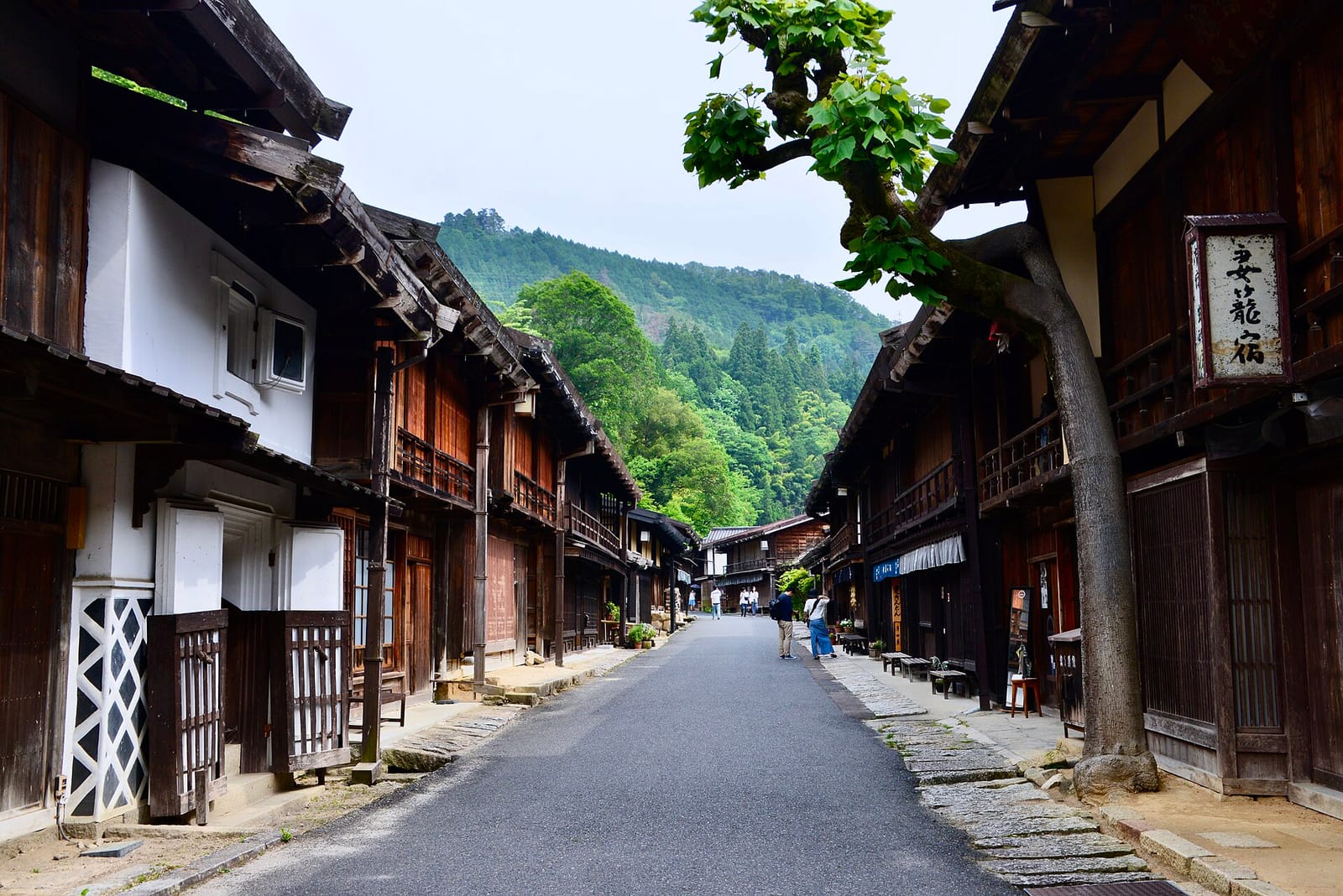
The Tsumago-juku street
Photo: 皓月旗 / CC BY-SA 4.0 · Original · Resized and croppedHistoric districts
Tsumago-juku, Nagiso
南木曽町妻籠宿 (なぎそまちつまごじゅく)
A Nakasendo post town whose rows of houses with overhanging upper floors and udatsu firewalls keep the look of the late Edo and Meiji periods. Residents pledged early on not to sell, rent out or tear down their properties, and the protected area extends to the mountains seen from the old road.
Key facts
- Designation
- Important Preservation Districts for Groups of Traditional Buildings
- Type
- Historic districts
- Location
- Nagiso, Nagano
- Address
- 長野県木曽郡南木曽町
Before you go
- Opening hours
- The Nagiso Town Museum, Tsumago-juku Honjin and Waki-honjin Okuya are open 9:00-17:00 (last entry 16:45).
- Closed
- The museum, Honjin and Waki-honjin are closed on the 2nd and 4th Thursdays of each month (open if a national holiday) and from December 29 to January 3.
- Admission (adults)
- A combined ticket for Waki-honjin Okuya and the museum costs ¥800 for adults. Tsumago-juku Honjin is open free of charge.
- Time needed
- Allow 2 to 3 hours, including a meal and souvenir shopping.
- Getting there
- From Nagiso Station on the JR Chuo Line, take a bus bound for Hogami or Magome (about 10 minutes) and get off at Tsumago. Walking from the station along the Nakasendo takes about 40 minutes. By car it is about 30 minutes from Nakatsugawa IC on the Chuo Expressway; use the town parking lots along Route 256 (¥500 per car per day).
- Best time to visit
- Every November 23, residents in Edo-period dress parade through the post town in the Bunka-Bunsei Customs Procession. The Wachino Shrine summer festival takes place on July 23-24.
- Good to know
- The post town is pedestrian-only from 10:00 to 16:00, and cars may not enter. Parking lots cannot be reserved and have no time limit.
Checked against official information on November 12, 2026. Fees and hours can change, so please also check the official site before you go.
Sources for visitor information
Key facts
- Designation
- Important Preservation Districts for Groups of Traditional Buildings
- Type
- Historic districts
- Location
- Nagiso, Nagano
- Address
- 長野県木曽郡南木曽町
About this place
Tsumago-juku in Nagiso is a post town that prospered as one of the eleven Kiso post stations on the Nakasendo. The preservation district covers 1,245.4 hectares, roughly 30 percent of the total area of all Important Preservation Districts for Groups of Traditional Buildings in Japan, and it was selected in 1976. Its preservation takes in not only the buildings of the post town but also the surrounding natural scenery, centered on the views from the Nakasendo.
The district is understood as four parts. At the center is the post-town landscape zone, where houses with dashibari-zukuri (projecting upper floors) and udatsu (firewalls) stand in a row, retaining the look of the late Edo to Meiji periods. Around it are the road landscape zone and the rural landscape zone, with the natural landscape zone of mountains seen from the road as a backdrop. The town explains that the preservation takes the view from the Nakasendo as its center and treats the surrounding nature as a background, which incorporates the idea of borrowed scenery.
Preservation in Tsumago began at a time when the post town's function had declined with the changes in transport after the Meiji era, and when young people moving to cities during the rapid economic growth that began in the 1950s had left the community weakened. A preservation plan was made in 1968, and preservation and repair work got under way in earnest as a Nagano Prefecture project commemorating 100 years of Meiji. In the same year the "Society for Loving Tsumago" was founded and the Bunka-Bunsei Fuzoku Emaki procession, which continues today, began. In 1971 the "Residents' Charter for Protecting Tsumago" was established.
The town recalls that at the time, adopting the policy that "preservation is development" was unusual and was viewed with half-doubt. As preservation advanced, visitors increased sharply, and the town provided parking, walking paths, signs and public toilets. In the preservation projects since selection in 1976, 197 repairs and 8 landscape improvements have been carried out. When looking at the buildings, it is worth overlaying the long process through which the whole town has been kept, not just the age of each house.
Within the post town, the Waki-honjin Okuya (Hayashi family) opened as the Okuya Local History Museum in 1967, and in 1995 the restoration of the Tsumago-juku Honjin and the History Museum were completed. The road was designated a national historic site as the Nakasendo (Historic Road) in 1987, and in 2016 the Kiso region was certified as a Japan Heritage site. Residents take part in turning over stone-weighted board roofs, and at the Isshi-tochi Tateba Chaya, a vacant house used as a free rest area, they offer rest while counting travelers on the Nakasendo.
About the district
- Type of district
- post town
- Area
- 1245.4 hectares
- Selected
- September 4, 1976
Sources and date checked
Facts such as eras, structures and locations are edited and translated by us from the Agency for Cultural Affairs’ database of nationally designated cultural properties. The Agency and the national government did not produce this page.
Database of nationally designated cultural properties- Agency for Cultural Affairs, Database of National Cultural Properties
- Nagiso Town Tsumago-juku (prepared by Nagiso Town, published by Agency for Cultural Affairs)
Checked on November 6, 2026
Report an error
If you notice a mistake, please tell us along with a source for the correct information.
Where to go next
Places you could see on the same day, and places worth comparing.
More from Nagano
Discover more of the same region on our sister sites.
Meiga no Furusato
Paintings linked to Nagano
- Mount Asama
- Thirty-six Views of Mount Fuji: Lake Suwa in Shinano Province
- The Sixty-nine Stations of the Kisokaido: Karuizawa
- The Sixty-nine Stations of the Kisokaido: Rain on the Hiratsuka Plain near Kutsukake Station
Sake Tabi
Breweries and distilleries in Nagano
- Chateau Mercian Kikyogahara Winery
- Hayashi Farm Goichi Wine Vineyard Visit
- Komoro Distillery
- Mars Komagatake Distillery (Hombo Shuzo)