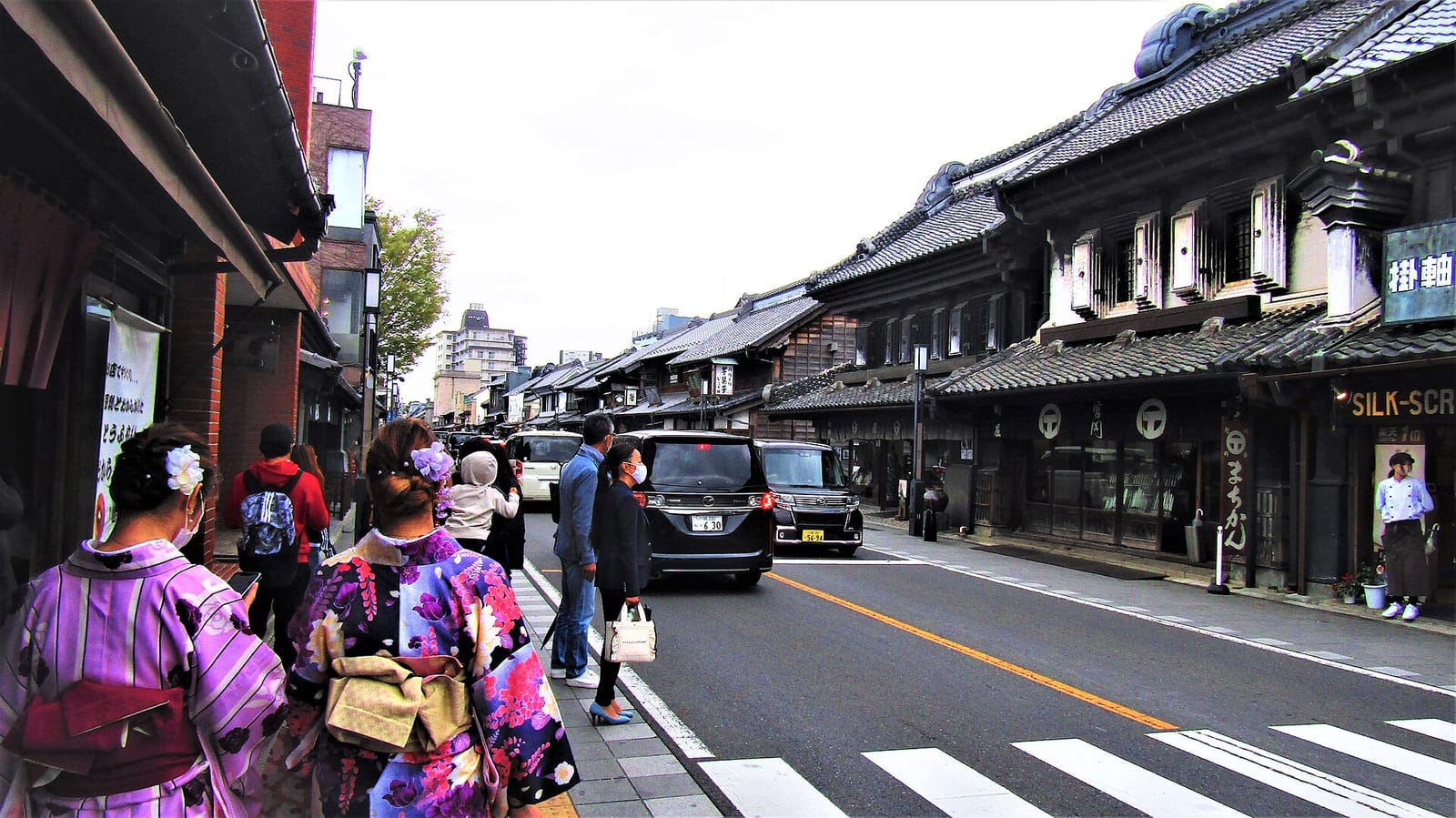
The street of kurazukuri storehouses
Photo: Dandy1022 / CC BY-SA 4.0 · Original · Resized and croppedHistoric districts
Kawagoe, Kawagoe
川越市川越 (かわごえしかわごえ)
A merchant town of black-plastered kura-style shophouses with massive ridge tiles, rebuilt after the great Kawagoe fire of 1893. Each house is built a little differently, and modern Western-style buildings mixed among them show the town's long history as a trading center.
Key facts
- Designation
- Important Preservation Districts for Groups of Traditional Buildings
- Type
- Historic districts
- Location
- Kawagoe, Saitama
- Address
- 埼玉県川越市
Before you go
- Opening hours
- Check the official site
- Closed
- Check the official site
- Admission (adults)
- Check the official site
- Time needed
- Check the official site
- Getting there
- From stop 3 at the east exit of Kawagoe Station, the Tobu Koedo Meisho Meguri sightseeing bus takes about 24 minutes (¥230) to Ichibangai bus stop. Local buses running via Kura-no-machi also stop at Nakacho, close to the street. Drivers can use the free Kawagoe Tourist Parking Lot (290 cars, 9:30 to 18:00).
- Best time to visit
- The Kawagoe Festival is held every year in mid-October.
- Good to know
- Besides the free Kawagoe Tourist Parking Lot (290 cars), visitors may use the paid north and south lots at City Hall only on weekends, holidays and over New Year. Car parks in the city center may be closed during festivals and events.
Checked against official information on November 12, 2026. Fees and hours can change, so please also check the official site before you go.
Sources for visitor information
Key facts
- Designation
- Important Preservation Districts for Groups of Traditional Buildings
- Type
- Historic districts
- Location
- Kawagoe, Saitama
- Address
- 埼玉県川越市
About this place
Kawagoe, Kawagoe is a merchant town in the center of the former castle town in Kawagoe, Saitama Prefecture. It was selected as an Important Preservation District for Groups of Traditional Buildings on 1 December 1999 and covers about 7.8 hectares. According to Kawagoe City's material, today's townscape consists of traditional buildings in a variety of styles, beginning with the black-plastered kurazukuri (storehouse-style) merchant houses built after the Great Kawagoe Fire of 1893 (Meiji 26) and including modern Western-style buildings. It is worth noting first that this is not a townscape of kurazukuri alone.
According to Kawagoe City, the roots of the present town go back to 1457 (Choroku 1), when Ota Doshin and his son Ota Dokan built Kawagoe Castle as the residence of the Ogigayatsu Uesugi clan. It was developed as an early modern castle town in the early Edo period and thereafter prospered as a commercial city as river transport and highways were developed. Matsudaira Nobutsuna, who became lord the year after the fire of 1638 (Kan'ei 15), laid out the town anew as part of the recovery. Sources differ on the date of the layout that survives: the National Council of Traditional Building Preservation Districts says it largely follows the form of the Kan'ei era (1624-1643), while a Kawagoe City document published by the Agency for Cultural Affairs says the form fixed in the Keian era (1648-1652) was followed until the end of the Edo period. The preservation district corresponds to the center of the townspeople's quarter in that layout. The streets were planned with T-junctions and hook-shaped turns as well as crossroads, and this pattern remains clearly visible today.
The main attraction among the buildings is the kurazukuri merchant houses rebuilt after the fire of 1893. Kurazukuri with fire-resistant black plaster exterior walls became the lead element of this landscape. The National Council of Traditional Building Preservation Districts likewise says that kurazukuri merchant houses with black plaster walls, built after the fire, are the stars of the scene. Beyond the black of the walls, look at the height of the roofs and how the ridges stand out. The local town-planning code does not fix a uniform height; it offers suggestions such as "decide height by looking at the surroundings" and "let the principal ridges and buildings stand out." The mixture of modern Western-style buildings also shows the depth of layers that the commercial city built up from the Meiji period on.
In the history of preservation, in fiscal 1981 the city began designating kurazukuri merchant houses as city cultural properties. In fiscal 1987 the Machinami Iinkai (Townscape Committee) was founded on Ichibangai. Composed of shopping-street members, researchers, specialists and the government, it aims at both commercial revitalization and conservation of the townscape. It set the Machizukuri Kihan (town-planning code) and has also consulted and advised on individual building projects. The code's basic goals are revitalizing commercial activity, a living environment suited to modern times, and preserving and handing down the historic townscape. The burying of Ichibangai's utility lines was completed in fiscal 1992, a preservation ordinance followed in fiscal 1998, and national selection in fiscal 1999. From fiscal 2000 to 2025, 100 repairs and 5 facade restorations were carried out.
The City's material also gives clues for combining it with its surroundings. The Toki no Kane bell tower underwent seismic reinforcement from fiscal 2013 to 2016, showing that preservation extends beyond buildings to the town's symbols. The Kawagoe Hikawa Festival float event, an Important Intangible Folk Cultural Property, was inscribed on UNESCO's Intangible Cultural Heritage list in 2016, and the city also subsidizes float repairs. Visitor numbers for Kawagoe City reached 7.75 million in 2019. For the kurazukuri merchant houses, look at the walls and eaves at quieter times of day, when the details of the construction are easier to see.
About the district
- Type of district
- merchant town
- Area
- 7.8 hectares
- Selected
- December 1, 1999
Sources and date checked
Facts such as eras, structures and locations are edited and translated by us from the Agency for Cultural Affairs’ database of nationally designated cultural properties. The Agency and the national government did not produce this page.
Database of nationally designated cultural properties- Agency for Cultural Affairs, Database of National Cultural Properties
- Kawagoe City Kawagoe (Agency for Cultural Affairs, Preservation and Utilization of Important Preservation Districts for Groups of Traditional Buildings, document by Kawagoe City)
- National Council for Preservation of Historic Districts: Kawagoe City Kawagoe
- Overview of the Preservation District for Groups of Traditional Buildings (Kawagoe City Urban Landscape Division, March 2022)
Checked on November 6, 2026
Report an error
If you notice a mistake, please tell us along with a source for the correct information.
Where to go next
Places you could see on the same day, and places worth comparing.
More from Saitama
Discover more of the same region on our sister sites.
Meiga no Furusato
Paintings linked to Saitama
- One Hundred Famous Views of Edo: Zenkoji Temple and the Ferry at Kawaguchi
- The Sixty-nine Stations of the Kisokaido: The Toda River Ferry near Warabi Station
- The Sixty-nine Stations of the Kisokaido: Distant View of Mount Asama from Urawa Station
- The Sixty-nine Stations of the Kisokaido: Distant View of Mount Fuji from Omiya Station