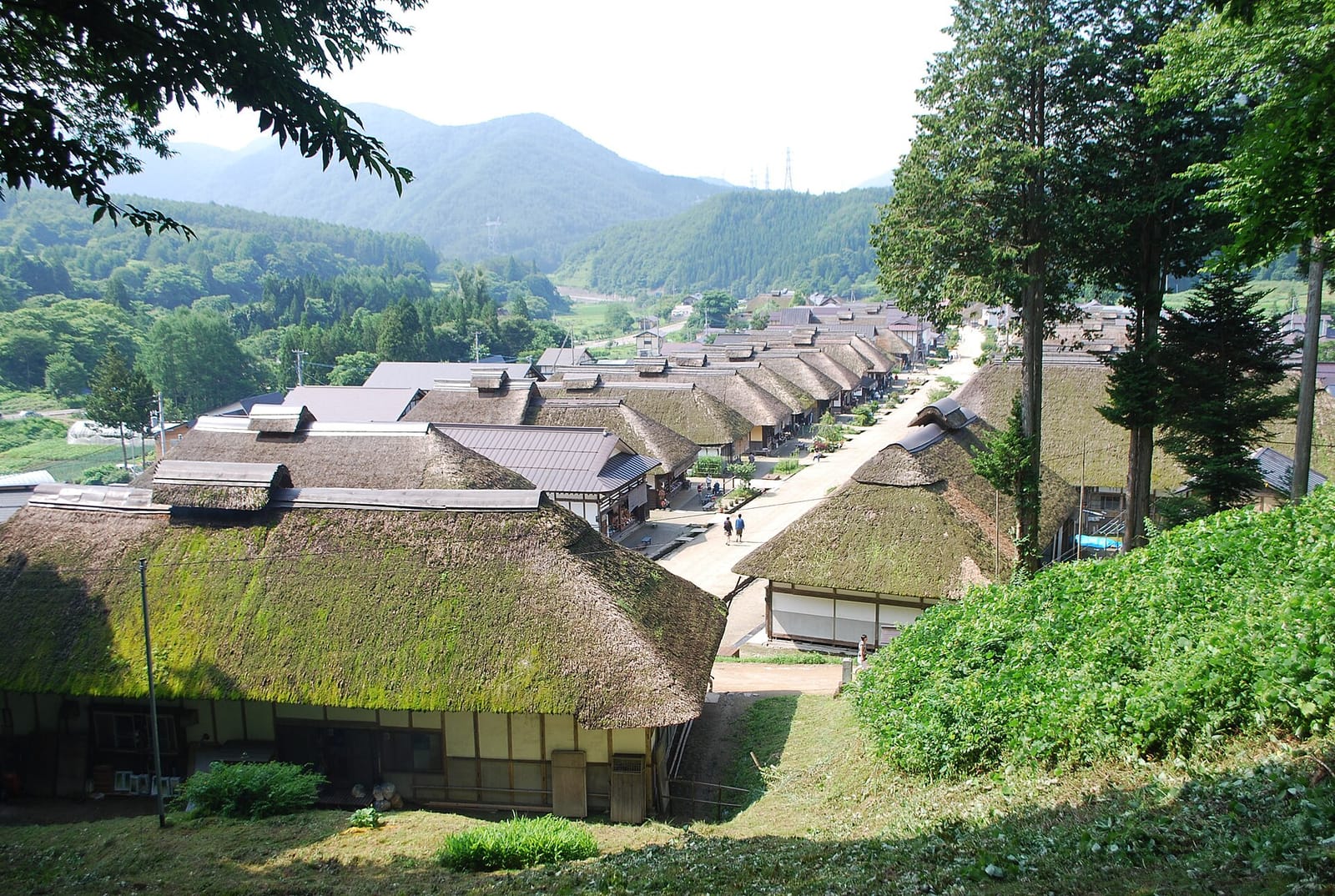
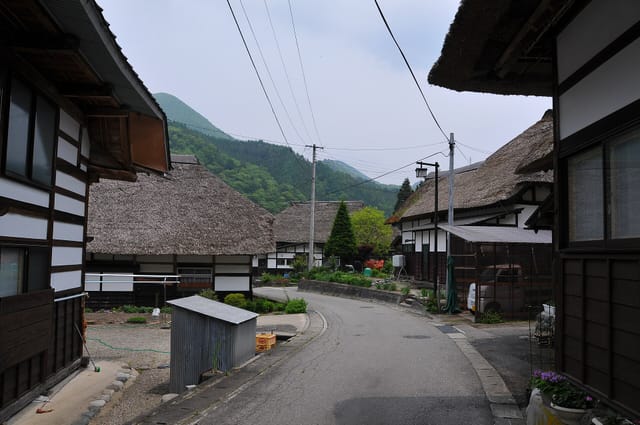
The thatched post town seen from above
Photo: Katorisi / CC BY-SA 3.0 · Original · Resized and croppedHistoric districts
Ouchi-juku, Shimogo
下郷町大内宿 (しもごうまちおおうちじゅく)
A post town on the old highway between Aizu and Shimotsuke, where thatched, hip-roofed houses stand at nearly even intervals along a street about 450 meters long, their gable ends facing the road. Residents still cut thatch and re-roof the houses together, keeping the shape of an Edo-period post town alive in the mountains.
Key facts
- Designation
- Important Preservation Districts for Groups of Traditional Buildings
- Type
- Historic districts
- Location
- Shimogo, Fukushima
- Address
- 福島県南会津郡下郷町
Before you go
- Opening hours
- The shops are also homes, so hours vary, but most are open from about 9:00 to 16:00. Some close early or take the day off depending on the weather.
- Closed
- Check the official site
- Admission (adults)
- Check the official site
- Time needed
- Check the official site
- Getting there
- From Yunokami-Onsen Station on the Aizu Railway, it is about 10 minutes by taxi (about ¥2,000 one way). The Saruyu-go shared bus also runs between the station and the village. Drivers use the paid Ouchi-juku car parks (¥500 per car per visit, rising to ¥1,000 from April 1, 2027).
- Best time to visit
- The Ouchi-juku Snow Festival is held every year on the second Saturday and Sunday of February, and the Hangesho Festival on July 2. Every September 1, a village-wide fire drill sends jets of water over the thatched roofs.
- Good to know
- Parking fees are paid in cash on the day, and the bus parking lot takes no reservations (first come, first served). In winter only a few shops stay open.
Checked against official information on November 12, 2026. Fees and hours can change, so please also check the official site before you go.
Sources for visitor information
Key facts
- Designation
- Important Preservation Districts for Groups of Traditional Buildings
- Type
- Historic districts
- Location
- Shimogo, Fukushima
- Address
- 福島県南会津郡下郷町
About this place
Ouchi-juku in Shimogo is one of the post stations on the Minamiyama-dori road (also called the Minamiyama Kaido or the Shimotsuke Kaido), which ran from the castle town of Aizu-Wakamatsu to Imaichi in Shimotsuke, and it covers about 11.3 hectares. As a typical example that keeps the form of a post town of this region, it was selected as an Important Preservation District for Groups of Traditional Buildings in 1981. The natural setting of surrounding mountains is also valued as part of the scenery. The natural watercourse that runs through the town was chosen in 1996 as one of the 100 Soundscapes of Japan Worth Preserving.
The main thing to see is the layout of the street, which runs about 450 meters along the road. Thatched, hip-roofed main houses from the late Edo to the Meiji period stand at roughly equal intervals, with their gable ends facing the road. The sight of the large triangular gable faces lined up along the street clearly reflects the form of the post town of the past. Walk from one end of the street to the other and look at the direction and spacing of the roofs.
Keeping a thatched town going requires materials, skills and protection against fire. In Ouchi-juku, there is a thatch storehouse, the Townscape Exhibition Hall houses a training center for thatching skills, and the district's thatch fields have been designated a "Hometown Cultural Property Forest." Residents cut thatch and practice roofing, and the spirit of mutual aid called "yui" remains. For fire prevention, water tanks and water cannons were installed from 1991 to 1993, and every house has an indoor hydrant.
The starting point of preservation was the 1970s. In 1970 Fukushima Prefecture carried out an emergency survey of folk materials, and in 1972 the Agency for Cultural Affairs and the prefecture surveyed the settlement and townscape. The Ouchi-juku Preservation Council was formed in 1979, the town's preservation ordinance followed the next year, and selection came in 1981. The first snow festival was held in fiscal 1986. The road itself was designated a national historic site in 2001 as the Shimotsuke Kaido (Historic Road).
Today many buildings serve as restaurants and souvenir shops, and the number of visitors is around 800,000 a year. The town lists behavior that disregards the landscape, traffic jams, and problems of reception such as toilets as issues, and says further measures are needed to balance preservation and tourism. Taking fiscal 1977 as 100, the population of the Ouchi area was 61 in fiscal 2020, declining more slowly than the town as a whole at 53.7. The reason is thought to be that tourism-centered work has appeared and younger generations keep living there.
About the district
- Type of district
- post town
- Area
- 11.3 hectares
- Selected
- April 18, 1981
Sources and date checked
Facts such as eras, structures and locations are edited and translated by us from the Agency for Cultural Affairs’ database of nationally designated cultural properties. The Agency and the national government did not produce this page.
Database of nationally designated cultural properties- Agency for Cultural Affairs, Database of National Cultural Properties
- Shimogo Town Ouchi-juku (prepared by Shimogo Town, published by Agency for Cultural Affairs)
Checked on November 6, 2026
Report an error
If you notice a mistake, please tell us along with a source for the correct information.
Where to go next
Places you could see on the same day, and places worth comparing.
More from Fukushima
Discover more of the same region on our sister sites.
Meiga no Furusato
Paintings linked to Fukushima
- Wakamatsu, Aizu District, Oshu (Famous Places in the Provinces of Japan)
- Landscape of Mt. Kuriko
- The Glade
- Enfance de Bretagne