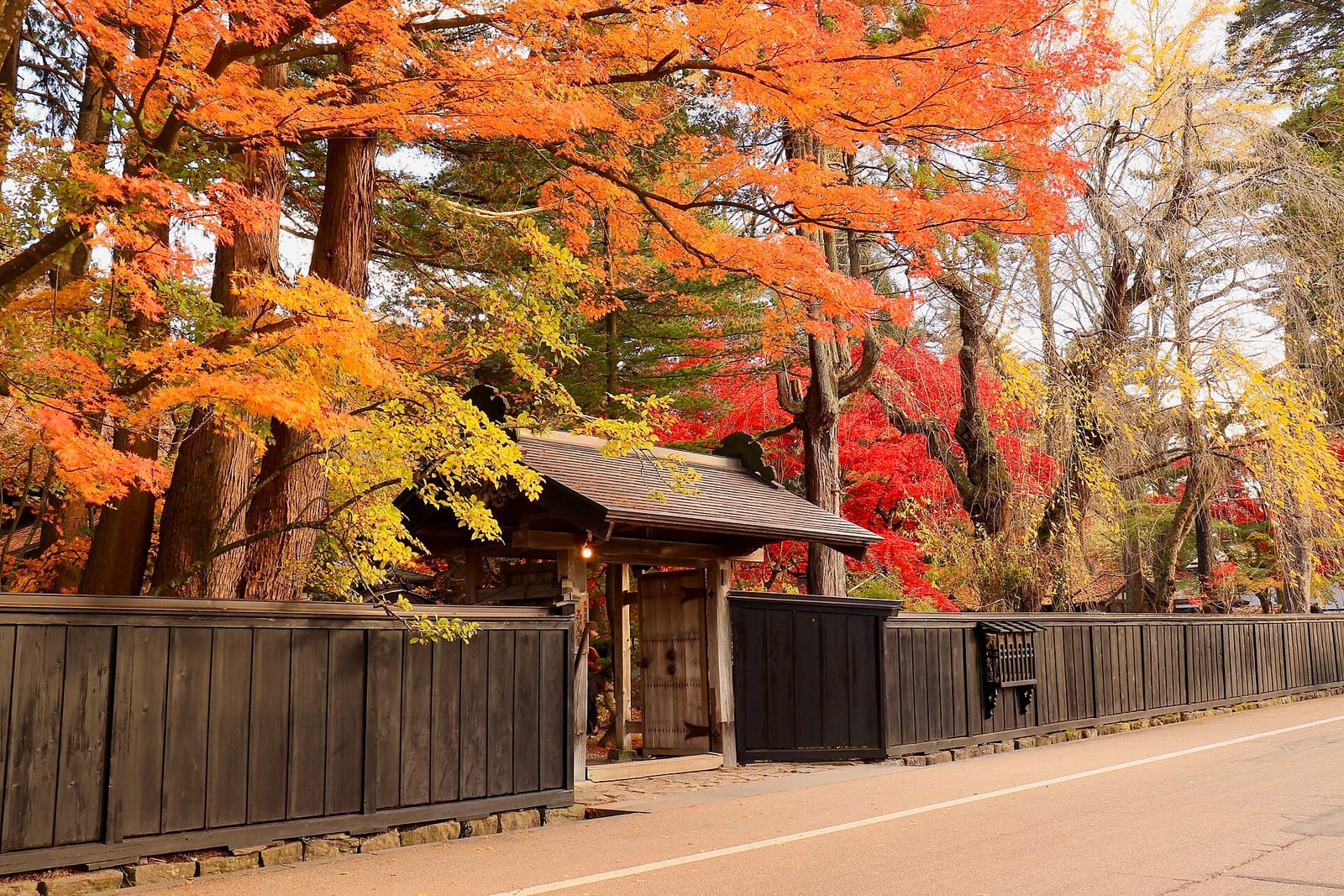
The samurai district street in autumn
Photo: Ken_Lee / CC BY 4.0 · Original · Resized and croppedHistoric districts
Kakunodate, Semboku
仙北市角館 (せんぼくしかくのだて)
A samurai town that still follows the street plan laid out in 1620, with fences lining its wide streets and residences that keep their main house, gate and storehouses. Weeping cherry trees over 300 years old and tall firs form groves that are part of the townscape itself.
Key facts
- Designation
- Important Preservation Districts for Groups of Traditional Buildings
- Type
- Historic districts
- Location
- Semboku, Akita
- Address
- 秋田県仙北市
Before you go
- Opening hours
- Among the samurai houses open to visitors, the Aoyagi and Ishiguro houses are open 9:00 to 17:00 from April to November and 9:00 to 16:00 from December to March. The Iwahashi and Odano houses are open 9:00 to 16:30 from April 3 to November 30.
- Closed
- The Aoyagi house is open every day of the year, and the Ishiguro house closes on irregular days. The Iwahashi and Odano houses are open daily during their open season.
- Admission (adults)
- The paid Aoyagi, Ishiguro and Kawarada houses each cost ¥500 for adults. The Iwahashi, Odano and Matsumoto houses are free.
- Time needed
- A walking course from Kakunodate Station around the samurai houses and back takes 1.5 to 2 hours.
- Getting there
- About a 15-minute walk from JR Kakunodate Station to the samurai residence street. Drivers can use the municipal Sakura Namiki parking lot (April 1 to November 30, 8:30 to 16:30, ¥500 per car) or the temporary lot at the entrance to the street (April to November, ¥500).
- Best time to visit
- The Kakunodate Cherry Blossom Festival runs every year from April 15 to May 5, adjusted to the bloom. In autumn the samurai residence street is lit up for the foliage; in 2026 this runs October 16 to November 23, 16:30 to 22:00.
- Good to know
- View the autumn light-up from the samurai residence street, and watch your step because the streets are dark at night. In winter (December to March) the Sakura Namiki parking lot is not cleared of snow and serves as a landing site for medical helicopters, so keep away from the marked area.
Checked against official information on November 12, 2026. Fees and hours can change, so please also check the official site before you go.
Sources for visitor information
- Tazawako and Kakunodate Tourism Association: The charm of Kakunodate's samurai residence street
- Tazawako and Kakunodate Tourism Association: Samurai residence street walking course
- Semboku City: Samurai residences
- Semboku City: Sakura Namiki municipal parking
- Tazawako and Kakunodate Tourism Association: Kakunodate Cherry Blossom Festival
- Tazawako and Kakunodate Tourism Association: Samurai residence street autumn light-up 2026
Key facts
- Designation
- Important Preservation Districts for Groups of Traditional Buildings
- Type
- Historic districts
- Location
- Semboku, Akita
- Address
- 秋田県仙北市
About this place
Kakunodate in Semboku is a samurai-quarter preservation district in the inland southeast of Akita Prefecture, covering about 6.9 hectares. It was a castle town laid out in 1620 by the Ashina clan and later taken over by the Satake Kita family. The preservation district lies almost in the middle of the former samurai quarter, where the residential plots of upper- and middle-ranking samurai stood. It was selected as an Important Preservation District for Groups of Traditional Buildings in 1976. The district also contains the Kabazaiku (cherry-bark craft) Museum.
Semboku City explains that if you put the town-plan map of the Kyoho era beside today's preservation district, you can confirm that the townscape created in 1620 has not changed. By that account, the street layout here is inherited from one drawn at the start of the Edo period. Walls continue along wide streets, and the plot divisions of the late Edo period survive, with the arrangement of main house, gate and storehouse.
What shapes this landscape is the large weeping cherry trees and firs. The weeping cherries, over 300 years old, are a nationally designated Natural Monument, and together with the firs they form dense groves that join the layout to make the townscape. The city says that the town became known as a place of samurai residences and cherry blossoms because of continued townscape improvement after selection and, above all, the opening of the Akita Shinkansen in 1997. Whatever the season, the width of the plots and the height of the walls are worth checking together with the shade the groves cast on the streets.
Several houses can be seen from the inside. The Iwahashi residence is open in all its rooms and was designated a national Important Cultural Property in January 2026. The Odano residence is also open in all rooms, and the Kawarada residence has been open for a fee under the city since 2021, when its repair work was finished. At the former Matsumoto residence there are demonstrations of itaya-craft, and the former Aoyagi and Ishiguro residences are opened by corporate bodies. The Onozaki residence, a house for a chief retainer of the Satake Kita family, was reconstructed on the site of the Kakunodate High School gymnasium and opened in 2001, and it also contains a community hall, a martial arts hall and an archery range.
Residents' efforts continue as well. In 2001 an association to protect the townscape of the preservation district was formed and a residents' charter was enacted. In 2007 an ordinance banning smoking on the streets in the district was adopted. During the cherry blossom festival and the autumn leaf season, local elementary, junior high and high school students serve as guides to Kakunodate. Until 2019, more than two million tourists visited each year and over 400,000 of them toured the samurai residences. Numbers fell sharply in 2020 because of COVID-19, and the city says they have been gradually recovering since.
About the district
- Type of district
- samurai residence town
- Area
- 6.9 hectares
- Selected
- September 4, 1976
Sources and date checked
Facts such as eras, structures and locations are edited and translated by us from the Agency for Cultural Affairs’ database of nationally designated cultural properties. The Agency and the national government did not produce this page.
Database of nationally designated cultural properties- Agency for Cultural Affairs, Database of National Cultural Properties
- Senboku City Kakunodate (prepared by Senboku City, published by Agency for Cultural Affairs)
- National Council for Preservation of Historic Districts: Senboku City Kakunodate
Checked on November 6, 2026
Report an error
If you notice a mistake, please tell us along with a source for the correct information.
Where to go next
Places you could see on the same day, and places worth comparing.
More from Akita
Discover more of the same region on our sister sites.
Matsuri Biyori
UNESCO-listed festivals in Akita
- Kakunodate Festival Yama Float Event
- Tsuchizaki Shinmeisha Shrine Festival Hikiyama Float Event
- Hanawa Festival Yatai Float Event
- Nishimonai no Bon Odori
Meiga no Furusato
Paintings linked to Akita
- The Senjomaku Cliffs, Lake Towada (Souvenirs of Travel I)
- Hachirogata Lagoon, Akita
- Kansa Shrine, Lake Tazawa
- Shinobazu Pond
Sake Tabi
Breweries and distilleries in Akita
- Kimura Brewery (Fukukomachi)
- Fukunotomo Brewery
- Bishu Ranman (Akita Meijo)
- Takashimizu Brewery Tour (Akita Shurui Seizo Head Brewery)